
Seven breeds · Appearance, personality, and grooming
A fluffy coat can hide very different grooming needs. Among long haired cat breeds, a Persian’s dense fur usually needs more daily attention than a Birman’s silky coat. Comparing coat texture, body shape, and typical activity helps you find a cat whose care fits your routine.
This guide compares the Maine Coon, Ragdoll, Persian, Birman, Norwegian Forest Cat, Siberian, and Turkish Angora. You’ll learn how to tell their coats apart, what their usual behavior can suggest, and which grooming and health questions to ask before bringing one home.
Compare Seven Long Haired Cat Breeds
Coat length is only part of the difference. The undercoat is the softer fur beneath the outer coat. Its thickness, along with hair texture and shedding, affects how easily tangles form and how much combing a cat needs.
| Breed | Coat and appearance | Main grooming need |
|---|---|---|
| Maine Coon Cat | Large body, shaggy fur, and a bushy tail | Comb the longer fur on the belly and backs of the hind legs |
| Ragdoll Cat | Silky, semi-long coat with minimal woolly undercoat | Regular combing, with extra attention during shedding |
| Persian Cat | Very long, dense fur and a short muzzle | Daily combing to prevent knots and mats |
| Birman Cat | Silky fur, darker markings on the face and legs, and white paws | Remove loose hair and check for small tangles |
| Norwegian Forest Cat | Long outer hairs over a woolly undercoat | More combing as the thick winter coat sheds |
| Siberian Cat | Dense coat that becomes fuller in winter | Remove loose undercoat before it becomes tangled |
| Turkish Angora Cat | Fine, silky fur and a long, feathery tail | Gentle combing and regular checks for tangles |
Several of these long haired cat breeds have coats described as semi-longhaired. The Cat Fanciers’ Association’s breed profiles describe their distinguishing features. Compare coat structure as well as length: similar-looking fur can need very different care.
Breed descriptions can suggest what to expect, but personality and tolerance of grooming vary between cats. Ask about the cat’s usual behavior at home as well as its appearance.
1. Maine Coon Cat
A large cat with a shaggy coat and bushy tail
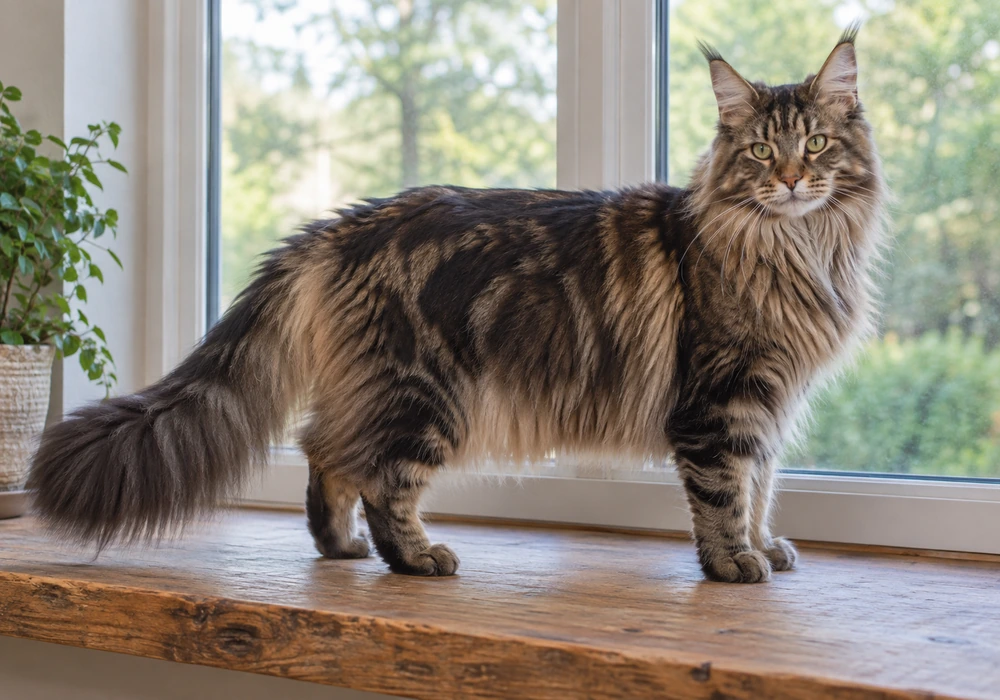
The Maine Coon cat has a long, rectangular body, a square muzzle, large ears, and a long tail covered in thick fur. The coat is shorter over the shoulders and longer on the belly, around the neck, and on the backs of the hind legs. Compared with the flowing coat of a Turkish Angora, its fur has a distinctly shaggy outline.
Maine Coon cats are often sociable and playful. Many follow their owners around the house or settle nearby, although they may prefer sitting beside someone to being held. Provide daily play and a sturdy cat tree or other secure places to climb.
Comb the longer areas carefully, especially where the legs meet the body. Coat texture varies: softer, cottony fur can tangle more easily than silky fur. Part the fur gently as you work so you can check beneath the long outer hairs.
2. Ragdoll Cat
Blue eyes and a soft, silky coat
Ragdoll cats are large cats with blue eyes and a colorpoint pattern: the face, ears, legs, and tail are darker than the body. Some patterns also include white paws or larger white areas. Their semi-long coat has abundant outer guard hairs and very little woolly undercoat, giving it a soft, silky feel. Coat fullness can change with the season.
Many Ragdoll cats enjoy spending time with their owners and are described as gentle and affectionate. They still need play, and each cat has its own preferences about being picked up. Support the whole body when lifting one, and put the cat down if it tries to leave.
Like other long haired cat breeds, Ragdolls can develop knots under the front legs even when the outer coat looks smooth. Comb regularly to remove loose hair, and increase grooming during shedding or whenever you find new tangles.
3. Persian Cat
A round face and a long, dense coat
Persian cats have a compact, sturdy body, a round head, and a short muzzle. Their long fur gives them a full, rounded outline, but the texture varies from silky to soft and cottony. Dense fur can conceal knots, so comb through small sections without pulling on the skin.
Persian cats often enjoy a calm household, gentle play, and attention from familiar people. They are among the long haired cat breeds that usually need daily combing, so a relaxed temperament still comes with a substantial grooming commitment.
The face needs attention too. An extremely short muzzle can be associated with breathing, eye, and dental problems. Ask about ongoing eye discharge, noisy breathing, and the cat’s veterinary history. Have persistent symptoms assessed rather than assuming they are harmless breed traits.
4. Birman Cat
Blue eyes, darker facial markings, and white paws
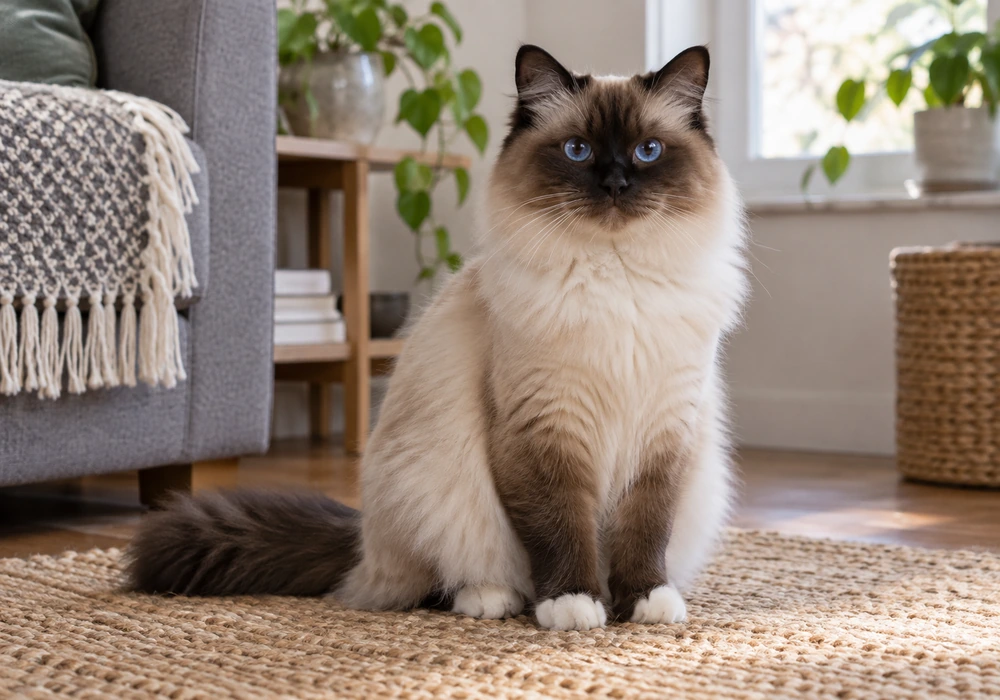
The Birman cat has blue eyes, darker coloring on the face, ears, legs, and tail, and white fur on all four paws. These white markings are called gloves. Its silky, semi-long coat has little or no undercoat. This makes it different from the much denser coat of a Norwegian Forest Cat or Siberian.
Birman cats are often affectionate and enjoy being near people. They can also be playful and curious, joining games or following household activity. Ask the current caregiver how the cat likes to interact rather than assuming it will always want to sit on a lap.
The coat is generally easier to comb than a dense woolly coat, but it still sheds and can develop tangles. Regular combing removes loose hair; more frequent sessions may be needed during seasonal shedding.
5. Norwegian Forest Cat
A thick double coat that changes with the seasons
The Norwegian Forest Cat has a strong, muscular body, a triangular head, and a long, full tail. Its coat combines a soft, woolly undercoat with longer, coarser outer hairs called guard hairs. In winter, it often develops a prominent ruff—the longer fur around the neck and chest.
These cats commonly enjoy climbing and exploring. A stable cat tree and secure elevated resting places give them opportunities to do both indoors. Many also enjoy company while choosing for themselves when to approach or rest nearby.
Seasonal shedding is a major consideration for long haired cat breeds with a dense undercoat. A Norwegian Forest Cat may look noticeably less full in summer. Increase combing as the winter undercoat loosens, checking the ruff, belly, and hind legs before loose hair becomes matted.
6. Siberian Cat
A muscular cat with a dense, seasonal coat
Siberian cats have strong bodies and a thick coat commonly described as a triple coat. This refers to a combination of longer guard hairs, intermediate hairs, and a soft undercoat. The coat is usually fuller in winter and needs extra attention when loose undercoat is being shed.
Siberian cats are often playful, agile, and interested in what their owners are doing. Plan for interactive play and secure climbing places as well as grooming. Thick fur can hide weight gain or loss. Ask your veterinarian to show you how to assess body condition by feeling the ribs and waist.
Are long haired cat breeds such as Siberians hypoallergenic? No breed can be assumed to be allergy-safe. The American Academy of Allergy, Asthma & Immunology states that all cats produce allergens, including proteins found in saliva and on the skin. Hair length does not reliably predict allergen levels. Someone with cat allergy or asthma should seek an allergist’s advice before adopting.
7. Turkish Angora Cat
Fine, silky fur on a slender, athletic body
The Turkish Angora cat has a slender but muscular body, a fine semi-long coat, and a long, feathery tail. Although white is a familiar color, Turkish Angora cats also come in other colors and patterns. Their coat usually has little or no undercoat, which can make combing easier.
These cats are commonly described as active, curious, and sociable. They often enjoy climbing, investigating their surroundings, and playing with people. They need daily opportunities to use that energy, even when their coat requires relatively little work.
Comb gently to remove loose hair and check for tangles. Fine fur still needs care, and the amount of grooming should increase if shedding, age, or reduced self-grooming makes the coat harder to maintain.
Coat Care for Long Haired Cat Breeds
Check the coat daily for all long haired cat breeds. Persians generally need daily combing; other cats may need shorter or less frequent sessions depending on shedding, coat density, and self-grooming. New knots mean the routine needs adjusting.
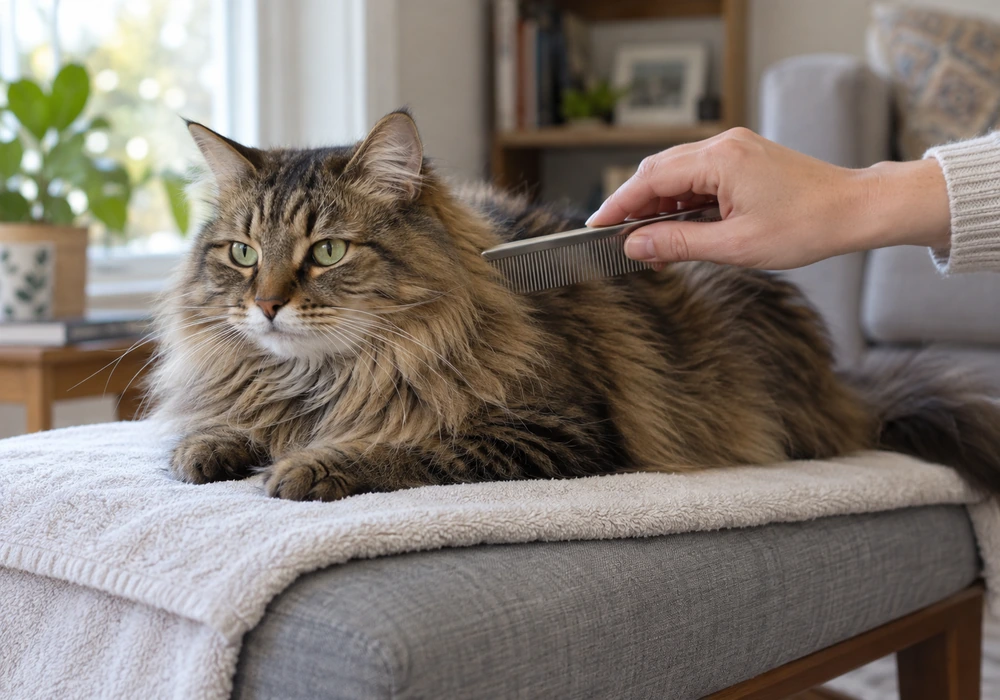
Use a smooth-toothed comb long enough to reach through the fur. Follow the direction of hair growth without scraping the skin. Check behind the ears, under the front legs, on the belly, and behind the hind legs.
- Start with a few gentle strokes. Begin where your cat accepts touch, reward calm participation, and build up gradually.
- Check beneath the surface. If the comb catches, inspect the knot instead of pulling harder.
- Respond to discomfort. Pause if your cat tenses or pulls away. New tenderness, matting, or reduced self-grooming may indicate pain or illness.
Do not cut mats out with scissors. Skin can be pulled into a mat and accidentally cut. VCA’s grooming guidance recommends professional help for mats that cannot be removed safely. Soreness, damaged skin, or an inability to tolerate grooming needs veterinary attention.
Most healthy cats that groom themselves well rarely need baths. Long hair alone does not call for a summer shave; ask a veterinarian or experienced cat groomer about necessary clipping. Tools and handling are covered in grooming a cat at home.
Health Questions to Ask Before Bringing a Cat Home
Health screening for long haired cat breeds depends on ancestry and family history, rather than fur length itself. Review veterinary records and ask which screening has been carried out. If you are buying a kitten, request the parents’ relevant results as well as the kitten’s own examination records. Check the animal’s identity, test name, date, and result rather than relying on the phrase “health tested.”
- Maine Coon and Ragdoll cats: ask about screening for hypertrophic cardiomyopathy (HCM), a disease that causes thickening of the heart muscle. Relevant DNA tests include the MYBPC3 A31P variant in Maine Coon cats and R820W in Ragdoll cats. Ask about cardiac ultrasound screening too.
- Persian cats: ask about PKD1 testing for inherited polycystic kidney disease, along with any concerns involving the eyes, breathing, or teeth.
- Norwegian Forest cats: ask about testing for glycogen storage disease type IV, a serious inherited disorder associated with the breed.
- White cats, including white Turkish Angora cats: ask about hearing if there is a concern. White cats, especially those with blue eyes, have an increased risk of congenital deafness, but many hear normally. A brainstem auditory evoked response (BAER) test can assess hearing in each ear.
A negative DNA result means the tested variant was not detected; it is not a guarantee of good health. HCM, for example, can occur without the variants listed above. Cornell’s cardiomyopathy overview explains that echocardiography—an ultrasound of the heart—is used to diagnose cardiomyopathy. Your veterinarian can help interpret the records and recommend any further assessment.
Which Long Haired Cat Breeds Could Suit Your Home?
When choosing among long haired cat breeds, match the coat and activity level to the time you can give to daily care. Birmans and Turkish Angoras have little or no undercoat to comb, while Persians usually need more daily coat care. Norwegian Forest Cats and Siberians can need extra work during seasonal shedding.
Before deciding, meet the cat and ask to see how it responds to a normal grooming session. Discuss its usual activity, comfort with handling, and behavior around other cats or children if relevant. An adult cat’s established habits can be easier to assess than a kitten’s future personality.
Is a Domestic Longhair a Breed?
No. “Domestic longhair” describes a long-coated cat without an established pedigree breed. Such a cat may suit your home just as well as one of the seven breeds above. Its grooming needs depend on its actual coat, health, and ability to groom itself.
This guide reflects everyday experience living with cats and does not replace veterinary advice about a particular animal. New tenderness, matting that appears without explanation, a sudden drop in self-grooming, noisy breathing, persistent eye discharge, or a cat that stops eating needs a veterinary examination.