
Cats and purring are closely associated with comfort, yet a cat may make the same low rumble while waiting for food, feeling stressed, or experiencing pain. The sound becomes more useful when you pair it with body language. This guide explains the common reasons for purring, how cats produce it, and which changes deserve veterinary attention.
Start with two questions: what happened just before the purring began, and is your cat behaving normally otherwise? A loose posture and voluntary contact support a comfortable interpretation. Hiding, a hunched posture, or a change in appetite deserves a closer look, even if the purring continues.
A purr is one clue, not a health check. Comfortable breathing, relaxed movement, normal meals, and voluntary contact provide more reassurance than the sound alone. If breathing looks difficult, seek veterinary help immediately.
Cats and Purring: Five Common Situations
A purr does not have one fixed meaning. Several explanations can overlap: a cat may enjoy your company while anticipating food, or seek familiar contact while uncomfortable.
1. They Are Enjoying Comfortable Contact
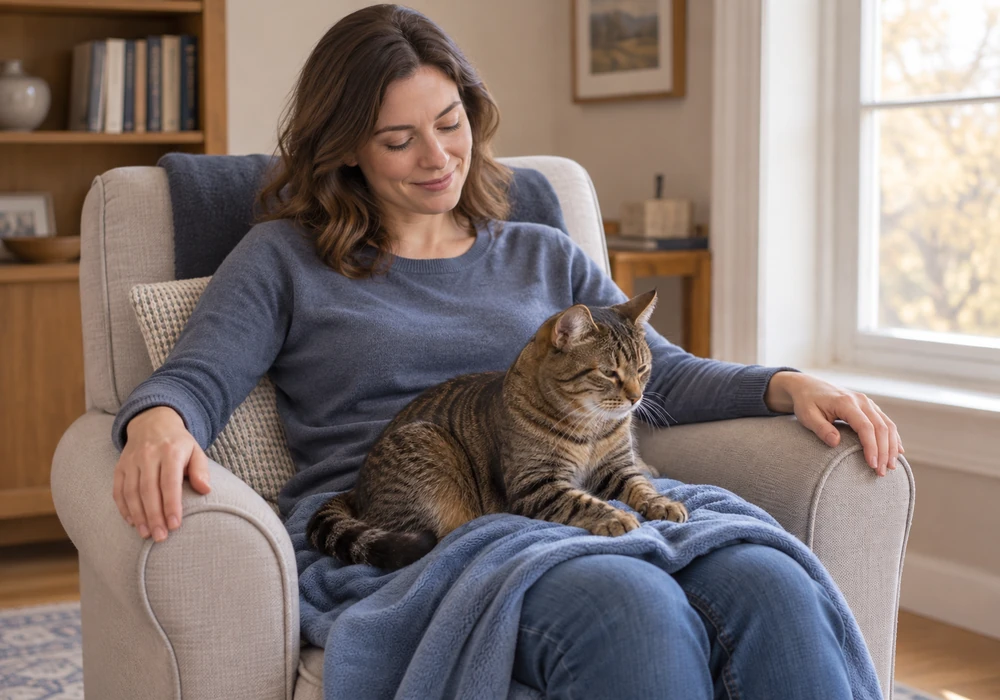
A cat that approaches you, settles with a loose body, and purrs during gentle petting is often enjoying the interaction. Relaxed ears, unhurried movement, and the choice to stay nearby help support that interpretation. Purring may accompany rubbing or kneading, the alternating pressing of the front paws against a surface, one of the everyday things cats love.
Let your cat set the pace. Pause your hand occasionally and leave room for them to move away. Purring is not automatic permission to pick them up, rub their belly, or keep petting indefinitely.
2. Mothers and Kittens Use It During Close Contact
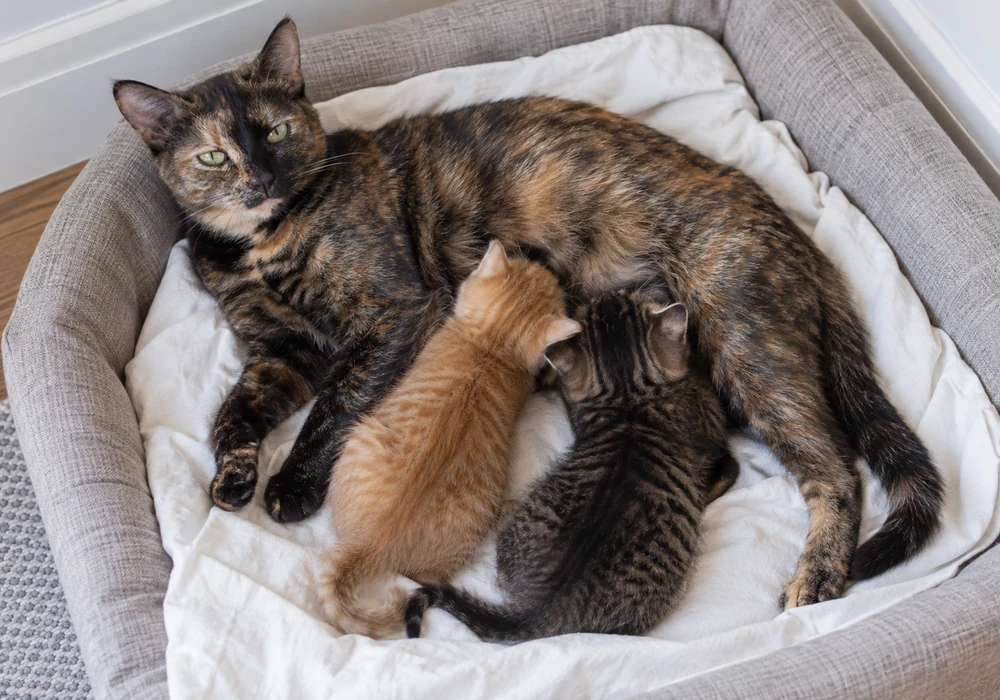
Purring occurs in early mother–kitten interactions, including nursing and resting together. In this setting, it is part of close-range communication and contact, rather than simply the adult “happy cat” sound we tend to imagine.
Watch quietly and avoid interrupting nursing to hear the sound more clearly. A kitten’s purr does not confirm that they are getting enough milk or are healthy; concerns about feeding, growth, or activity still need assessment.
3. They Are Asking for Food or Attention
Some cats become particularly insistent when you prepare a meal. This can include solicitation purring, meaning purring used while seeking a response, such as food.
In a 2009 study, researchers played recordings from 10 cats to 50 people. At matched playback levels, food-seeking purrs were judged more urgent and less pleasant than other purrs. An embedded, higher-frequency cry-like component contributed to that effect. The University of Sussex’s account of the research explains how removing that component reduced listeners’ urgency ratings.
This helps explain why a breakfast purr can be hard to ignore. It does not mean every purr signals hunger, or that cats consciously imitate infants. Check the usual meal schedule and planned portion rather than adding food whenever the rumble starts.

4. They Are in a Stressful Situation
A cat may purr after a car journey, during an examination, or amid unfamiliar noise. If the body is tense, the ears turn sideways, or the cat tries to hide, the surrounding behavior deserves more weight than the reassuring impression the sound gives you.
Purring during distress may have a coping or self-soothing role, but its precise function is not settled. Hearing it does not demonstrate that the cat has relaxed. Reduce unnecessary disturbance, allow a retreat, and avoid pulling a hiding cat out for reassurance. Our guide to subtle signs of fear in cats explains the quieter behaviors that are easy to overlook.
5. They Are Uncomfortable or in Pain
Some cats purr while injured or ill, including while accepting familiar attention. Purring therefore cannot rule out pain. Equally, a purring cat is not necessarily in pain: the important clues are changes such as eating less, withdrawing, sitting hunched, or hesitating before jumping.
A new combination of these signs calls for veterinary advice. Describe what your cat is doing differently rather than trying to decide whether the sound is a particular kind of “pain purr.”
Inside the sound
The Science Behind Cats and Purring
A purr is a rhythmic sound usually made with the mouth closed. It can continue as a cat breathes both in and out. The larynx, or voice box, contains vocal folds: tissues whose vibration produces sound.
A 2023 laboratory study tested eight domestic cat larynges outside living animals. All eight produced self-sustaining vibrations at 25–30 hertz (Hz) without nerve input or active muscle contractions. The researchers also identified connective-tissue masses up to 4 millimeters across within the vocal folds that may help enable these low frequencies.
Research on cats and purring is still developing. This finding supports a mechanism in which airflow and tissue elasticity sustain vibration. It does not mean the brain plays no role in a living cat’s purring; nervous-system control and muscle activity may still contribute.
Frequency is not breathing rate. Hertz measures vibration cycles per second. A 25 Hz sound has 25 vibration cycles each second, not 25 breaths. The study’s 25–30 Hz result is not a universal normal range or a home diagnostic cutoff.
A purr can also contain harmonics, sound components at multiples of its basic repetition rate. These help explain why a broad range of frequencies mentioned in an article is not necessarily the purr’s fundamental, or basic, frequency. Neither pitch nor loudness alone tells you how healthy or happy a cat is.
Understanding Cats and Purring Through Body Language
Begin with the moment around the sound. Did your cat approach you, notice food preparation, return from a stressful trip, or react when touched? Then consider the whole body and what is normal for that individual; our overview of understanding cat behavior explains how the pieces fit together.
- Watch their choices. Approaching and remaining nearby voluntarily differ from freezing, leaning away, or staying because there is no clear exit.
- Look beyond one facial feature. Ear position, eyes, tail movement, and body tension make more sense together. Large pupils can reflect dim light or play as well as distress.
- Check ordinary activities. Notice meals, movement, grooming, social contact, and litter-box use. Changes in these habits are more useful than comparing your cat’s purr with another cat’s volume.
Why Does My Cat Purr and Then Bite During Petting?
The interaction may have become unwelcome while purring continued. Watch for growing tension, repeated tail movement, ears shifting back, or a turn toward your hand. Stop touching before the cat needs to escalate, keep future sessions brief, and let them choose whether to return.
Do not punish the bite or hold the cat in place to finish petting. Newly increased sensitivity, especially when a particular area is touched, deserves a veterinary examination.
If you are unsure whether you are hearing a purr, a trill, or a growl, our guide to common cat sounds and what they mean compares their typical sound patterns.
Cats and Purring: When to Call a Vet
You do not need to identify a noise perfectly before asking for help. Use breathing and changes in everyday behavior to decide the next step.
| What you notice | What it means for your decision | What to do |
|---|---|---|
| Familiar purring, comfortable breathing, voluntary contact, and usual daily habits | Comfortable interaction is a reasonable interpretation | Allow choice and pause if body language changes |
| A changed pattern with reduced eating, withdrawal, stiffness, or sensitivity to touch | Pain or illness needs consideration | Contact your veterinary team promptly and describe the changes |
| Open-mouth breathing, obvious effort to breathe, or an extended head and neck with breathing difficulty | Possible respiratory distress | Seek emergency veterinary care immediately |
Cornell’s guidance on breathing difficulty in cats emphasizes prompt veterinary attention whenever a cat may not be breathing comfortably. Keep handling and disturbance low while arranging transport. Do not delay care to record the sound or try calming audio.
For a nonurgent change, note when it began, what happened beforehand, and any differences in eating, movement, or litter use. A brief recording of a naturally occurring episode can help your veterinarian if you can make it without disturbing the cat. Keep the original sound and show the posture as well as the face. Our overview of cat health explains how to describe changes clearly.
For suspected pain, the Feline Grimace Scale is a validated tool for assessing acute pain, such as pain after injury or surgery. It considers ear position, eye narrowing, muzzle tension, whisker position, and head position. Use its official training resources with veterinary guidance; it is not a purr translator, a test for every type of pain, or a diagnosis of the cause.
A popular claim, examined
Cats and Purring: Do Healing Claims Hold Up?
The idea that purring heals bones comes partly from comparisons between purr frequencies and frequencies studied in vibration therapy. A historical 2001 conference abstract described recordings from 44 members of the cat family and proposed a healing explanation. It did not report a controlled trial showing that purring repaired fractures.
Matching a frequency does not establish a treatment. Vibration strength, how it reaches tissue, exposure time, and measured outcomes also matter. A recording played through a speaker does not automatically reproduce a cat’s body vibration. Research on cats and purring does not establish the sound as a treatment for fractures, chronic pain, or breathing problems in cats or people.
A nearby purring cat may feel soothing to you. That experience is real, but it does not reveal how much comes from the sound, touch, companionship, or a restful setting.
For cats, a small crossover study completed by 20 cats found lower behavioral stress and handling scores during veterinary visits with cat-specific music than with classical music or silence. It tested a musical composition, not isolated purring. It did not significantly change the neutrophil-to-lymphocyte ratio, a ratio of two white blood cell types used as a physiological stress measure. These results do not establish that purring recordings will calm every cat at home.
More Questions About Cats and Purring
Is a Loud Purr Better Than a Quiet One?
No. Research on cats and purring has not established a loudness cutoff that grades a cat’s health or attachment to you. Distance, room acoustics, and microphone processing also change apparent volume. Notice changes in your own cat alongside other behavior.
Why Doesn’t My Cat Purr Audibly?
Some cats have very quiet purrs or rarely purr audibly. If that has always been their pattern and they are otherwise behaving normally, it is not automatically a concern. A new loss or alteration of a familiar sound, especially with appetite, activity, or breathing changes, warrants veterinary advice.
Can a Cat Choose When to Purr?
The available studies do not fully resolve voluntary control. Showing that isolated vocal tissue can vibrate under suitable conditions does not establish how a living cat initiates, regulates, or stops purring.
Can an App Translate My Cat’s Purr?
Acoustic individuality is different from emotional meaning. A 2025 study analyzed 557 purr recordings from 21 cats and found features that helped distinguish individuals statistically. Those recordings represent 21 cats, not 557 independent animals. The result does not validate an app for diagnosing pain or explaining a cat’s feelings.
Should I Play Purring Sounds for My Cat?
There is no established need or universal playback schedule. If you try it, start quietly, keep the speaker away from the cat, and leave access to a silent area. Stop if your cat avoids the sound or becomes watchful or agitated. Never put headphones on a cat or press a vibrating device against their throat or chest.
Enjoy the Purr—and Keep Watching the Cat
When your cat chooses to settle beside you, breathes easily, and behaves as usual, enjoy the company. If they lean away, change the interaction. If eating, movement, or breathing changes, respond to those signs. Everyday changes that reduce stress at home can support comfort, but making your cat purr more should never be the goal.
This guide draws on published behavior research and on years of living with cats; it is general information, not a diagnosis and not a substitute for veterinary advice. A purr cannot tell you whether a cat is well. If a cat is breathing with obvious effort, breathing through an open mouth, or has stopped eating, contact a veterinarian promptly.