
Maine Coon cats stand out for their long bodies, shaggy coats, and impressive tails. Yet some of their most interesting features take a little explaining: a kitten can keep filling out for years, extra toes have more than one genetic explanation, and a sociable cat may still prefer its own seat. These ten facts connect the breed’s history, biology, and behavior with what life alongside one actually involves.
1. Maine Coon Cats Have a Documented American History
The breed’s regional roots lie in New England, especially Maine. Its public history includes a brown tabby named Cosey, who won Best Cat at the 1895 Madison Square Garden show. Today, Maine’s state-cat statute names the Maine Coon as the official state cat.
The ancestry stories need more caution. Cats and raccoons cannot produce a hybrid, while tales about Marie Antoinette’s cats or a captain named Coon remain folklore. Our guide to cat breed name origins explores the naming stories in more detail. A bushy tail can explain a resemblance; it cannot establish ancestry.
2. Maine Coon Cats Can Take Years to Reach Full Size
A Maine Coon’s outline combines a long, rectangular torso, a broad chest, substantial bone, and a flowing tail. Males generally grow larger than females. TICA’s breed-group standard states that the breed reaches full maturity at four to five years of age, although growth varies between individuals.
That timeline describes physical development. It does not mean every cat needs kitten food for five years or should keep gaining weight indefinitely. In fact, online weight ranges can conflict: TICA’s own profile lists adult males at 18–22 pounds in one section and 13–18 pounds in another. Neither range provides a universal feeding target.
For large cat breeds such as this one, track weight alongside fat cover and muscle condition. Ask your veterinarian to demonstrate how to feel the ribs and assess the waist beneath the fur. A large frame and excess body fat are different things.
3. Their Shaggy Coat Is Shorter at the Shoulders
The coat does not grow to one uniform length. Shorter hair over the shoulders grades into longer fur along the body, with a neck ruff, belly shag, longer hair behind the hind legs, and a full tail. This arrangement helps create the breed’s distinctive outline. The square muzzle and large, furnished ears add to the recognizable look.
Long hair has a genetic basis: recessive variants of FGF5 contribute to the trait, and several of them occur in this breed, including one found at high frequency in Maine Coons and a further variant reported only in this breed. A hair-length result does not predict exact texture, shedding, or grooming tolerance.
Likewise, “all-weather” in a breed standard does not mean waterproof or safe in every temperature. Check the coat daily and comb often enough to prevent tangles, especially in areas where the legs meet the body. Our guide to grooming cats gently explains the technique, and this look at long-haired cat breeds sets the coat care in a wider context. Tight or painful mats need professional help; scissors can injure skin hidden inside the tangle.
4. Maine Coon Cats Come in Far More Than Brown Tabby
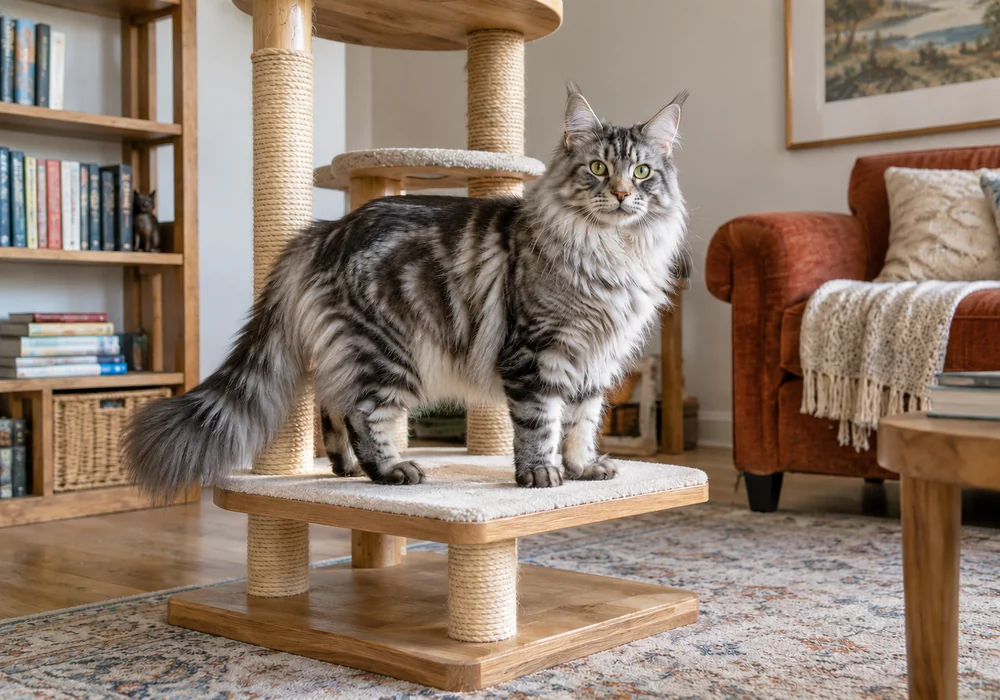
Brown tabby is a familiar appearance, but CFA’s breed description and standard include many other colors and patterns. Examples include red and silver tabbies, solid colors, tortoiseshell, smoke, shaded coats, and combinations with white.
These terms describe different features. Tabby refers to a marking pattern; tortoiseshell describes a mixture of colors. In a smoke coat, pale roots contrast with darker hair farther from the skin. White spotting adds areas without the surrounding pigmentation.
Registry rules still matter. TICA’s reviewed standard excludes pointed, mink, and sepia categories, along with certain colors such as chocolate and lilac. An unusual color does not establish pedigree, intelligence, or better health. For an ancestry claim, check the actual registration and family records.
5. Extra Toes Have More Than One Genetic Explanation
Cats ordinarily have five digits on each front foot and four on each hind foot. Some Maine Coon cats have additional digits, a trait called polydactyly. Other cats can have it too, so extra toes are neither a breed requirement nor proof of Maine Coon ancestry. TICA recognizes a separate Maine Coon Polydactyl designation within its breed group.
A genetic study of 75 Maine Coons found the known Hw variant in only a subset of the polydactyl cats. Sequencing two regulatory regions turned up no other variant in the cats that lacked it, yet the trait behaved as an autosomal dominant condition with incomplete penetrance and variable expression. In practical terms, one test result cannot tell you the exact number or arrangement of toes.
A separate clinical study examined 70 Maine Coons, including 48 with extra toes, and found considerable variation in foot structures. Those findings do not establish a universal hunting or swimming advantage, and the authors reported no apparent harm to welfare. For daily care, ask your veterinary team to locate every claw, including small or tucked-away ones, following the approach in our cat nail trimming guide. A sore digit, a claw curling into skin, or a changed gait needs attention.
6. “Gentle Giant” Describes a Reputation, Not Every Cat
Many Maine Coons enjoy joining household activity, greeting familiar people, and playing. However, companionship can mean resting nearby rather than sitting on a lap. Enjoying your company does not automatically mean enjoying a lift or prolonged holding.
A 2019 owner-questionnaire study compared behavior across 5,726 cats; its pedigree-based heritability analysis included 356 Maine Coons. The researchers found breed differences and genetic contributions to behavior, with heritability estimates between 0.4 and 0.53 for the traits examined. Those results still cannot predict one cat’s personality. Experience, environment, health, and the limits of owner reporting also matter.
Ask what the individual does in ordinary situations: how does it approach people, respond to visitors, play, and handle combing? With children, supervise gentle contact and protect the cat’s rest. With resident cats, use gradual introductions and separate resources. A flattering breed label cannot replace that work.
7. Chirps, Trills, and Play Make Their Own Kind of Conversation
A large cat does not necessarily have a booming voice. Breed profiles describe a repertoire that includes chirps, trills, purrs, and meows. Read the sound alongside posture and context: a vocalization during a game does not automatically mean the same thing as one beside a closed door.
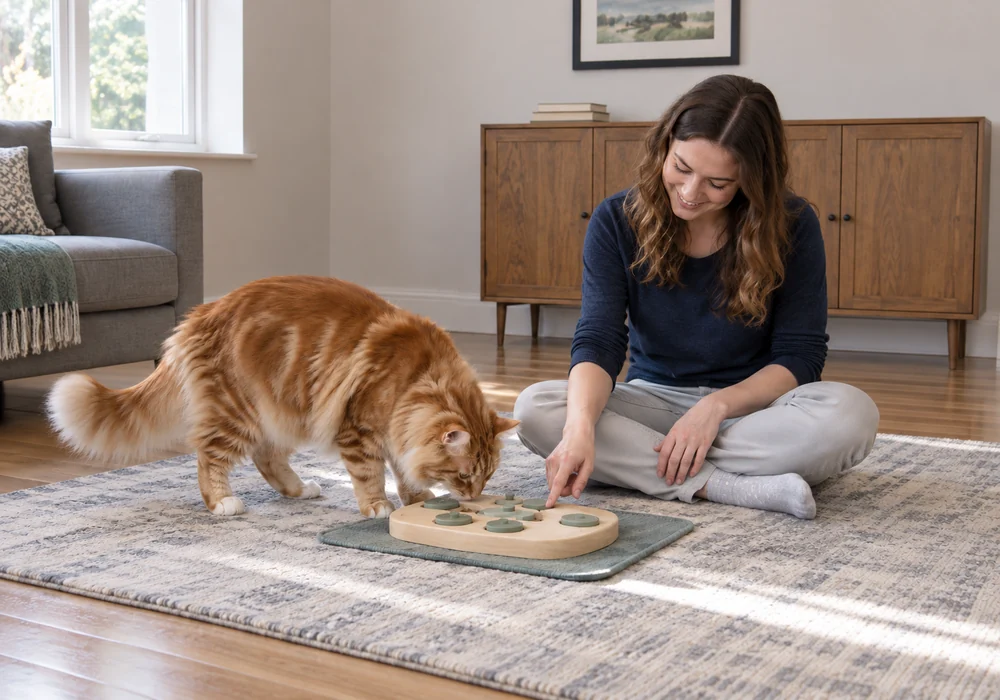
Play can also become a way to learn. Maine Coon cats can practice useful behaviors through prompt rewards and small, manageable steps. For example, reward a voluntary approach to an open carrier before asking for entry. Keep the task easy enough that the cat stays comfortable and chooses to return; never push it inside to complete a lesson.
Some individuals investigate moving water or enjoy retrieving toys. These preferences are not universal breed skills. Watching a faucet does not mean a cat wants a bath or can swim safely. Offer activities according to the cat’s actual interest.
8. Their Heart DNA Test Answers a Specific Question
Hypertrophic cardiomyopathy, or HCM, involves abnormal thickening of heart muscle. The Maine Coon-associated MYBPC3 A31P variant increases risk, particularly in cats with two copies. One-copy cats can also develop HCM. This risk-associated inheritance differs from an unaffected-carrier model for a simple recessive condition.
An A31P DNA test identifies that variant; it does not show the heart’s structure or exclude every cause of HCM. Cornell’s cardiomyopathy guidance explains why echocardiography, an ultrasound examination of the heart, plays a central role in assessment, and our cat health section covers the wider picture of routine screening.
If someone describes a cat or its parents as “heart clear,” ask which test supports the statement and request the original report with the animal’s identity and date. A normal ultrasound describes that examination, while a negative DNA result concerns the tested variant. Neither promises lifelong freedom from heart disease.
9. Hip Research Shows Why Bigger Is Not Always Better
Hip dysplasia means abnormal development of the hip joint and can contribute to degenerative joint disease. Two major screening datasets illustrate both the concern and the need to interpret numbers carefully.
| Screening study | Reported finding | Important limit |
|---|---|---|
| Loder and Todhunter: OFA records through April 2015 | 24.9%: 635 of 2,548 evaluable cats | A selected registry sample with non-borderline scores |
| Low and colleagues: PawPeds records, 2000–2019 | 37.4% of 5,038 cats | A different screening population and grading system |
Do not average the percentages or treat either as a forecast for your pet. The OFA analysis excluded borderline scores and examined cats radiographed between four and sixty months of age; the PawPeds analysis used a four-level grading scale. Both measured radiographic findings in screened cats, not the chance that any particular cat will develop visible disability.
The 2019 PawPeds study also found a positive genetic relationship between body mass and hip scores, at 0.285. That supports caution about selecting for extreme size; it does not mean every large cat has painful hips. Ask about documented hip evaluations in breeding animals. If a pet becomes reluctant to jump, changes its gait, or struggles with the litter box, arrange a veterinary assessment.
10. Maine Coon Cats Have Other Inherited Conditions Worth Understanding
Two relevant conditions affect different systems. Spinal muscular atrophy (SMA) involves loss of motor neurons and wasting of hindlimb muscles; affected kittens may first show an unsteady gait around three to four months. Pyruvate kinase (PK) deficiency affects red-blood-cell energy metabolism and can cause intermittent anemia, with variable onset and severity.
The tested forms of both conditions follow autosomal recessive inheritance. A cat with one copy is a carrier: it does not develop that condition from the single variant but can pass the variant on. Two copies indicate an affected genotype; clinical assessment establishes the individual’s signs and care needs. SMA, for instance, is disabling but not painful or fatal, and affected cats can live comfortably indoors.
If two carriers of the same recessive condition mate, each kitten has an expected 25% probability of being affected, 50% of being a carrier, and 25% of inheriting neither copy. That does not promise one affected kitten in every litter of four. It also does not apply to A31P-associated HCM.
“DNA tested” is therefore only a starting phrase. Ask which conditions and variants the laboratory checked. Our questions to ask when buying a cat guide explains how to review records and discuss missing information without assuming a test panel covers everything.
Making Room for Life With a Maine Coon
The practical thread running through these facts is simple: choose care for the actual cat. Maine Coon cats need equipment that accommodates their bodies, attention that respects their preferences, and ongoing health care rather than a promise based on size or appearance.
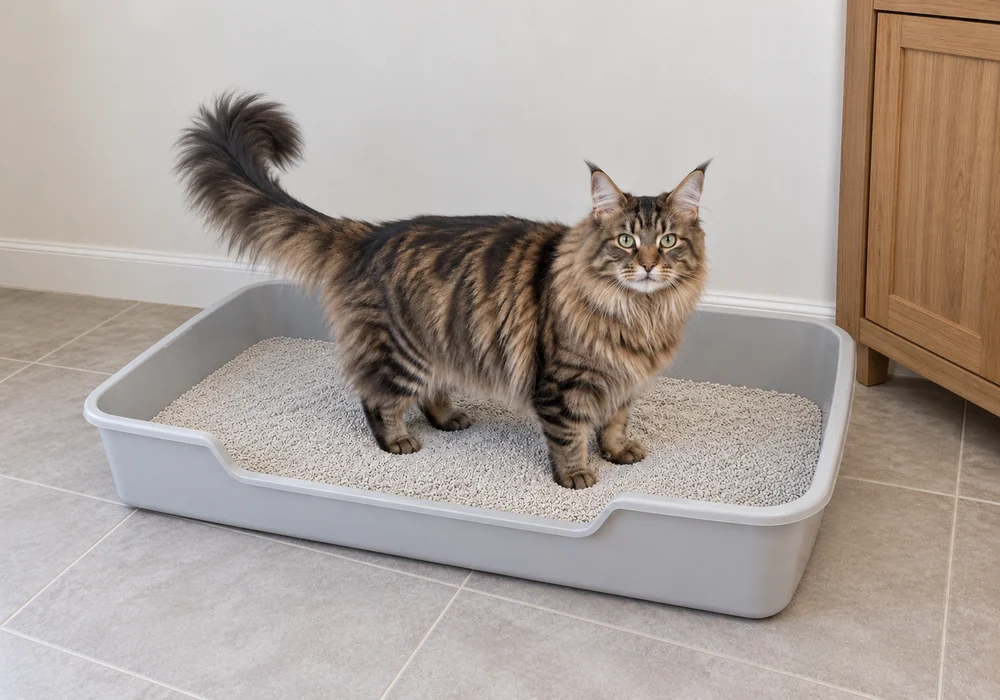
- Measure usable space. Choose a carrier with room to stand, turn, and lie comfortably. A litter tray around 1.5 times the cat’s nose-to-tail-base length offers a useful starting point; adjust the entrance for mobility.
- Check support. Look for stable climbing furniture, broad platforms, sound fasteners, and suitable anchoring. Recheck it after moving or assembling it.
- Feed for healthy condition. Use a complete diet appropriate to life stage and health. Measure portions and food rewards; a breed label does not establish a need for supplements or a special diet.
- Keep care manageable. Make coat checks, every-claw inspection, dental care, play, and veterinary reviews part of the routine. Arrange dependable care during absences.
Seek immediate veterinary help for labored or open-mouth breathing, collapse, or sudden painful weakness or paralysis. A quiet breed reputation does not explain an abrupt change in movement, breathing, appetite, or engagement.
A Maine Coon’s appeal goes well beyond an impressive photograph. Its documented history, varied coat, individual social style, and interesting biology become more rewarding when you understand what each feature means—and what it cannot tell you.
This article draws on what we have learned living with cats of our own as well as on the published sources cited above, and it cannot replace a veterinary examination. Contact a veterinarian promptly for labored or open-mouth breathing, collapse, sudden hindlimb weakness or paralysis, a cat that stops eating, or a kitten whose growth or gait looks wrong.