
The right questions to ask when buying a cat help you establish where the cat came from, whether its needs fit your home, and what care you will take over. A friendly meeting is encouraging, but it cannot tell you when the next vaccine is due or whether a health problem needs follow-up. Ask for specific examples, match the answers to the records, and decide what you can realistically provide.
These ten questions work for breeders, private rehoming, and rescue organizations, although the available history will differ. An adult rescue may have no birth records. A breeder claiming to have raised a litter should be able to explain its upbringing. Honest gaps call for a care plan; unexplained contradictions call for a pause.
Start with questions to ask when buying a cat about its background, household fit, and ongoing costs. Resolve those points before choosing a collection date.
1. Who Is Selling the Cat, and Where Did It Grow Up?
Ask for the seller’s name, contact details, relationship to the cat, and reason for selling or rehoming. Find out where the cat was born and where it currently lives. For a breeder’s kitten, arrange to see the kitten with its mother in the home where the breeder raised it. Observe their interaction and the living conditions; an adult female simply being present does not prove she is the mother.
Ask the breeder how they monitor the mother’s health, how many previous litters she has had, which parental health checks they arranged, and which veterinary practice provides care. Also ask how they record and manage illness in a litter or related cat.
Check any claimed license with the issuing authority where licensing applies. The UK government’s buying guidance, for example, recommends viewing the animal and its documents and verifying applicable licensing. Check the rules where you live, especially if the cat is coming from abroad.
Pause if: the address, age, or story changes, the seller refuses reasonable checks, or pressure to pay prevents verification. Save the advertisement and written promises. In a rescue or adult rehoming, ask what the caregiver knows and what remains uncertain rather than demanding a mother or litter history that may genuinely be unavailable.
2. Can This Particular Cat Live Well in My Household?
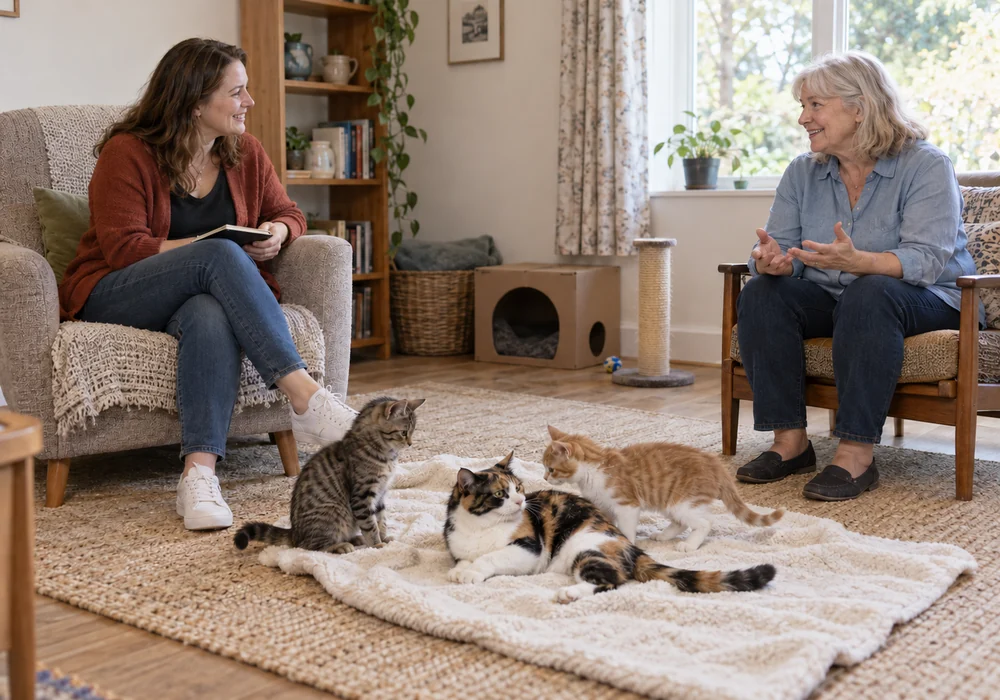
Ask, “What does a normal day look like for this cat, and what kind of home would be difficult for it?” Describe your work hours, children, resident cats, travel, and any limits on the care you can provide. Then ask for examples of how the cat has responded to similar circumstances.
“Good with children” needs context: children of what ages, doing what, and under whose supervision? Likewise, living peacefully with one familiar cat does not establish compatibility with every cat. Ask about activity, handling preferences, access needs, and how much company the cat currently receives.
A healthy adult’s established habits may be easier to assess than a kitten’s future temperament. Breed descriptions offer tendencies, not a personality guarantee. If allergies are a concern, do not assume a short coat or a “hypoallergenic” advertisement solves them; discuss significant allergy or asthma with an allergy specialist before committing.
Questions to ask when buying a cat should cover your household’s limits as well as the cat’s preferences. Ask the seller how your home could meet the needs they describe. Reading up on ordinary cat behavior beforehand makes those answers easier to judge. If you cannot make a workable plan, consider a different cat or a later date.
3. Questions to Ask When Buying a Cat About Costs
Ask, “What does the price include, and which costs will I take over?” Request an itemized list of examinations, vaccine doses, parasite treatments, neutering, microchipping, and supplies that the fee covers. A lower purchase fee may leave more appointments to pay for. Also budget for food, litter, grooming, holiday care, and treatment outside that package.
| Budget category | Ask or obtain a quote for | Check before committing |
|---|---|---|
| Due now | Purchase or adoption, transport, equipment, and remaining preventive care | Which services has the provider completed and documented? |
| Recurring | Food, litter, routine veterinary care, insurance, and grooming where needed | Can the household meet these costs consistently? |
| Not included or uncertain | Illness, injury, policy exclusions, special diets, and care while you travel | What funds or support can you access when needed? |
For context, PDSA’s UK cost model, priced in 2024, estimates £366 for initial setup and a minimum of £79 per month. Its lifetime figure of £11,400–£13,600 is reached by multiplying the monthly minimum by twelve and then by an assumed lifespan of 11.7 to 14 years. It excludes acquiring the cat, veterinary bills for illness or injury, boarding, and special diets. These are historical minimum benchmarks, not current local quotes or a limit on what your cat may cost.
Use dated quotes from your own area and read insurance exclusions, deductibles, and payment limits. A plan that works only if the cat never becomes ill leaves an important gap.
Once the source and practical fit make sense, use the visit to understand age, health, and behavior. Observe gently and ask whether what you see is typical.
4. How Old Is the Kitten, and Why Is It Ready to Leave?
Request the recorded birth date and proposed collection date. Ask when the kitten stopped depending on milk, whether growth or feeding has been difficult, and what contact with its mother and littermates has continued. Eating solid food, readiness for a new home, and finishing a vaccination plan are separate milestones.
Cats Protection advises keeping kittens with their mothers until at least eight weeks of age, because early separation is linked to retained juvenile behaviors such as kneading and suckling. Pedigree practice often runs later: the GCCF’s published kitten checklist says a pedigree kitten from a reputable breeder will probably stay with its mother until twelve or thirteen weeks, and its hard minimum is eight weeks. A breeder’s customary handover age is a practice, not proof of how this particular kitten’s vaccination course was scheduled.
For an orphaned kitten or one whose medical needs required early separation, ask for the individual veterinary and welfare plan. Otherwise, “it already eats by itself” is not enough to explain very early collection. Resolve conflicting dates before proceeding, and ask your clinic what care will still be needed.
5. Health Questions to Ask When Buying a Cat
Ask, “When did a veterinarian last examine the cat, what did they find, and what still needs follow-up?” Request the findings rather than relying on a “healthy” label. Cover previous illness, injuries, surgery, medication, supplements, recurring symptoms, and any problem the veterinary team is still investigating.
Check that the records identify this animal and connect each concern with its date, investigation, treatment, response, and follow-up. For an adult, ask whether a health or behavior problem contributed to rehoming. For a kitten, a reported heart murmur, hernia, or abnormal teeth needs veterinary interpretation; the finding alone does not tell you its cause or severity.
With the current keeper’s permission, arrange record transfer and ask your clinic to review concerns before or promptly after collection. If the cat has persistent eye or nasal discharge, poor body condition, marked lethargy, or visible skin problems, ask a veterinarian to assess the concern. Do not accept “normal for the breed” as an explanation without clinical assessment. Breathing difficulty requires immediate veterinary care.
A cat with a condition that the caregiver discloses and your veterinarian considers manageable may still fit your household. The decision is whether you understand the likely care and can provide it. Concealed problems, withheld records, or an unexplained treatment history are different concerns.

6. How Does the Cat Behave in Everyday Situations?
Ask how the cat responds to unfamiliar people, gentle handling, grooming, carriers, noise, and time alone. Follow up on biting, spraying, house-soiling, persistent hiding, and any previous returns with three questions: when does it happen, how often, and what helps?
For kittens, ask what positive handling and ordinary household experiences actually occurred. “Raised in a family home” does not describe those experiences. For adults, observations from someone who has lived with the cat can be more informative than a breed label.
Let the cat choose whether to approach. Do not restrain it to test friendliness. A quiet or fearful visit may reflect the situation, so compare the visit with the longer history. Our guide to signs of fear in cats explains the body language that helps you tell a wary cat from a relaxed one. Also ask what boundaries the cat shows and whether the caregiver respects them.
Your questions to ask when buying a cat should lead to a realistic adjustment plan. If you have resident cats, plan a separate starting space and gradual introductions. Previous companionship does not guarantee a close bond with your own cat, and forced contact is not a useful compatibility test.
The remaining cat-buying questions turn general assurances into named treatments, relevant test results, written responsibilities, and a routine you can reproduce.
7. What Preventive Care Has the Cat Received, and What Comes Next?
Request vaccine names, dates, the administering clinic, and the next planned dose. Also ask for parasite-treatment products and dates, neutering status or plans, and relevant infection-test results. “Wormed” does not identify the parasites the product targets or tell you whether the cat needs further treatment.
For core kitten vaccinations, the 2024 WSAVA vaccination guidelines recommend repeated core doses every two to four weeks, a final initial-series dose at sixteen weeks or older, and revaccination at or after twenty-six weeks rather than waiting until twelve to sixteen months. The guidance explains the timing: maternal antibodies vary enough within and between litters that early doses can fail, and the later booster narrows that window. The guideline’s summary table for the modified-live feline triple vaccine phrases the repeat interval as every three to four weeks, so expect your veterinarian to reconcile the record with the product used, local risk, and the individual kitten. Rabies and FeLV recommendations also vary by region.
For feline leukemia virus (FeLV) and feline immunodeficiency virus (FIV), record the test type, date, result, and any later exposure. A single negative result can miss recent infection. A positive screening result may need further investigation, and maternal antibodies can complicate FIV antibody results in kittens. Ask the veterinarian whether they recommend confirmation or retesting.
Leave with one calendar showing the action, due date, person responsible, and expected cost. Do not treat “fully vaccinated” as proof that no more appointments are needed.
8. Questions to Ask When Buying a Cat About Inherited Risks
Ask, “Which inherited risks have you checked, and can I see the reports?” Identify the condition and genetic variant, the cat the laboratory tested, the laboratory’s name, and the test date. Check whether the report belongs to the kitten or to a parent, and ask your veterinarian whether the evidence is relevant to this cat.
For example, the UC Davis Veterinary Genetics Laboratory states that its Maine Coon HCM test detects the MYBPC3-A31P variant associated with hypertrophic cardiomyopathy. A negative result does not exclude every cause of HCM or other heart disease; as our Maine Coon guide explains, the variant raises susceptibility rather than guaranteeing disease. Likewise, a PKD1 result concerns the tested inherited form of polycystic kidney disease, not every kidney disorder, and the MYBPC3 variant tested in Ragdolls is a different one, which our Ragdoll breed guide sets out.
Ask whether clinical screening is also appropriate and how the breeder responds when a relative develops disease. Physical features deserve attention too: ask about comfortable breathing, movement, eye care, and grooming rather than assuming a popular appearance has no welfare cost.
A pedigree, rare color, large DNA panel, or high price is not comprehensive health clearance. Mixed-breed cats also need veterinary care and can develop inherited or acquired disease. Our overview of cat health topics is a place to start on what routine monitoring covers.
9. What Paperwork, Transfer Help, and Support Does the Seller Provide?
Review the agreement before final payment. It should identify the parties and cat, the price and collection date, known conditions, included services, and each person’s responsibilities. Ask what happens if your veterinarian identifies an illness after collection, who pays which costs, and how the seller would help with a return or rehoming if the match fails.
Request the veterinary records and any applicable pedigree or registry documents. Verify the relevant organization’s transfer requirements. Pedigree registration and medical evidence serve different purposes; neither replaces the other.
If the cat already has a microchip, arrange a scan, match the number to the paperwork, and confirm who will transfer the recovery record and register your current contact details. If a younger kitten does not yet have a chip, agree who will arrange it and check local deadlines. Our guide to getting your cat microchipped explains the registration checks in detail.
Keep copies and clarify any unclear terms before signing. A contract is not a health certificate, and its wording does not establish that every clause is legally enforceable. If legal rights or obligations are uncertain, obtain advice for your jurisdiction. Do not let a refund discussion delay necessary veterinary care.
10. What Exact Daily Routine Should Come Home With the Cat?
Ask for the exact food formulation, measured amounts, meal times, treats, appetite, and any prescribed diet. Record the litter type, tray design, usual toileting habits, preferred scratching surfaces, grooming tolerance, and familiar places to rest or hide.
Request enough suitable familiar food for a planned transition. “Chicken food” or “one bowl a day” is too vague to reproduce. Familiarity can ease adjustment, but it is not a reason to continue an unbalanced diet or inaccessible litter setup indefinitely. Have your veterinarian review diet suitability and any prescribed changes.
Use these answers to choose practical equipment: a securely latched, ventilated carrier; washable food-safe bowls; an accessible litter tray; stable scratching surfaces; and safe bedding and hiding places. Check fasteners, damaged finishes, loose threads, and wear. Price and appearance do not establish that equipment is safe or that the cat will use it. Our guide to setting up a litter box covers placement and size for a cat of this build.

Prepare a quiet, secure starting room and arrange a veterinary examination promptly after arrival. For a kitten, our guide to the first days with new kittens covers room setup, meals, monitoring, and gradual introductions.
Questions to Ask When Buying a Cat: Your Final Check
Before collection, confirm that the animal, medical records, agreement, and chip number, if present, all match. You should know which care is complete, which appointments remain, who to contact, and how you will meet the cat’s everyday needs.
- Proceed when the evidence is consistent and you can provide the agreed care.
- Clarify a missing record, uncertain test result, or disclosed condition with the appropriate clinic or organization.
- Pause when pressure, withheld information, or contradictions prevent a sound decision.
This is a practical decision guide, not a health guarantee or a scoring test. A good choice is a cat whose needs you understand and can meet, with clear records and support for what comes next.
This article draws on what we have learned living with cats of our own as well as on the published sources cited above, and it cannot replace a veterinary examination or a contract review. Have the cat seen promptly after collection, and seek care without delay for labored breathing, refusal to eat for a day, repeated vomiting or diarrhea, sudden weakness, or a limp or unresponsive kitten.