
Cat weight chart by age · kitten to senior
A cat weight chart by age gives you a range to compare against, not a number to hit. Newborn kittens weigh 90–100 g and gain 50–100 g a week for the first three to four months. Most domestic shorthairs reach 3.2–5.4 kg (7–12 lb) by twelve months, then hold that band until roughly seven years.
Past about seven the direction changes: muscle starts thinning, though bodyweight still peaks near ten. Beyond ten and a half a falling number becomes the finding that matters. Because of that reversal, a chart on its own cannot answer the real question — is the cat in front of you healthy?
Kitten90–100 g at birth, then 50–100 g a week to about four months. Growth rate flattens earlier, but skeletal growth is done by 30 weeks.
Adult3.2–5.4 kg is only a population band, wide enough to hold a lean large male and an obese small female.
SeniorMuscle goes first, from about seven. Weight peaks near ten, then declines.
01 · The numbers, with their sources attached
How the Cat Weight Chart by Age Is Built
Every row in this cat weight chart by age comes from a published reference study. Indeed, none of it is taken from figures passed around the internet. Each band instead shows where the bodyweights of a large group of cats at that age actually fell. The last column names the growth event behind the range, because a number without a reason is only arithmetic.
| Age | Typical weight | In metric | What is happening |
|---|---|---|---|
| Birth | 3.0–4.2 oz | 85–120 g | Weight is a vital sign. A kitten that fails to gain needs same-day advice. |
| 1–2 weeks | 4.9–8.8 oz | 140–250 g | The steepest slope on the whole curve, at 50–100 g a week. |
| 3–4 weeks | 6.3–12.0 oz | 180–340 g | Published ranges for this age already differ by nearly a factor of two. |
| 6–8 weeks | 1.5–2.6 lb | 680 g–1.2 kg | The validated centile standard begins at eight weeks. |
| 3 months | 2.0–4.0 lb | 900 g–1.8 kg | Sex differences widen, and weight stops predicting age at ten weeks. |
| 4–5 months | 3.5–6.2 lb | 1.6–2.8 kg | Growth rate plateaus at 150–160 days. |
| 6 months | 5.1–7.9 lb | 2.3–3.6 kg | Skeletal growth is usually complete by 200–220 days. |
| 9 months | 6.2–10.1 lb | 2.8–4.6 kg | Filling out now rather than growing taller. |
| 12 months | 7.1–11.9 lb | 3.2–5.4 kg | Adult band reached. The growth standard ends at 78 weeks. |
| 1–6 years | 7.1–11.9 lb | 3.2–5.4 kg | Flat on purpose, which is exactly what makes a slow drift easy to miss. |
| 7–10 years | Upper half of the adult band | Mean 4.8 kg at 10 | Weight peaks near ten. Muscle has been falling since seven. |
| 11 years and over | Trending down | Mean 4.3 kg at 16 | Weight and muscle both fall. Loss is a finding, not just old age. |
Two notes on the rows, because the sources differ on both. The birth figure here is the wider owner-facing band, 85–120 g, while reference texts give 90–100 g. The senior rows are cohort means rather than ranges, because means are what the longitudinal study reports. Across 209 cats and 1,231 examinations, those means were 4.77 kg at seven years, 4.82 kg at ten and 4.30 kg at sixteen. Still, a mean is not a target: a cat that has always been small should stay small.
How to read this cat weight chart by age
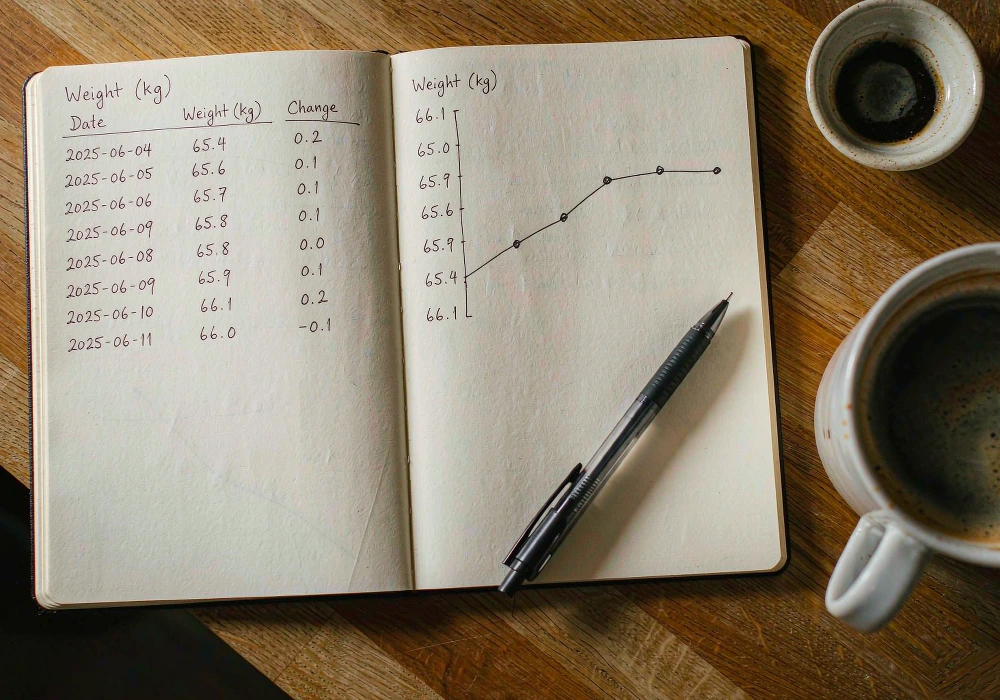
Any cat weight chart by age is a starting assumption, so treat it as a prior rather than a verdict. A single reading places your cat among strangers. A second reading two weeks later, on the same scale, then shows any drift from its own baseline, and only that comparison has a clinical answer. The best feline growth standard plots nine centile lines, then asks one question: does this individual stay on its own line? In fact, about half of the reference kittens did, which is why the useful signal sits in the exceptions.
Where a cat weight chart by age stops being useful
Yet four things override the table. Frame first: a 6 kg Ragdoll and a 6 kg shorthair are not the same finding, because the centile standard is built on shorthair data scoped to 2–7 kg. That leaves other builds to healthy adult weights for large cat breeds. Sex second: males start heavier, and the gap widens rather than closing. Then neutering, the single largest lever on adult weight, covered further down. Finally coat length: long fur changes what you see long before it changes the scale.
02 · Birth to twelve months
Kitten Weight Chart: Birth to 12 Months
For the first four months, bodyweight is not a cosmetic statistic. It is also the most responsive single indicator of whether a kitten is getting enough energy and absorbing it. That is why a kitten weight chart by week earns closer attention than any other section here.
Newborn kitten weight: weeks 0–8
Normal kitten birth weight is 90–100 g, and growth then runs at 50–100 g a week for the first three to four months. Both figures come from the Merck Veterinary Manual’s feeding reference, while owner-facing guides publish slightly wider bands, generally 85–120 g.
Puppy growth is exponential and swings with anticipated adult size, whereas kitten growth is broadly linear for the first weeks. Because of that linearity, a simple arithmetic rule can estimate age at all.
When the one pound per month rule holds
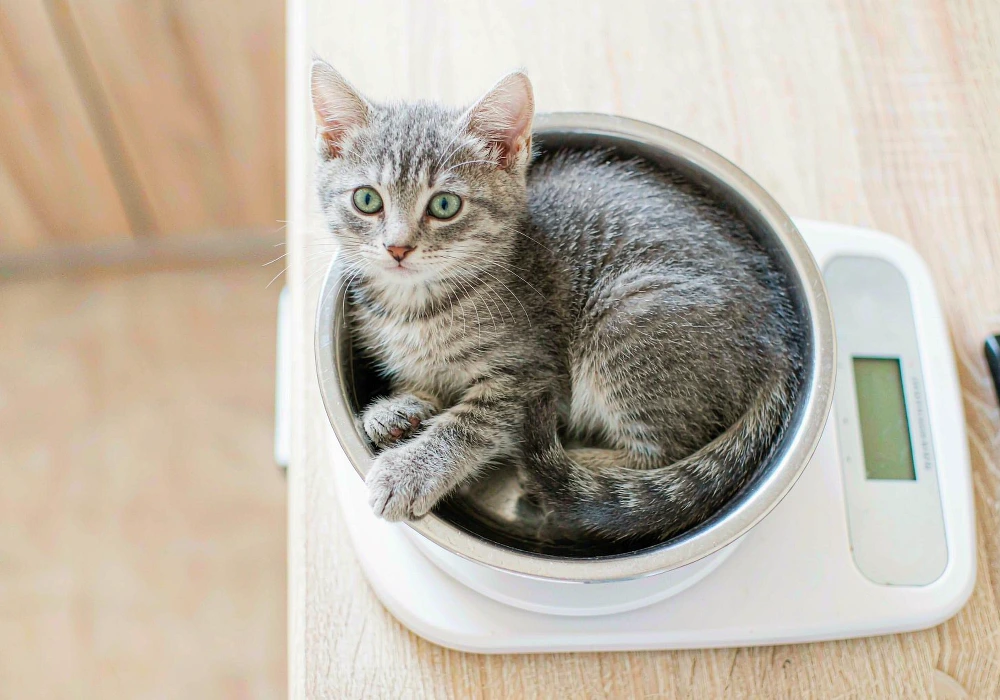
In practice, the rule is simple: a kitten gains about a pound for every month of age. Two cohorts tested it and returned different numbers, which is where most online summaries go wrong.
In 246 kittens weighed repeatedly from birth, the estimate landed within a week of the true age for 98.8 percent at two weeks and 95.1 percent at four. Accuracy then reached 82.5 percent at six weeks and 77.6 at eight. In 1,310 kittens weighed once at a shelter visit, accuracy was 77.4 percent at six weeks, 67.5 at eight, 57.0 at ten, 46.6 at twelve and 28.8 at fourteen. The two eight-week figures are not a contradiction: the first comes from kittens whose growth was tracked from birth, the second from a single measurement in a cat of unknown history.
Both curves point the same way, and the authors conclude that body weight predicts age reliably through ten weeks. After that, other cues have to take over. If you are ageing a rescue litter, read the published assessment of body weight for age determination in kittens.
One pound per month is a ten-week instrument, not a growth target.
At two weeks it is right for almost every kitten, and still right for most at eight. But by twenty weeks it is right for fewer than one in five, at 17.9 percent. The recurring mistake is to treat it as a growth target for the whole first year. That is how a perfectly normal five-month-old ends up looking behind a chart that was never describing it.
After ten weeks, then, teeth supply the cross-check that weight cannot. With a stray kitten, a kitten age chart built on dental eruption beats the scale once the first month has passed.
Why centile crossing beats any single weight
However, this is the part most published charts leave out. Of 122 kittens later classified as overweight, 63 had crossed at least two centile lines upward. And they were already heavier than average when monitoring began. They passed the 75th centile somewhere between 24 and 34 weeks, long before an owner notices anything at all. Those figures come from the growth standard for domestic shorthair kittens, which rests on 507 cats and 33,274 weights.
The window you can act on is the second and third weighing, not the first. So two weights two weeks apart on one scale are the minimum the standard needs before it will draw a curve. Note the scope: shorthairs between 2 and 7 kg. Note too that Maine Coons keep filling out until three to five years.
Do not wait out a flat line. A kitten that fails to gain, or loses weight before weaning, needs same-day assessment, because neonates have minimal reserves. A stalled scale can become a collapsed kitten inside 24 hours.
03 · One to seven years
Adult Cat Weight: What Healthy Actually Means
Between roughly one and seven years a cat weight chart by age has almost nothing to say, because the expected value is flat. That flatness, in fact, is the danger. No threshold is crossed, so no alarm sounds. Then a drift of one to three percent of bodyweight a year reads as noise on a bathroom scale.
The 8–12 lb myth about healthy cat weight
Yet almost every chart gives 8–12 lb (3.6–5.4 kg) as healthy. That span is wide enough to hold a lean, long-bodied male at one end and an obese, small-framed female at the other. So landing inside it proves very little. Reference manuals give a tighter anchor: about 3.2 kg (7 lb) for a male and 2.8 kg (6 lb) for a female. The first is an ideal; the second is a population average that now includes many overweight animals. Any workable answer to what a healthy cat weight is therefore has to start from the ideal.
Frame, sex and the neuter effect on weight
Neutering is the highest-leverage metabolic event on the timeline, though it is usually described as fate rather than arithmetic. In a controlled study of 22 adult female shorthairs, every cat was spayed and then fed exactly the allowance she had received while intact. Yet intake did not change. Over eleven weeks, though, bodyweight rose 16 percent and body condition a full point, because maintenance requirement had fallen by about a quarter. Left unrestricted, gains above 20 percent in six months have been documented.
The body condition check you can do in 30 seconds
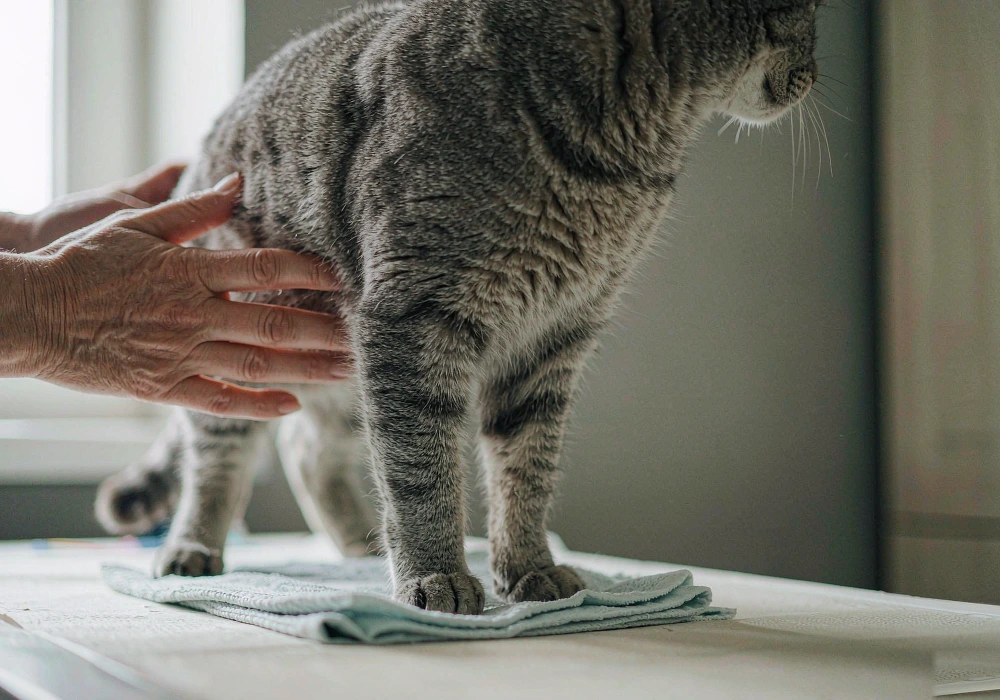
Instead, body condition scoring estimates the fat compartment by hand. First run your palms along both sides of the ribcage. You should then feel ribs under a thin covering, more like the back of your hand than your palm. Look from above for a waist, then from the side for a belly that tucks up. Guidance points to 4–5 on the nine-point scale, since each point above 5 is roughly 10–15 percent of bodyweight.
| Score | Ribs | Waist from above | What it means |
|---|---|---|---|
| 1–2 | Visible, no fat cover | Severely pinched | Emaciated. Urgent veterinary assessment. |
| 3 | Easily felt, minimal cover | Clearly pinched | Thin. Look for a cause rather than adding food. |
| 4–5 | Felt under a thin layer | Visible behind the ribs | Lean to ideal. Maintain. |
| 6 | Felt under slight excess | Present, not obvious | Above ideal. Review portions. May still suit some older cats. |
| 7–9 | Hard to feel, or not at all | Absent or bulging | Obese by definition at 7 and above. Needs a structured plan. |
In the 2024 US pet obesity survey, 61 percent of pet cats scored 6–9. Yet roughly 55 percent of owners described their cat as ideal. When most of the population sits above ideal, the visual norm moves with it. Consequently, a cat at 6 stops looking heavy, because it looks like every other cat in the waiting room. Muscle condition scoring is the companion check, reading the spine, shoulder blades, skull and pelvis. It matters, since a cat can carry excess fat while losing muscle.
04 · Seven years and beyond
Senior Cat Weight Chart: Why the Number Drops
The 2021 feline life stage guidelines run kitten to one year, young adult one to six, mature adult seven to ten and senior beyond ten. That sets the vocabulary, though care should follow a cat’s condition rather than its birthday. For weight monitoring, the ten-year mark is where the meaning of the reading flips.
Muscle goes first, weight follows
Indeed, the clearest evidence comes from 209 client-owned cats aged roughly seven to sixteen. All were followed through 1,231 examinations at six-month intervals for up to seven years. Mean bodyweight rose from 4.77 kg at seven years to 4.82 kg at ten, then fell to 4.30 kg by sixteen. Meanwhile body condition turned down after about ten and a half. The longitudinal study of bodyweight and muscle condition in ageing cats reports means. The shape therefore holds, even though any one cat’s path will wobble.
Yet muscle told an earlier story. On a 30-point composite score it fell from 30 to 28 between seven and ten years, then to 15 by sixteen. By fourteen, the cats were more likely to be underweight than obese.

Three conclusions follow, each contradicting a habit built into consumer charts. Lean mass starts going before middle age, before the cat looks old and before bodyweight moves. Consequently, a stable weight at ten can conceal muscle loss matched by fat gain. Bodyweight then peaks near ten rather than at maturity. And the direction of concern reverses: past ten and a half, a cat above the band is often the reassuring case.
When weight loss is a symptom, not ageing
The differential is crowded, and the scale does not distinguish between its members. For example, chronic kidney disease affects up to 40 percent of cats over ten, rising to around 80 percent over fifteen. Hyperthyroidism is reported at roughly 6 percent over ten, yet radiographic osteoarthritis is present in about 61 percent of cats aged six and over.
Hyperthyroidism raises metabolic rate, so the cat loses weight while eating enthusiastically, which makes eating well but still losing weight the pairing to take to a vet. Kidney disease, by contrast, drives muscle breakdown and appetite loss, while arthritis reduces movement until muscle wastes. A cat eating well, losing weight and losing muscle has a medical problem until proven otherwise. A thin cat with an established cause needs a different plan, such as a vet-led plan for putting weight back on an underweight cat.
What to do instead of watching the weight number
Weigh monthly on the same scale, at the same time of day, before the first meal. Put your hands on the spine and shoulder blades every few months too, since fingers find muscle loss first, and book veterinary checks twice a year from about ten. Each 100 g lost in a geriatric cat is associated with a 6.4 percent rise in mortality risk, and in cats with cancer, kidney disease or hyperthyroidism, weight loss begins about 2.25 years before death. Even so, that is not an argument for alarm at every fluctuation; it is an argument for writing the number down.
05 · The risk curve is a U, not a slope
Why an Overweight Cat Is Not Healthy
Reading a cat weight chart by age correctly means accepting that the risk curve is a U, not a slope. In 2,609 cats scored at every visit, the hazard of death was measured against a reference score of 6. That hazard then came out 4.67 times higher at a score of 3, 2.61 at 4 and 1.43 at 5. Scores of 7 and 8 were not statistically distinguishable from the reference. Median lifespan across the group was 15.8 years.
What the weight risk curve means for your cat
Being thin carried a higher hazard than being moderately heavy, so a cat that has dropped below its band has not improved. Second, the price on the heavy side was concentrated at the extreme. That is why a little overweight differs from obese, and why obesity is a poor place to stop paying attention, since it raises diabetes risk roughly two to four times.
A few common questions
Frequently Asked Questions
Is 14 lb overweight for a cat?
Usually, but not automatically. Fourteen pounds is 6.4 kg, above the 3.2–5.4 kg band, so it needs a reason. On a large-framed male, 14 lb may be a body condition score of 6, while on a small female it is more likely 7 or 8.
When do cats stop gaining weight?
Three true answers, because growth rate plateaus at 150–160 days and skeletal growth completes by 200–220 days. Beyond that, the published standard runs to 78 weeks, after which there is no validated curve at all.
My cat lost weight but eats normally. Should I worry?
Yes, because the appetite is the clue rather than the reassurance. Eating well while losing weight is the classic pattern for hyperthyroidism, diabetes and several gut conditions. In an older cat, that is a reason for bloodwork.
Why did my senior cat lose weight without a diet?
Because after about ten years the curve inverts, which does not make the loss harmless. It makes it a finding, since kidney disease, hyperthyroidism, dental pain and arthritis all present this way.
06 · What to take away
The Bottom Line
A cat weight chart by age is worth exactly as much as the routine behind it. That means the same scale, the same time of day, and a second reading two weeks later. It also means body and muscle condition beside the number. The bands tell you what an average cat weighs, not what your cat is made of. After the tenth birthday the question flips — is the number too high now, or is it falling?
Weigh monthly and feel for ribs and spine, then treat any unplanned change as information rather than a verdict. Start with routine cat care basics, because that routine keeps a baseline stable enough for these numbers to mean anything.
This article reflects our own experience of weighing and feeding cats at home, and draws on the published veterinary sources cited above. It is not a diagnosis or a feeding prescription: weight and body condition are screening measurements, not a substitute for examination. Call your veterinarian if a kitten stops gaining, if any cat loses weight without a clear reason. The same applies if a cat stops eating, breathes with effort, vomits repeatedly or collapses.