
The best way to put weight on a cat is to find out why it is thin, address any illness, and feed a measured amount of suitable, complete food.
A cat can lose weight even while finishing every meal, and a full bowl does not tell you how much an unwell cat actually eats. This guide explains how to assess body and muscle condition, choose food, turn a calorie allowance into portions, and track recovery.
Check the causeConfirm that gain is needed.
Plan the mealsChoose food and measure portions.
Review the responseTrack intake, weight, and muscle.
01 · Start with your cat’s condition
The Best Way to Put Weight on a Cat Begins With a Checkup
A small adult cat with a stable weight and healthy body condition may need no extra calories. A cat that is getting lighter, bonier, or less muscular needs an explanation, even if it still finishes meals. Compare reliable previous weights with a current veterinary measurement.
Your veterinary team can assess body condition score (BCS), which estimates body fat by looking and gently feeling the body. Specifically, the WSAVA nine-point feline chart labels 5/9 as ideal. At that score, the ribs can be felt beneath a slight fat covering and a waist is visible behind them. A long coat can hide the outline, so photographs alone are not enough.
Muscle condition score (MCS) assesses muscle separately, including around the spine, shoulder blades, skull, and pelvis. A cat can carry excess fat while losing muscle. For that reason, ask the clinic to record both scores and agree on a target; a previous overweight measurement should not automatically become the goal. Basic cat care shows how the everyday routines hold a recovery plan together.
Bring a useful starting record: Previous weights, the current food label, amounts eaten, all medicines and supplements, and changes in vomiting, stool, thirst, urination, or behavior.
02 · Find what is getting in the way
Find Out Why Your Cat Is Losing Weight
Some cats cannot eat enough because of dental pain, nausea, illness, difficulty reaching food, or another cat taking their meals. Others eat well but lose weight because their bodies use energy differently or do not digest and absorb nutrients normally.
Examples include hyperthyroidism, in which excess thyroid hormone increases metabolic activity, and diabetes, which interferes with the normal use of glucose, or blood sugar, for energy. Digestive disease and intestinal parasites can also affect condition. For this reason, appropriate testing is needed; thinness alone does not tell you which treatment is needed.
When a cat eats well but keeps getting thinner, the cause of the weight loss has to be addressed alongside food intake. Increased appetite in cats gathers the changes that tend to accompany a raised appetite. Weight or muscle loss in an older cat deserves investigation.
Tell the clinic what eating looks like: approaching the bowl and leaving, dropping pieces, licking only the gravy, or being interrupted by another cat. Those details can then help the clinic identify barriers that a larger serving would leave unresolved.
03 · Choose calories with complete nutrition
Choose Complete Food That Supports Weight Gain
The food that suits a cat depends on its nutritional needs, medical history, and willingness to eat it. Compare recipes by suitability and calorie content; wet food, dry food, or an appropriate combination may work.
For an ordinary main diet, look for a nutritional adequacy statement confirming that the food is complete and balanced for the appropriate life stage. In the United States, this claim is supported by meeting an Association of American Feed Control Officials (AAFCO) nutrient profile or passing a feeding trial using AAFCO procedures. The FDA’s food-label guidance defines these terms. Also, check the intended use of any therapeutic diet with your veterinarian, because it is formulated for a specific medical condition.
| Food option | What matters for weight recovery |
|---|---|
| Complete wet food | Adds moisture and may offer an appealing soft texture. Often provides fewer calories per gram than dry food, so more grams may be needed to meet the same calorie allowance. |
| Complete dry food | Many recipes provide more calories in a smaller portion. Check the actual calorie content, eating comfort, and acceptance; keep drinking water available. |
| A measured combination | Can accommodate preferences. Count both foods toward the daily allowance and confirm that mixing them fits any medical diet restrictions. |
| Veterinary therapeutic or recovery food | May suit a specific illness or period of nutritional support. Check intended use and duration; the word “recovery” does not make it appropriate for every cat. |
Calorie density means the energy supplied per gram of food. A higher density can help a cat consume the planned calories in less food. It does not prove better digestibility or suitability for kidney disease, diabetes, or another condition.
Protein supports tissue maintenance, and cats require nutrients such as taurine, an essential amino acid. Judge the whole diet rather than one ingredient or a high protein percentage. Moisture makes wet and dry label percentages difficult to compare directly; ask for typical nutrient information or amounts per 100 calories when needed.
Ask the manufacturer who formulates the food, what relevant nutrition qualifications they have, and how finished-food nutrients and safety are checked. “Premium,” “natural,” and “fresh” do not establish that a recipe is a better weight-gain diet.
Special needs change the choice. A healthy senior cat does not need protein restriction simply because of age. A cat with chronic kidney disease may need a kidney diet with controlled phosphorus and other adjustments. Kitten food, added meat, or a general recovery food may conflict with that plan.

04 · Turn the feeding plan into portions
Turn a Calorie Allowance Into Meal Portions
Ask your veterinarian for the starting daily calorie allowance, which weight to use in calculations, and when to adjust it. The amount depends on body condition, illness, life stage, and current intake, so package directions alone cannot set a recovery plan.
Resting energy requirement (RER) estimates energy used at rest. The AAHA energy calculation guide (PDF) uses the following starting equation:
RER = 70 × (body weight in kilograms)0.75
For a hypothetical 4 kg cat, this gives about 198 kcal/day. RER is still a resting estimate, not an automatic maintenance or weight-gain allowance.
A kilocalorie (kcal) is the unit commonly called a food calorie. Once the clinic has set the daily allowance, use the exact recipe’s calorie label to work out food amounts.
Worked example · Not a feeding prescription
Convert an agreed calorie allowance into grams
For example, suppose a veterinarian has set 240 kcal/day for a particular stable cat. The figures below show how to convert that allowance into food portions. They do not set a calorie target for your cat.
Grams of food = allocated calories ÷ calories per gram
| Illustrative food choice | Amount supplying approximately 240 kcal |
|---|---|
| Wet food at 1.1 kcal/g | 240 ÷ 1.1 = about 218 g per day |
| Dry food at 4.0 kcal/g | 240 ÷ 4.0 = 60 g per day |
| A suitable combination | 100 g wet food × 1.1 + 32.5 g dry food × 4.0 = 240 kcal |
If the label gives kcal/kg, divide by 1,000 to find kcal/g. If it gives calories per can, divide by the can’s net weight in grams. Both foods in a combination must be appropriate for the cat; matching calories does not make different diets nutritionally interchangeable.
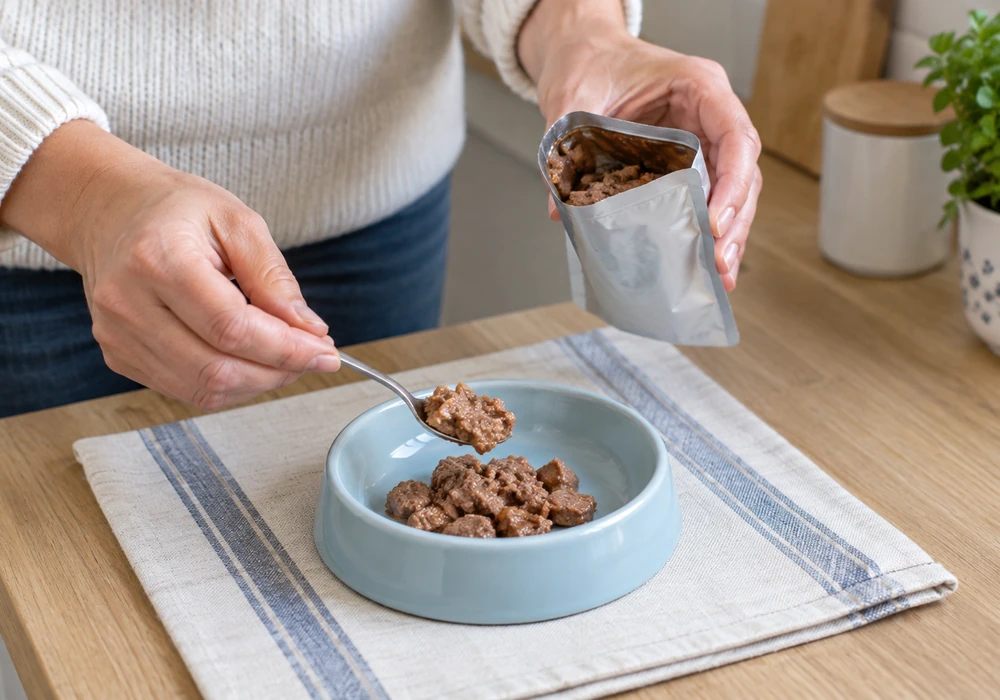
Use a kitchen scale and record food left over. For instance, serving 50 g and finding 15 g remaining suggests about 35 g was eaten, allowing for spillage or drying. Include permitted treats, toppers, food used for medicine, and meals given by other people. Treats still count toward the same allowance; how many treats a cat can have works out a limit you can apply here.
05 · Help your cat finish suitable meals
Make Meals Easier for an Underweight Cat
Give your cat an uninterrupted feeding spot
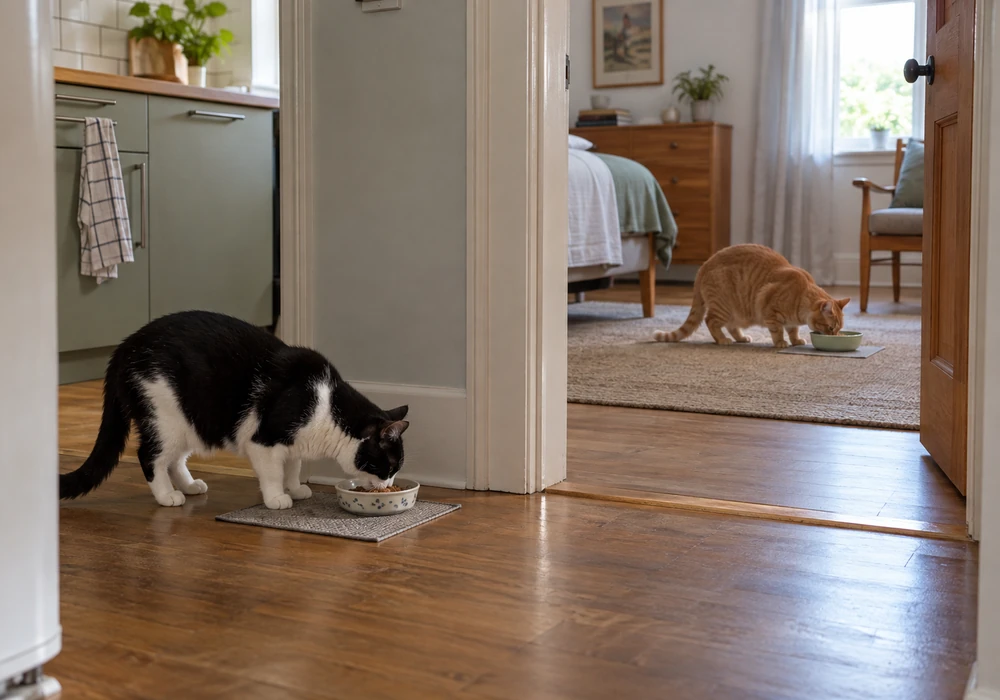
Feed in a quiet, accessible place, away from litter boxes and household traffic. In homes with several cats, use separate rooms or well-separated stations and watch each cat’s intake. If meals are being taken or guarded, reliable access to the cat’s own food comes first. Cat stress relief looks at the household changes that help when tension between cats is part of the problem.
Use a stable, smooth, washable dish and keep it within easy reach for a weak or painful cat. Divide the planned daily amount into several smaller meals if that suits the veterinary plan. A difficult puzzle feeder should not be the only route to food during recovery.
Watch for subtle signs of fear in cats, including withdrawing when another cat approaches. Improving access can help, but new avoidance or reduced intake still needs a health assessment.
Adjust texture and aroma carefully
Offer fresh portions of the chosen food. Gentle warming may make wet food smell more appealing; stir it and check that it is not hot. Try a suitable alternative texture when needed, changing one feature at a time so you can see what your cat accepts.
A little warm water can soften food, but it adds no calories. Excessive dilution makes the meal larger and may leave your cat unable to finish the planned amount. For a stable cat already eating, introduce a new food gradually over several days, or more slowly if needed, following veterinary advice. If intake falls or digestive signs develop, contact the clinic for an adjusted plan.
Keep accepted food available while arranging a better option. Do not let your cat go without food to force acceptance of a replacement. Warm only the serving needed. Promptly cover and refrigerate unused wet food at 40°F (about 4°C) or below, discard uneaten portions as directed, and wash bowls and utensils after use. Store dry food securely in its original bag in a cool, dry place. Follow the label’s storage and use-by instructions.
06 · Know when home feeding needs more support
When a Thin Cat Needs More Feeding Support
Before leaving the clinic, ask how much missed intake should trigger a call, what to do after hours, and when the next review is due. Continued refusal may require treatment for nausea, pain, dehydration, constipation, or the underlying illness.
Veterinarians may prescribe an appetite stimulant for selected cats. In the United States, feline transdermal mirtazapine, applied to the skin, is approved to manage undesired weight loss. Feline oral capromorelin is approved for weight loss in cats with chronic kidney disease. These medicines have different precautions and possible side effects; use only the prescribed product and instructions.
An appetite stimulant does not guarantee adequate intake or replace treatment for the cause. If voluntary eating remains insufficient, a veterinarian may recommend a feeding tube, which delivers nutrition through the digestive tract and requires specific care instructions. Do not push food or water into an unwilling cat’s mouth: oral syringe feeding risks aspiration, meaning material enters the airway, and can make the cat more reluctant to eat.
A severely starved cat needs a different plan
Refeeding syndrome involves potentially dangerous changes in metabolism and electrolytes, minerals needed for normal cell function, when nutrition restarts after prolonged starvation. A severely starved cat may need controlled feeding and monitoring of phosphorus, potassium, magnesium, and glucose. The veterinarian may also prescribe thiamine (vitamin B1) and other supplements according to the cat’s needs. An eager appetite does not remove the risk. Seek veterinary guidance before giving large catch-up meals or improvised supplements.
07 · Follow the response and adjust
Track Weight, Muscle, and Intake
Record daily food intake and symptoms. Use the same suitable pet or baby scale under similar conditions, on a schedule agreed with the clinic. Weekly weighing may be convenient for a stable cat being cared for at home; kittens, very thin cats, and cats receiving medical nutritional support may need closer monitoring.
Recheck body and muscle condition as well as weight. A higher reading can reflect fat, muscle, hydration, or abnormal fluid accumulation, so weight gain alone does not show that lost muscle has recovered.
| What you notice | What to do |
|---|---|
| More food served, but no more eaten | Measure leftovers, observe an uninterrupted meal, and discuss food access, acceptance, or illness with the clinic. |
| Weight continues to fall | Arrange reassessment with the intake record. Repeatedly increasing portions may leave the cause untreated. |
| Vomiting or diarrhea after a change | Report the timing and amounts eaten. Repeated vomiting with inability to keep water down needs urgent assessment. |
| Weight rises abruptly, or muscle still declines | Confirm the weight under similar conditions and contact the clinic. Review hydration, muscle condition, nutrition, and disease control. |
Knowing when to stop increasing calories matters as much as the increase itself. Once your cat reaches the agreed condition, review the calorie allowance with the clinic. The aim is comfortable eating, adequate muscle, and a sustainable weight. Diarrhea that follows a change to the diet is worth checking against diarrhea in cats: when to worry.
A few common decisions
Common Questions About Helping a Cat Gain Weight
Can I use kitten food for a thin adult cat?
A veterinarian may choose kitten food for some adults, but a growth formula can conflict with kidney diets or other dietary restrictions. Prepared cat food for kittens answers the related questions for growing cats. A thin kitten needs assessment and food that is complete and balanced for growth. Ask the clinic which diet and feeding amount suit the individual cat.
Will butter, oil, meat, or weight-gain treats help?
Extra calories can displace essential nutrients if they replace too much complete food. For this reason, butter, cream, oil, chicken, or tuna should not form the recovery diet. Keep any permitted unbalanced extras to no more than 10% of daily calories; a therapeutic plan may allow less or none. Long-term home-prepared diets need formulation by a board-certified veterinary nutritionist. Avoid raw meat and unpasteurized milk because of infection risks.
How quickly should my cat gain weight?
There is no single safe weekly percentage for every underweight cat. Illness, severity, hydration, and muscle loss affect the goal. Set a target with your veterinarian based on your cat’s condition and treatment response. Ask the clinic for an expected trend, a review date, and clear instructions for when to call sooner.
This article reflects our own experience of feeding cats at home and the published veterinary sources cited above; it is not a diagnosis or a feeding prescription. Ask your clinic before changing a diet, especially for a cat with kidney, heart, thyroid, or diabetes treatment already in place. Call the same day if your cat stops eating, vomits repeatedly, breathes with effort, collapses, or shows yellow gums or eyes, and treat any cat that cannot keep water down as an emergency.