
Signs of fear in cats can be easy to miss when there is no hissing or growling. A cat may go still during petting, lean away from a hand, or avoid a room it usually enjoys.
Compare the behavior with your cat’s usual habits, consider what happened just beforehand, and watch what changes when you give the cat space. Read the whole body and the situation together; one movement alone cannot confirm fear.
Check health as well as behavior. New hiding, reduced appetite, or reluctance to move can also indicate pain or illness. Use the veterinary guidance below before assuming your cat simply needs time to adjust.
Seven Subtle Signs of Fear in Cats
Use the observations below as reasons to pause and look more closely. None diagnoses fear on its own, and your cat does not have to show all seven.
1. Becoming completely still during handling
A cat that stops moving while being held, brushed, or examined may be freezing rather than relaxing. Freezing can be a protective response to a perceived threat, though pain or illness can also reduce movement.
Watch for a stiff body, a lowered head, sideways ears, or leaning away. For nonessential handling, pause and safely release the cat on a stable surface. Remaining still is not an invitation to finish the task. Notice whether the cat moves away or chooses to stay once the pressure is removed.
2. Holding the body low and tightly tucked
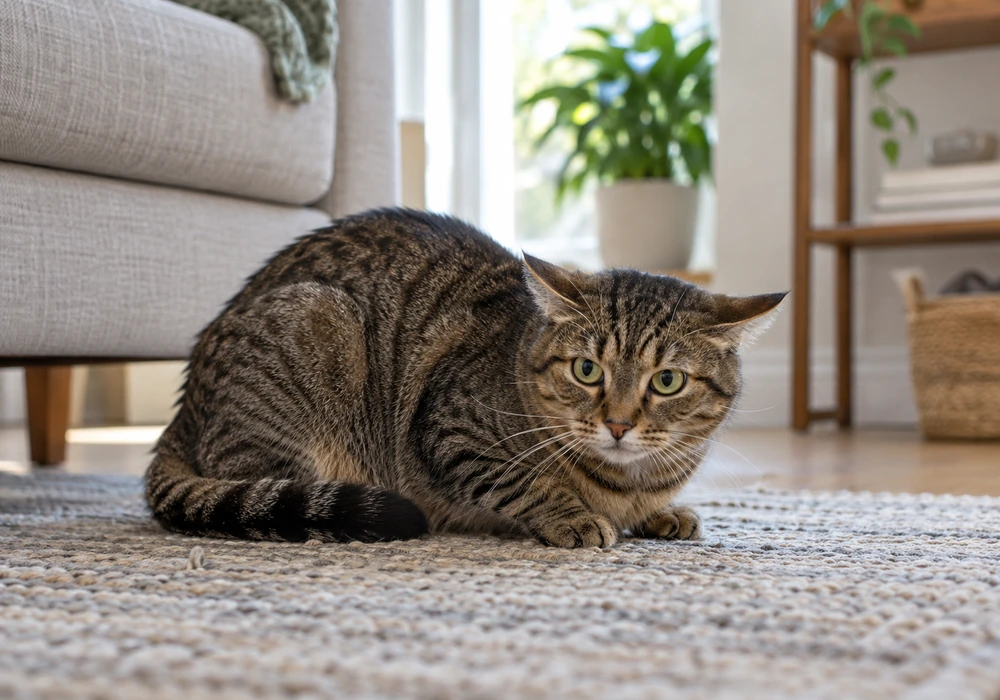
A frightened cat may crouch close to the ground, draw its head toward its shoulders, and hold its tail tightly against its body. The cat may appear ready to retreat even though it has not moved.
A comfortable resting cat can also tuck its paws or curl its tail around itself. Look for body tension, watchfulness, avoidance, and a change when someone approaches. Crouching can also accompany pain, so a new posture should not automatically be labeled fear.
3. Leaning away or turning the head during contact
A small shift away from your hand may be an early sign that an interaction is uncomfortable. Your cat might turn its head, pull back slightly, or stop approaching when you reach toward it.
This can mean the cat wants less contact, without establishing exactly why. Stop touching and leave room to move away. If the cat later approaches voluntarily, that is useful information; it does not mean you should immediately resume the same handling.
4. Changes in ear position and eye appearance
Ears may rotate sideways or backward as a cat becomes uncomfortable. With stronger distress, they may flatten closer to the head. Wide eyes and enlarged pupils can accompany heightened alertness, while whiskers may be held more tightly or change position.
These features need context. Ears also turn to follow sounds, and pupils enlarge in dim light or during play. A cat with large pupils, a tense crouch, and a retreating movement gives you more information than pupil size alone. Observe from a distance rather than moving closer to inspect the face.
5. Hiding more or avoiding familiar routes
Hiding can be a normal way to sleep or take a break. What deserves attention is a change: staying under the bed much longer, leaving when a familiar person enters, or avoiding a hallway that the cat previously used freely.
Look for what happens along that route. A visitor, loud appliance, or another cat may make the space difficult to use. Keep a safe retreat available while checking actual food intake and litter-box use. Making a litter box shows how placement keeps the tray reachable for every cat.
6. Abrupt grooming or repeated lip licking during an interaction
A cat may suddenly lick its coat, lick its lips, yawn, or turn away when an encounter becomes uncomfortable. Sometimes these are displacement behaviors: ordinary actions appearing during a situation in which the cat has conflicting motivations.
The timing matters more than the action alone. Grooming after a nap is different from repeatedly stopping contact to lick. Pause the interaction and observe. Repeated lip licking outside that setting, persistent overgrooming, hair loss, or skin damage needs veterinary attention; nausea, oral discomfort, and skin conditions can produce similar signs.
7. Quiet changes in meals, play, and social contact
A cat may come out only after everyone leaves, stop joining familiar play sessions, or wait to eat until another cat moves away. These changes can reveal difficulty coping even when there is no obvious confrontation.
In a household with several cats, watch for staring or blocking at doorways and essential resources. A lack of fighting does not guarantee easy access to food or litter boxes. Reduced appetite, withdrawal, and changes in toileting can also have medical causes. Helping a cat gain weight describes the assessment a cat needs when it is eating poorly and losing condition, so record these changes rather than attributing everything to fear.
Read the Whole Body in Context
Fear is a response to a perceived immediate threat. Anxiety concerns an anticipated or uncertain threat. Stress is the body’s broader response to a challenge. These states can overlap; you cannot reliably separate them by looking at one ear movement or facial expression.
Look for a cluster of signs and compare it with your cat’s usual behavior. Consider the trigger, the cat’s ability to leave, and what happens after you reduce the pressure.
For example: your cat stops moving, turns its ears sideways, and leans back when a visitor reaches down. Asking the visitor to stop and sit farther away gives the cat room to respond. The observation is more useful than deciding the cat is “shy” from its appearance.
Hissing, growling, swatting, and raised fur are more noticeable signs of distress. They may reflect fear, frustration, or pain. Cats do not follow a fixed progression from quiet signals to a hiss or bite, so act on the earlier signs you notice. When a hiss appears without an obvious cause, hissing for no apparent reason sets out the triggers worth reviewing.
When Fearful Behavior Needs Veterinary Attention
Signs of fear in cats can resemble signs of pain, and both may occur together. A cat may resist handling because it hurts, or remain withdrawn after an apparent trigger has gone. Changes in eating, movement, grooming, or litter-box habits deserve particular attention.
| What you notice | What to do |
|---|---|
| A clear trigger, with normal meals, movement, and litter use between episodes | Reduce the trigger and allow a retreat. Seek advice if episodes recur or interfere with daily life. |
| New or persistent hiding, poor appetite, sensitivity to touch, or changed movement or toileting | Contact your veterinarian promptly. Do not wait for a home training plan to resolve a possible health problem. |
| Labored breathing or open-mouth breathing at rest | Seek emergency veterinary care. Cornell’s guidance on breathing difficulty in cats explains why prompt assessment matters. |
| Repeated straining with little or no urine | Seek emergency care for possible urinary blockage. Do not assume the cat is merely frightened or avoiding the litter box. |
Facial appearance cannot reliably tell you that a cat is afraid rather than in pain. The Feline Grimace Scale helps assess acute, or short-term, pain; it is not a fear test and does not rule out chronic painful conditions. A veterinarian should interpret behavioral and physical signs together.
Respond Without Adding Pressure
If there is no medical emergency or immediate danger, stop the interaction and give your cat space. Let the cat recover before deciding whether to try again.
- Pause the demand. Stop reaching, petting, grooming, or approaching. Do not punish a hiss or hold the cat until it stops resisting.
- Increase distance. Move back calmly, reduce noise, and keep other people or cats from following. Leave a clear route away.
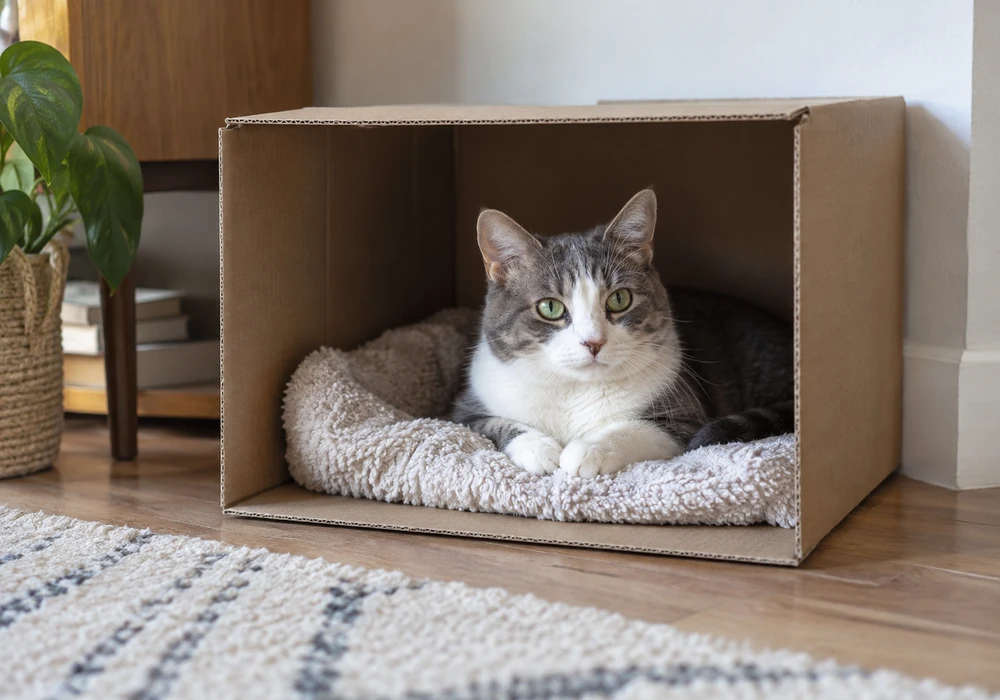
- Keep a safe retreat available. Offer a covered bed, cardboard box, or another familiar hiding place. Keep essentials accessible, and avoid reaching inside to pull the cat out for reassurance.
- Watch what happens next. Observe breathing, movement, and the return of ordinary activity. If the cat needs emergency care, arrange transport and call the clinic for handling advice; do not delay care to see whether the cat settles.
The 2022 AAFP/ISFM Cat Friendly Veterinary Interaction Guidelines emphasize responding to the individual cat’s emotional state and preserving a sense of control. Staying still during an examination does not, by itself, show that a cat is comfortable.
Reduce Everyday Triggers at Home
To reduce recurring fear, match the adjustment to what you observe. For visitors, prepare a quiet retreat before they arrive. For household conflict, provide separate resource locations and routes so one cat cannot control another’s access. Keep routines predictable, preserve some familiar bedding, and avoid unnecessary strong fragrances. Cat stress relief at home walks through more quiet retreats and separate places for resources.
Once health concerns have been addressed, gradual learning may help with a specific task. Desensitization means exposing a cat to a trigger at an intensity low enough that it remains comfortable, then increasing the challenge gradually. Counterconditioning pairs that manageable experience with something the cat values.
For example, begin grooming practice with the brush visible at a comfortable distance, without touching. Reward voluntary interest if the cat wants the reward. Later steps might involve a small brush movement and eventually one brief stroke. If the cat ducks, stiffens, or leaves, pause the session. Resume at an easier step only after it is comfortable again. Accepting food does not prove that the handling is comfortable. Gentle cat grooming covers brushing technique and the tools that suit a cat who dislikes handling.
Repeated exposure that overwhelms the cat is not the same as gradual practice. If fear is persistent, severe, or makes necessary care unsafe, ask your veterinarian for qualified behavior support. Tell the clinic when distress begins before a visit; any pre-visit medication needs an individual prescription and clear instructions.
Track Comfort and Everyday Behavior
Look for a looser posture, voluntary movement, normal meals and litter use, and the ability to rest or return to ordinary activity after an event. Choosing to remain nearby without being touched may be meaningful progress.
A basic cat care routine makes changes in meals, activity, and litter use easier to compare. Keep a short record of the trigger, the exact behavior, what you changed, and how the cat recovered. A brief video can help your veterinarian if you can record a naturally occurring episode without approaching or prolonging it.
Less noise or less movement is not enough to establish improvement. If your cat becomes quieter while hiding more, eating less, or avoiding essential resources, reassess the plan with your veterinarian.
This article draws on our own experience of living with cats and the published behavior and veterinary guidance cited above; it is not a diagnosis. Quiet behavior can be fear, pain, or both, so a change in eating, movement, grooming, or litter use deserves a veterinary check rather than a training plan alone. Seek emergency care the same day for labored or open-mouth breathing at rest, repeated straining that produces little or no urine, or a cat that cannot be handled without signs of severe pain.