
Start with a flavor your cat already accepts. These five recipes for natural cat biscuits combine plain cooked meat or fish with egg and finely ground oats. Each one gives weighed ingredients, a full preparation sequence, and an internal-temperature check, so you can bake a batch and portion it consistently.
These baked treats are intended as occasional rewards for healthy adult cats. Keep portions small, and continue feeding a complete and balanced diet appropriate for your cat’s life stage. If baking is more effort than you want, our guide to homemade cat treats that need no oven covers simpler options.
Choosing Ingredients for Natural Cat Biscuits
“Natural” here describes the ingredients only. It does not establish that a treat is safer, cleaner, or nutritionally better than a commercial one. These mixtures do not supply the balance of nutrients a cat needs as a main diet, so keep regular meals complete and balanced for your cat’s life stage.
Ask your veterinarian before offering these recipes to a kitten, a pregnant or nursing cat, or a cat with a prescribed diet, food allergy, weight problem, diabetes, kidney or urinary disease, or recurring digestive trouble. Every recipe contains whole egg and oats, including those named for turkey, salmon, or beef. A kitten’s needs differ enough that treats designed for adults are not automatically suitable; our guide to prepared cat food for kittens explains what growing cats require.
Use fresh, plain ingredients. Leave out onion, garlic, leeks, chives, seasoning powders, gravy, and flavored broth; heat does not destroy the compounds that make onion-family ingredients a risk to cats, so cooking them into a batch does not make them safe. Remove bones, skin, and eggshell. These recipes need no added oil, salt, sugar, sweeteners, dairy, or supplements.
For the listed quantities, weigh meat and fish after cooking, oats while dry, and egg without its shell. Beat a whole raw egg before weighing the amount needed; “half an egg” is not a consistent measurement.
Before Baking Natural Cat Biscuits
Set out a gram scale, food processor or sharp knife, mixing bowl, spatula, parchment-lined baking sheet, and a thin-tip food thermometer suitable for shallow foods. Have small, clean storage containers ready before you begin. Wash your hands with soap and water for at least 20 seconds before and after preparation. Clean food-contact surfaces and utensils, and keep raw meat and egg separate from cooked food and finished treats.
Cook poultry to 165°F (74°C), ground beef to 160°F (71°C), or fin fish to 145°F (63°C), measured internally with a food thermometer rather than judged by color. For the fifth recipe, hard-boil the additional egg until both the white and yolk are firm. These figures match the safe minimum internal temperatures in the FDA’s food-handling guidance, which also notes that color and texture are unreliable indicators of safety.
Do not offer any uncooked mixture; all five recipes use raw egg as a binder. These formulations are not kitchen-tested, so the baking time and yield are estimates. Use an internal-temperature check to confirm the mixture is cooked.
Five Recipes to Try
Each batch is divided into 40 approximately equal portions for the calorie estimates below. A portion is a measuring unit, not a recommended mouthful; break it into smaller fragments before serving.
1. Chicken and Oat Biscuits
Estimated batch: 244 kcal · About 6.1 kcal per 1/40 batch
These natural cat biscuits are a straightforward starting point if your cat already eats chicken, egg, and oats without problems.
Ingredients
- 80 g plain roasted chicken breast meat, cooked, skinless, and boneless
- 25 g beaten raw whole egg
- 20 g plain dry oats, finely ground
- Optional: 5–15 g water, added only as needed
Mix and bake
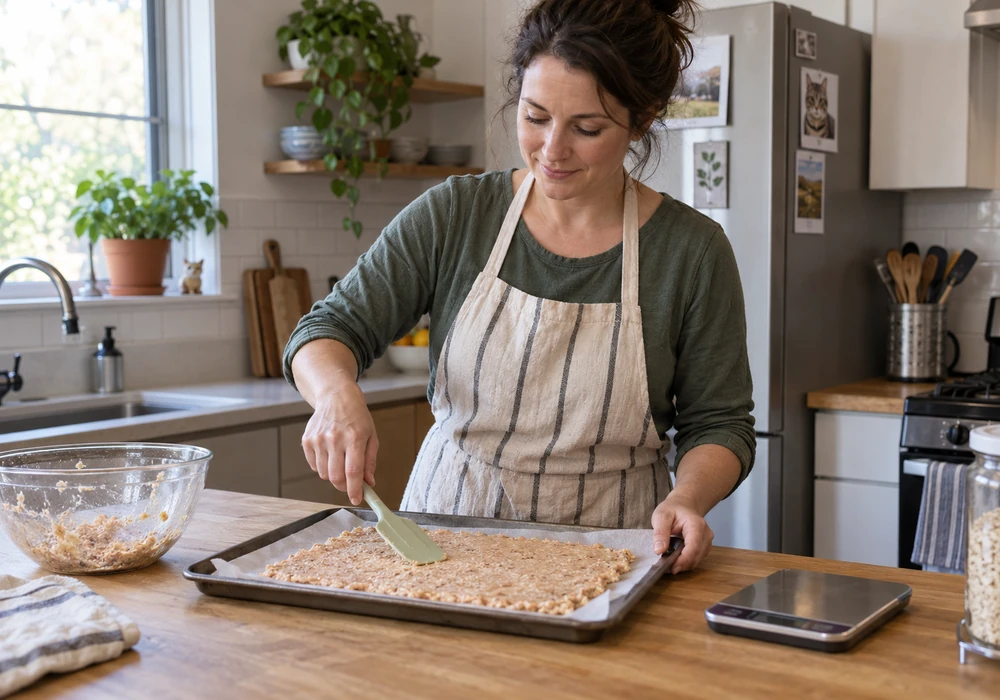
Process the chicken finely, removing long fibers or tough pieces. Mix with the egg and ground oats. If it remains crumbly, begin with 5 g water and add a little more only as needed, up to 15 g.
- Shape the mixture. Preheat a conventional oven to 350°F (175°C). Spread the mixture about ¼ inch (5–6 mm) thick on a parchment-lined baking sheet. Lightly score five rows and eight columns to mark 40 approximately equal portions.
- Bake and check the temperature. Begin checking around 20 minutes; 20–25 minutes is an estimate, not a guaranteed cooking time. The mixture should be set and reach at least 165°F (74°C) internally in several places. Insert a suitable thin probe sideways into the center of the layer without touching the tray. Browning and firmness do not confirm that the center is cooked.
- Divide and refrigerate. Separate along the scored lines and transfer to clean, shallow containers. Let heavy steam escape briefly, then refrigerate promptly; do not wait for the whole batch to become completely cold on the counter. Cool the serving before offering it, and break each measured portion into smaller fragments.
Check the thin layer accurately. The final 165°F (74°C) check applies household guidance for leftovers and mixed dishes to this combination of cooked ingredients and raw egg. If your thermometer cannot measure the thin layer reliably, use a suitable thermometer or choose a simpler, fully cooked treat.
Texture tip: Finer chopping may help the mixture hold together. Do that before adding extra oats, which would change the formulation and calorie estimate.
2. Turkey and Pumpkin Biscuits
Estimated batch: 236 kcal · About 5.9 kcal per 1/40 batch
Pumpkin adds moisture to the turkey mixture. Its role in this recipe is texture, not treatment for constipation, diarrhea, or hairballs.
Ingredients
- 80 g plain roasted turkey breast meat, cooked, skinless, and boneless
- 25 g beaten raw whole egg
- 20 g plain dry oats, finely ground
- 20 g plain canned pumpkin with no added salt or other ingredients
- Optional: up to 5 g water
Mix and bake
Finely process the turkey. Mix in the egg and pumpkin, then the oats. Let the oats absorb moisture briefly before deciding whether to add water, up to 5 g.
- Shape the mixture. Preheat a conventional oven to 350°F (175°C). Spread the mixture about ¼ inch (5–6 mm) thick on a parchment-lined baking sheet. Lightly score five rows and eight columns to mark 40 approximately equal portions.
- Bake and check the temperature. Begin checking around 20 minutes; 20–25 minutes is an estimate, not a guaranteed cooking time. The mixture should be set and reach at least 165°F (74°C) internally in several places. Insert a suitable thin probe sideways into the center of the layer without touching the tray. Browning and firmness do not confirm that the center is cooked.
- Divide and refrigerate. Separate along the scored lines and transfer to clean, shallow containers. Let heavy steam escape briefly, then refrigerate promptly; do not wait for the whole batch to become completely cold on the counter. Cool the serving before offering it, and break each measured portion into smaller fragments.
Check the products: Use plain pumpkin, not pumpkin pie filling. Deli turkey, brined turkey, and meat served with stuffing or gravy are unsuitable substitutes.
3. Salmon and Oat Biscuits
Estimated batch: 276 kcal · About 6.9 kcal per 1/40 batch
Salmon flakes readily into the mixture. These natural cat biscuits have the highest estimated calories per portion of the five, so the same number of pieces is not an equal-calorie swap.
Ingredients
- 80 g plain Atlantic farmed salmon, baked or roasted, cooked weight with skin and bones removed
- 25 g beaten raw whole egg
- 20 g plain dry oats, finely ground
- Optional: up to 5 g water
Mix and bake
Separate the cooked salmon under good light and check carefully for fine bones. Mash with the egg, then add the oats. Add up to 5 g water only if needed; the fish may provide enough moisture.
- Shape the mixture. Preheat a conventional oven to 350°F (175°C). Spread the mixture about ¼ inch (5–6 mm) thick on a parchment-lined baking sheet. Lightly score five rows and eight columns to mark 40 approximately equal portions.
- Bake and check the temperature. Begin checking around 20 minutes; 20–25 minutes is an estimate, not a guaranteed cooking time. The mixture should be set and reach at least 165°F (74°C) internally in several places. Insert a suitable thin probe sideways into the center of the layer without touching the tray. Browning and firmness do not confirm that the center is cooked.
- Divide and refrigerate. Separate along the scored lines and transfer to clean, shallow containers. Let heavy steam escape briefly, then refrigerate promptly; do not wait for the whole batch to become completely cold on the counter. Cool the serving before offering it, and break each measured portion into smaller fragments.
Keep the calculation in context: The estimate uses cooked Atlantic farmed salmon. Other species, added oil, or a different preparation change the calories. Do not use smoked, salted, or sauced salmon.
4. Lean Beef and Carrot Biscuits
Estimated batch: 256 kcal · About 6.4 kcal per 1/40 batch
Finely crumbled beef and smoothly mashed carrot make a different texture from the poultry versions. The carrot should be soft throughout, with no hard chunks.
Ingredients
- 80 g plain cooked ground beef, made from 95% lean/5% fat beef and broiled as an unseasoned patty
- 25 g beaten raw whole egg
- 20 g plain dry oats, finely ground
- 15 g carrot, boiled without salt, drained, and mashed smooth
- Optional: up to 5 g water
Mix and bake
Crumble the cooked beef very finely. Combine with the smoothly mashed carrot, egg, and oats. Add up to 5 g water only if needed to make a thick, spreadable mixture.
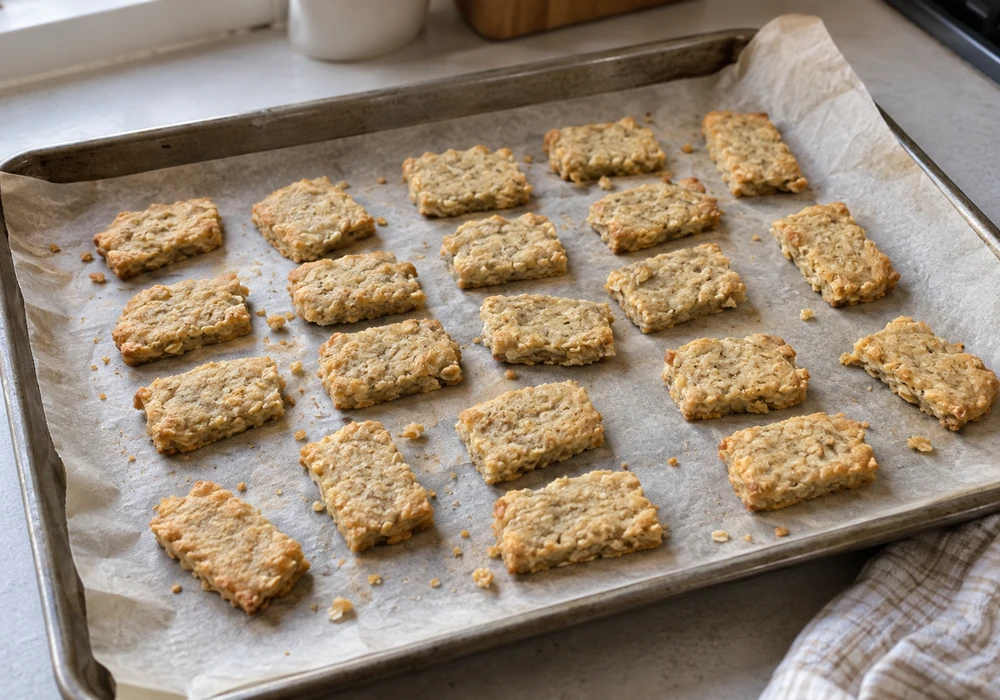
- Shape the mixture. Preheat a conventional oven to 350°F (175°C). Spread the mixture about ¼ inch (5–6 mm) thick on a parchment-lined baking sheet. Lightly score five rows and eight columns to mark 40 approximately equal portions.
- Bake and check the temperature. Begin checking around 20 minutes; 20–25 minutes is an estimate, not a guaranteed cooking time. The mixture should be set and reach at least 165°F (74°C) internally in several places. Insert a suitable thin probe sideways into the center of the layer without touching the tray. Browning and firmness do not confirm that the center is cooked.
- Divide and refrigerate. Separate along the scored lines and transfer to clean, shallow containers. Let heavy steam escape briefly, then refrigerate promptly; do not wait for the whole batch to become completely cold on the counter. Cool the serving before offering it, and break each measured portion into smaller fragments.
Use the specified beef: A different fat percentage changes the calorie estimate. Avoid seasoned burgers, sausages, onion powder, and flavored pan drippings.
5. Chicken and Cooked-Egg Biscuits
Estimated batch: 233 kcal · About 5.8 kcal per 1/40 batch
This formulation uses cooked egg as an ingredient and a separate amount of raw egg to hold the mixture together during baking.
Ingredients
- 50 g plain roasted chicken breast meat, cooked, skinless, and boneless
- 25 g hard-boiled whole egg, shell removed, with firm white and yolk
- 25 g beaten raw whole egg, measured separately
- 20 g plain dry oats, finely ground
- Optional: up to 10 g water
Mix and bake
Mash the cooked egg finely and process the chicken into short, fine pieces. Combine both with the separately weighed raw egg and oats. Add up to 10 g water gradually, only if needed to make a thick, spreadable mixture.
- Shape the mixture. Preheat a conventional oven to 350°F (175°C). Spread the mixture about ¼ inch (5–6 mm) thick on a parchment-lined baking sheet. Lightly score five rows and eight columns to mark 40 approximately equal portions.
- Bake and check the temperature. Begin checking around 20 minutes; 20–25 minutes is an estimate, not a guaranteed cooking time. The mixture should be set and reach at least 165°F (74°C) internally in several places. Insert a suitable thin probe sideways into the center of the layer without touching the tray. Browning and firmness do not confirm that the center is cooked.
- Divide and refrigerate. Separate along the scored lines and transfer to clean, shallow containers. Let heavy steam escape briefly, then refrigerate promptly; do not wait for the whole batch to become completely cold on the counter. Cool the serving before offering it, and break each measured portion into smaller fragments.
Measure both egg portions: The cooked egg does not replace the raw egg used as a binder. Egg white alone is also different from the whole egg specified here.
Serving Natural Cat Biscuits in Small Portions
Keep all treats and other nutritionally incomplete extras combined below 10% of your cat’s established daily calorie intake, or within a stricter limit set by your veterinarian. Working out that budget for a specific cat is covered in our guide to how many treats a cat can have. Include toppers, table food, commercial treats, and food used for medication. Fit them into the day’s total rather than adding them to a full allowance of regular food. The VCA cat-treat guide explains why these extras need to remain a small part of the diet.
A portion example
For a cat whose established intake is 200 kcal a day, all extras should total less than 20 kcal. Two chicken-and-oat portions provide about 12.2 kcal. Breaking each into four fragments gives eight small rewards, still totaling 12.2 kcal.
Three salmon portions would provide about 20.7 kcal—already above that example’s ceiling, before counting any other treats. The 200 kcal figure is an illustration, not a calorie prescription for your cat.
The estimates use USDA ingredient-composition data for the specified foods. They are not laboratory measurements of the finished biscuits or of the energy a cat absorbs. Uneven mixing, ingredient variation, and food left in the processor add uncertainty. Dividing a batch into 20 pieces instead of 40 approximately doubles the calories per piece.
For portions measured by weight, divide estimated batch calories by the fully cooled batch weight in grams, then multiply by the grams served. Baking removes water, so it changes calories per gram without removing the batch’s calculated calories.
Begin with a tiny fragment of one recipe while keeping normal meals familiar. Let your cat choose whether to eat it, and supervise chewing. Do not withhold meals to encourage interest. If you prefer to skip baking, our simple homemade cat-treat guide covers soft pieces, flakes, and other straightforward preparations.
How to Store Natural Cat Biscuits
These meat-and-egg biscuits remain perishable, even if the edges feel dry or crisp. Their moisture has not been measured or controlled to establish room-temperature storage. Keep the clean batch chilled and take out only the amount needed.
| Storage step | What to do |
|---|---|
| After baking | Refrigerate promptly in shallow containers. Do not exceed 2 hours at room temperature, or 1 hour if the air is above 90°F (32°C). These are outer limits, not waiting targets. |
| Refrigerated supply | Keep covered at 40°F (4°C) or below. Plan to use within 3 days of preparation, provided the ingredients were fresh and safely handled. |
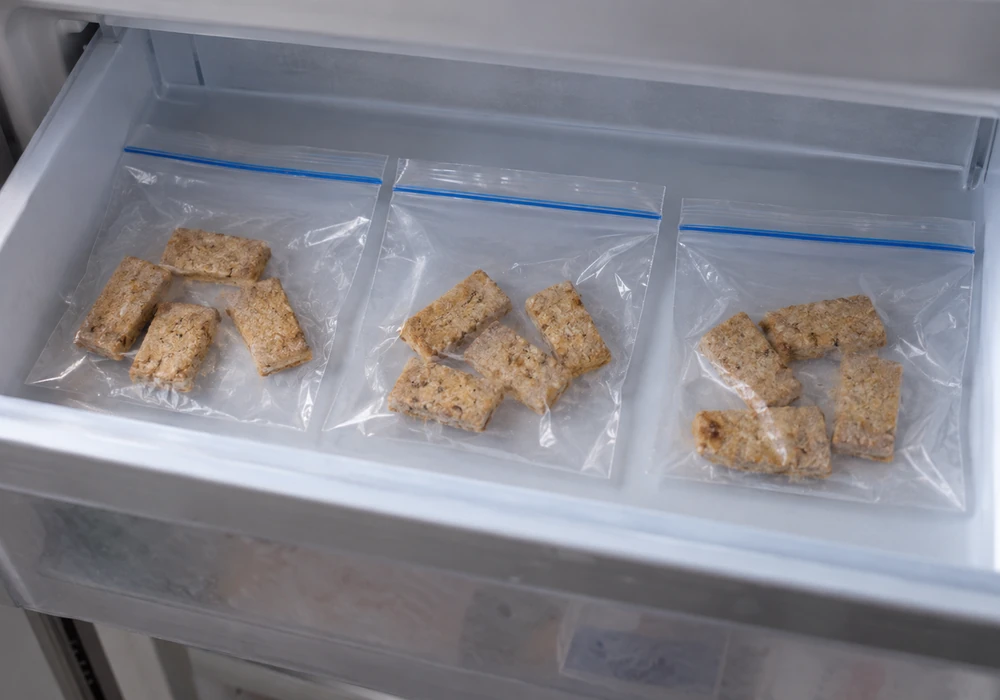
| Spare portions | Freeze promptly in small, sealed portions at 0°F (−18°C). Aim to use within 1 month for quality. Thaw only a small amount in the refrigerator. |
| After serving | Discard uneaten fragments exposed to saliva. Never return them to the clean supply, and wash the serving dish and utensils. |
The FDA’s storage guidance supports the appliance temperatures and time limits above. The three-day refrigerator plan and one-month freezer quality target are conservative planning choices for these untested formulations, not measured shelf lives or guarantees.
Label each batch with the recipe, preparation date, freezing date if applicable, and estimated calories per portion. If you are unsure whether a cat is well enough to try a new food at all, our overview of cat health covers the signs worth raising before you change anything. Use clean utensils, keep the main supply cold, and avoid repeatedly warming and chilling it. Baking does not reset the storage history of older cooked meat, and freezing cannot rescue spoiled or improperly stored food. Discard a batch if its handling history is uncertain; a normal smell does not prove it is safe.
Common Questions About Natural Cat Biscuits
What if the mixture is crumbly or too wet?
For a crumbly mixture, mince the meat more finely and add water gradually within the recipe’s range. For a wet mixture, check the ingredient weights, drain the cooked carrot thoroughly, and give the oats time to absorb moisture. Do not improvise large additions of oats or oil while continuing to use the original calorie estimate.
Should the biscuits be crunchy?
No. Baking natural cat biscuits harder does not establish dental benefits or make them shelf-stable. Do not offer hard, sharp pieces or charred edges. Break a cooled portion into manageable fragments; if it is too tough for your cat to eat comfortably, choose a softer treat.
Can I substitute another meat or flour?
A substitution changes moisture, binding, and calories. The original estimates and baking behavior no longer apply. For a cat with dietary restrictions, ask your veterinary team for a suitable reward rather than treating a short ingredient list as an allergy-safe recipe.
What if my cat gets an upset stomach?
Stop the new treat and record the ingredients, amount, and timing. Our guide to when cat diarrhea needs veterinary attention explains which patterns can wait and which cannot. Contact your veterinarian for repeated or persistent vomiting or diarrhea, blood, unusual tiredness, or reduced interest in meals. Trouble chewing or swallowing also needs assessment. Breathing difficulty is an emergency; do not force more food or water into the mouth.
These recipes come from our own kitchen and from published food-safety guidance; they are general information, not a veterinary or nutritional prescription, and no home-baked treat replaces a complete diet. Stop the treat and call your veterinarian if a cat vomits repeatedly, has diarrhea lasting more than a day, refuses meals, seems listless, or has trouble breathing or swallowing — breathing difficulty is an emergency.