
How many treats can a cat have? For routine feeding, keep all nutritionally incomplete extras together below 10% of your cat’s appropriate daily calories. Then use the calories in the actual product to work out the portion. Five tiny pieces and five large bites can mean very different amounts of food.
Treats are optional. A smaller allowance leaves more of the day’s nutrition to an appropriate complete diet, and some medical plans restrict the foods you can offer. Here is how to turn that general rule into a portion you can measure.
A quick example: If your cat’s agreed daily target is 200 kcal, the 10% boundary is 20 kcal. Five 2-kcal treats provide 10 kcal, or 5% of that target. Ten would use the entire boundary, leaving no room for other extras. This is an arithmetic example, not a calorie prescription for every cat.
How Many Treats Can a Cat Have Under the 10% Rule?
The veterinary-authored VCA cat-treat guide puts the general rule at 90% of daily calories from complete and balanced food and the remaining 10% from treats and snacks. AAHA’s 2021 nutrition guidelines treat calories from non-complete foods above 10% of daily intake as a risk factor, because they dilute essential nutrients. For everyday planning, treat 10% as an upper boundary and aim lower rather than trying to fill it.
This is a calorie limit, not a percentage of the food’s weight or the number of meals. It also does not establish that every snack is suitable. An excluded ingredient can disrupt an allergy trial even when its calorie contribution is tiny.
First, establish your cat’s total daily energy target with the veterinary team. Age, activity, body condition, health, and measured intake all matter. A heavier cat does not automatically need a bigger allowance, particularly when the extra weight is body fat.
How Many Treats Can a Cat Have? Work Out the Amount
You need three numbers: the total daily calorie target, a chosen allowance for extras, and the calories per piece or gram. Include any snacks already planned before counting additional treats.
- Find the boundary. Multiply the appropriate daily calorie target by 0.10.
- Choose a smaller working allowance. Follow any lower veterinary limit, then subtract calories allocated to other extras.
- Divide and round down. Divide the remaining calories by the calories per whole treat. If nothing remains, do not add more.
The examples below use a chosen 5% allowance and uniform 2-kcal pieces, with no other extras. The 5% choice illustrates modest portions; it is not a separately proven safety threshold.
| Daily calorie target | 10% boundary | Whole 2-kcal pieces within 5% |
|---|---|---|
| 150 kcal | 15 kcal | 3 pieces = 6 kcal |
| 200 kcal | 20 kcal | 5 pieces = 10 kcal |
| 250 kcal | 25 kcal | 6 pieces = 12 kcal |
| 300 kcal | 30 kcal | 7 pieces = 14 kcal |
How Many Treats Can a Cat Have When Mixing Snacks?
Suppose your cat’s daily target is 200 kcal and you choose a 15-kcal allowance for extras. A measured portion of paste supplies 6 kcal, leaving 9 kcal. Four 2-kcal pieces add 8 kcal, bringing extras to 14 kcal, or 7% of the daily target. Five pieces would exceed the chosen 15-kcal plan.
If those extras are used, the arithmetic leaves 186 kcal for the appropriate complete food. However, matching the total alone does not prove that the whole diet meets your cat’s nutritional needs. Keep extras modest instead of repeatedly shrinking meals to make room for more snacks.
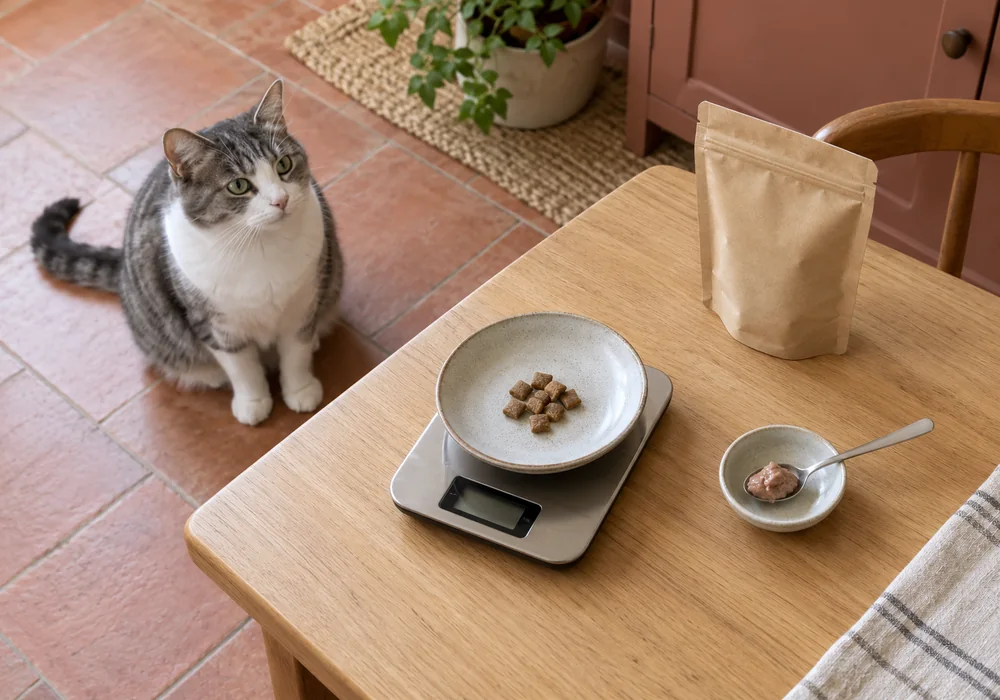
Find the Calories in the Amount Actually Eaten
Read the calorie statement, not just the feeding suggestion. AAFCO’s calorie-label guidance explains that kcal/kg is expressed “as fed,” including the product’s water. A familiar-unit value, such as kcal per piece or tube, makes portion calculations easier.
If the label gives 4,000 kcal/kg, divide by 1,000 to get 4 kcal/g. A 12-kcal allowance would therefore cover 3 g. These are hypothetical values; use your actual product and a scale capable of measuring such a small portion reliably.
For a 12-kcal tube, half supplies 6 kcal if divided evenly. Counting squeezes is less dependable. Likewise, irregular dried chunks may vary too much for an accurate piece count. Ask the manufacturer for usable calorie information when it is missing or unclear.
“Low Calorie” Does Not Mean Unlimited
Small numbers still add up. If a label says “less than 2 kcal,” using 2 kcal for cautious budgeting is reasonable, but it is not an exact measured value. Do not calculate a precise energy value from guaranteed minimum protein and fat alone.
Dental treats also count. Follow the exact product’s directions; dividing it or feeding less may change its intended benefit. If the directed portion conflicts with the diet, ask about another dental-care option.
What Counts Toward Your Cat’s Treat Limit?
Add commercial snacks, lickable pastes, toppers, table food, and edible pill carriers. Include food from every person, not just what reaches the usual bowl. Supplements can contribute calories and may also contain active ingredients with separate limits.
There is one useful distinction: appropriate complete food reserved from an already measured daily ration stays part of that ration when you give it as a reward. Do not serve the original full meal as well. This changes how food is delivered without adding nutritionally incomplete extras.
The FDA explains that treats, snacks, and supplements are often not complete and balanced, because they are not intended to be a pet’s sole diet. Check the nutritional adequacy statement and life stage rather than judging by shape or the word “treat.” Even a complete maintenance food may be unsuitable as a replacement for a prescribed diet.
Give the Household One Daily Allowance
Once you know how many treats your cat can have, make that portion visible. Set aside the day’s dry allowance in a small, clean container and record wet portions separately. Everyone uses the same allocation instead of reaching into the main bag.
Record the product, amount, calories, and person feeding it. In a multi-cat home, keep separate portions and supervise access when one cat steals another’s food. An empty container means the planned snack allowance has been used; an unfinished allowance does not need to be used up tomorrow.
Also track normal meals and leftovers. If weight rises or meals are increasingly left uneaten, review the whole day with the veterinary team. Monitor body and muscle condition as well as weight.

How Many Treats Can a Cat Have During Training?
Plan the food allowance before the session, then use small, easily consumed rewards. Dividing an ordinary suitable food piece can create more reward moments without changing its original calories. Do not apply that approach to medication or a product whose intended effect depends on its shape or dose.
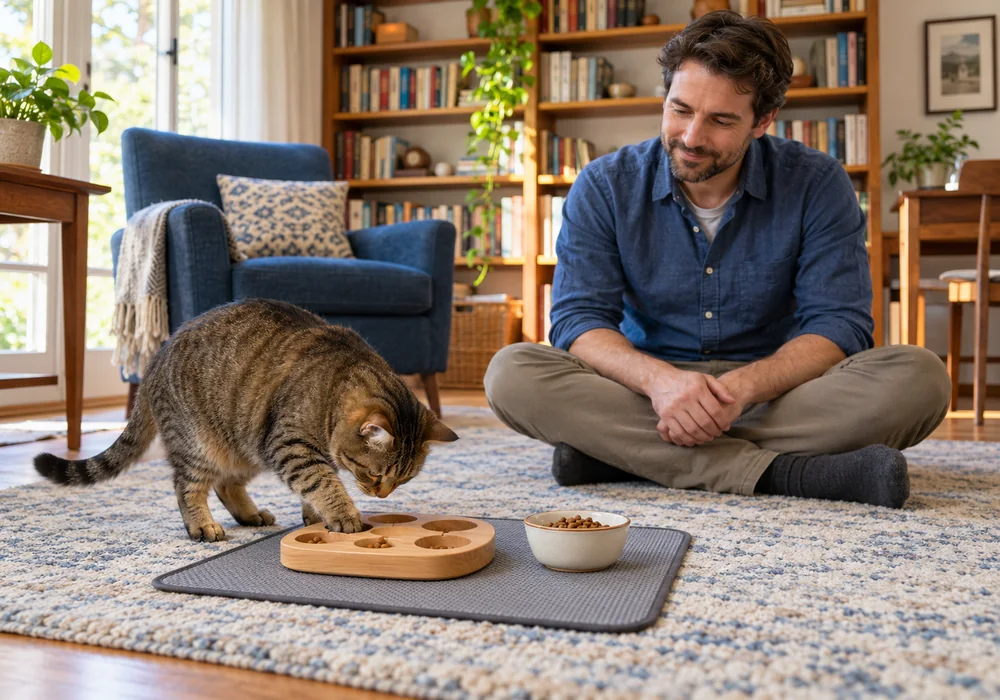
Where practical, reserve food from the appropriate main ration for an easy puzzle, carrier practice, or another voluntary activity. Timing a reward well takes a little practice, and training a kitten walks through reward timing and manageable steps; the quantity still comes from that kitten’s own feeding plan.
Keep regular meals available as planned and stop when the cat withdraws or becomes distressed. Food should not be used to push through uncomfortable handling. Play and welcomed attention may be rewarding too, and a puzzle does not justify extra calories on the assumption that the cat has burned them off.
Choose a Suitable Treat Before Choosing the Amount
When deciding how many treats a cat can have, consider texture, ingredients, and processing alongside calories. A soft bite is not necessarily lower in calories than a crunchy one. A moist paste contributes water, but a whole pouch may supply more energy than one tiny dry piece.
Meat-only, natural, and freeze-dried descriptions do not establish nutritional completeness or pathogen control. Freeze-drying is not cooking. Avoid raw or undercooked animal-source snacks, bones, and foods containing onion, garlic, chocolate, caffeine, alcohol, or raw yeast dough.
For a healthy cat without a relevant restriction, a tiny portion of plain, fully cooked, boneless food may be an option. Use calorie data matching the cooked edible portion; sauces and added fat change the calculation. If you would rather prepare a batch yourself, simple homemade cat treats covers suitable ingredients and small-batch amounts.
How Many Treats Can a Cat Have on a Special Diet?
A general percentage cannot approve a food for a medical diet. Kidney disease, diabetes, weight management, and allergy trials can change the permitted ingredients, nutrient composition, or amount. Have the exact product assessed against the complete feeding plan; cat health collects the conditions that most often change a diet.
During an elimination diet trial, unapproved snacks, toppers, supplements, and pill carriers can interfere with the assessment. “Single protein” does not automatically make a retail treat compatible. Discuss flavored medicines with the veterinarian rather than stopping prescribed treatment yourself.
Growing Kittens Need Their Own Feeding Plan
Do not copy an adult calorie target when working out how many treats a kitten can have. Growth requires an appropriate complete diet, and extras can fill a small stomach before necessary food is eaten. Reserve suitable growth food for rewards when practical and ask about other options. For the growth diet itself, prepared cat food for kittens sets out what it has to provide, and kitten treats works through portions for a cat that is still growing.
Similarly, a weight-loss plan should preserve adequate nutrition. Cutting ordinary meals drastically to protect a generous treat habit is not a balanced weight-management strategy.
Store Small Portions Properly
Accurate portions still need sound food handling. FDA storage guidance recommends retaining the original packaging, keeping dry food cool and dry below 80°F, and securing treats against raids. Wash and dry reusable storage containers between batches.
Promptly refrigerate unused wet food at 40°F or below, following the product’s after-opening directions. If you plan to save part of a paste, dispense the serving onto a clean dish instead of letting the cat lick the stored portion. Do not assume all opened tubes have the same storage life.
Wash hands and clean food-contact dishes, scoops, and puzzle surfaces after use. Discard spoiled food or compromised packaging rather than relying only on the printed date.
When the Treat Routine Needs Veterinary Attention
A cat eating snacks but refusing normal meals may still have pain, nausea, or illness. Contact your veterinarian promptly when meaningful food intake stops or falls substantially. Do not withhold all food until the cat “gives in,” and do not fast it to compensate for yesterday’s extras.
Stop a new extra and record the amount, ingredients, and storage history if vomiting or loose stool follows it. Repeated signs, poor appetite, or a generally unwell cat need assessment; timing alone does not diagnose an allergy. Stool changes that need a same-day call are flagged in cat diarrhea and when to worry. A new or marked increase in hunger deserves the same attention rather than an automatically larger allowance, and increased appetite in cats explains why that is worth investigating.
If a whole package is eaten, keep it and estimate the amount. Seek veterinary advice, especially when active supplements, hazardous ingredients, swallowed packaging, or symptoms are involved. Breathing difficulty, collapse, or suspected choking requires immediate care.
Ultimately, how many treats a cat can have comes down to a suitable food, a measured portion, and one agreed daily plan. Keep the extras modest, protect the main diet, and adjust the routine to the individual cat.
Disclaimer: this article draws on our own experience feeding cats and on published veterinary and nutritional guidance; it is not a nutritional prescription for your cat, and the calorie figures are worked examples rather than targets to feed toward. If your cat stops eating, vomits repeatedly, has diarrhea for more than a day, is breathing with effort, or has collapsed, contact a veterinarian rather than adjusting the portion yourself.