
Blue eyes, darker points, a silky semi-long coat, and a substantial frame are the most recognizable Ragdoll cat characteristics. Many Ragdolls also enjoy gentle company and seem relatively relaxed. However, affection may mean following you into another room rather than settling on your lap. Understanding the breed means looking at both its distinctive appearance and the preferences of the individual cat.
This guide explains the body type, colors, coat, and personality behind the Ragdoll reputation, then connects those traits with grooming, household fit, and health checks. A breed description helps you prepare; the cat’s behavior and records help you decide what care it needs.
Ragdoll Cat Characteristics at a Glance
- Build: a long, muscular body, broad chest, sturdy legs, and a full, plumed tail.
- Eyes and face: blue eyes and a broad head with softly rounded contours.
- Coat: silky, semi-long fur with relatively little woolly undercoat; regular checks and combing still matter.
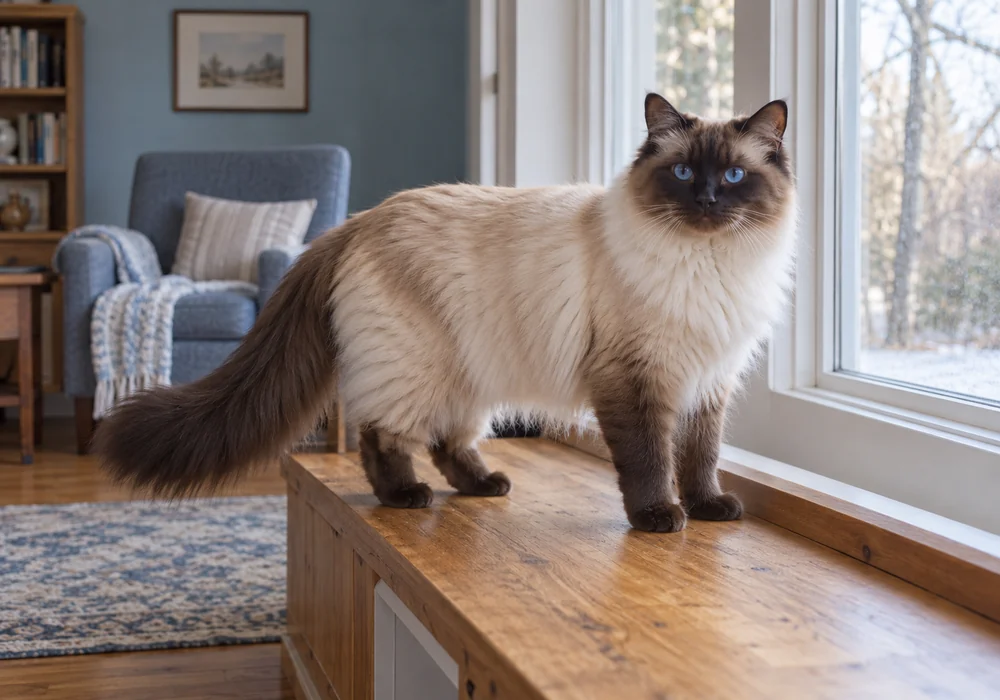
- Color: darker ears, face, legs, and tail against a lighter body, sometimes with white markings over that pattern.
- Personality: often affectionate and relatively calm, with individual differences in play, confidence, and handling preferences.
- Care commitment: a suitable diet, comfortable grooming, equipment that fits, daily interaction, and veterinary follow-up.
The Ragdoll Look: Build, Blue Eyes, and a Silky Coat
The breed began with Ann Baker’s selection of domestic longhaired cats in California during the 1960s. Today’s Ragdoll has a substantial outline: a long torso, broad chest, sturdy bone structure, and a tail with a generous plume. The head forms a broad modified wedge, with moderate ears and large blue eyes.
Size is one of the Ragdoll cat characteristics that affects practical care. TICA’s breed profile describes adult females at roughly 10–15 pounds and males at 15–20 pounds, or about 4.5–6.8 kg and 6.8–9.1 kg. These descriptive ranges are not feeding targets. Healthy individuals can differ, and a veterinarian should assess weight alongside fat cover and muscle condition. Our guide to large cat breeds sets these figures beside other substantial breeds.
Ragdolls mature slowly and may take up to four years to reach full size. That does not mean a growing cat should receive unlimited food. Follow growth and body condition rather than trying to produce the heaviest possible adult.
The coat flows along the body, with longer hair around the neck ruff and hindquarters. Relatively little woolly undercoat helps create its silky feel, but texture does not guarantee freedom from tangles. Seasonal changes and the individual cat’s ability to groom also affect the coat. For how coat length translates into routine care across breeds, see our long-haired cat breeds guide.
Ragdoll Cat Characteristics: Colors and White Patterns
A color name and a pattern name describe different things. Seal means deep brown points; blue means a diluted gray tone. Neither name tells you where white markings appear. “Blue mitted,” for example, combines a point color with a white-marking pattern.
| Pattern | What you typically see | Useful distinction |
|---|---|---|
| Colorpoint | Darker extremities, a lighter body, and no white spotting | The dark paws help distinguish this pattern from mitted cats. |
| Mitted | White front mitts, hind boots, a white chin, and a belly stripe | Small facial blazes can occur; the pattern differs from bicolor. |
| Bicolor | More extensive white, usually including an inverted V on the face | White markings overlay the underlying point pattern. |
CFA also recognizes a high-white Van pattern. Its principal point colors include seal, blue, chocolate, lilac, red, and cream, with lynx and tortie variations. Lynx describes tabby markings; tortie describes mixed-color markings. Registry standards do not all use identical categories.
The point contrast has an inherited biological basis. Temperature-sensitive pigment production associated with variants of the TYR gene produces more pigment in cooler extremities than in warmer body areas. Hair length involves different genes, including FGF5. These features explain appearance; they do not let you diagnose temperature, circulation, or general health from a photograph.
What about “mink Ragdolls”? TICA’s breed-group standard, which took effect on May 1, 2025, recognizes one Ragdoll Breed Group with two designations. Ragdoll (RD) covers blue-eyed pointed cats in the colorpoint, mitted, and bicolor patterns. Cherubim (CB) covers mink, sepia, and solid (sometimes called traditional-color) cats in those same three patterns. Structure, coat length, and temperament standards are identical; only coat color and eye color differ, and a single litter can contain both. Ask which registry and which breed designation the paperwork uses, because a familiar advertising label may not match a current show category.
Blue eyes, a fluffy tail, and pointed markings cannot establish pedigree on their own. Likewise, a white marking outside a show specification does not make a cat an inferior companion or establish a health problem.
Ragdoll Personality: Affection With Individual Preferences
Ragdolls have an affectionate, relatively quiet reputation. Some greet familiar people, move between rooms with them, or rest within reach. Others prefer brief petting followed by their own seat. Young Ragdolls can be lively, and an easygoing adult still needs play, exploration, and chances to retreat.
A 2019 study of breed-related behavior used owner questionnaires covering 5,726 cats in its main dataset. Ragdolls belonged to a cluster with relatively low aggression, extraversion, and fearfulness, and the breed’s heritability estimates, 0.40 for the shyness traits and 0.53 for aggression, sat at the two ends of the study’s overall range. Those findings describe group tendencies. Owner reporting, sampling, upbringing, and the home environment limit predictions about one cat.
“Less extroverted” does not mean unfriendly, and a relaxed reputation does not promise lap-sitting. Ask a caregiver what the cat actually does: does it approach for touch, sit nearby, join a game, or leave when visitors arrive? Our comparison of companionable cat breeds explains how different interaction styles can still form satisfying relationships.
The breed name also needs perspective. Some Ragdolls relax during comfortable handling, but not every cat goes limp. Support the body when lifting is necessary and stop optional handling if the cat becomes tense or tries to leave. Never dangle, drop, or restrain a cat to test its “floppiness.”
What Ragdoll Cat Characteristics Mean for Your Home
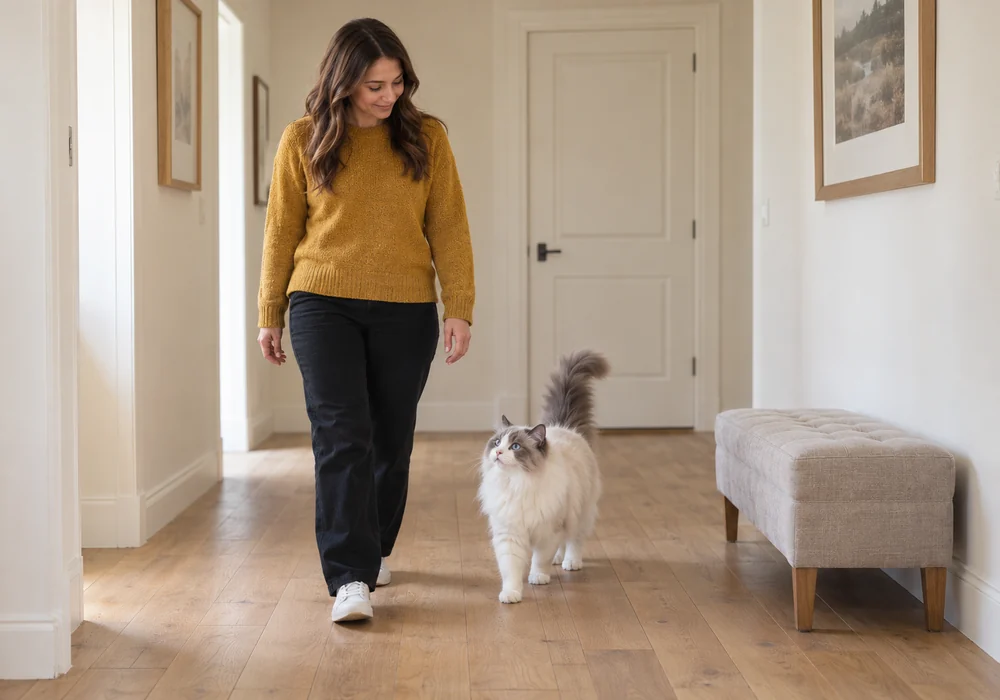
A calm, sociable individual may suit an apartment or a quieter family home, provided the environment meets normal feline needs. Floor area alone tells you little: the cat needs usable resting spots, hiding places, scratching surfaces, play, and easy access to food, water, and litter.
- With children: supervise gentle interaction and give the cat a clear escape route. A tolerant reputation does not justify chasing or forced carrying.
- With resident cats: assess each animal’s history and introduce them gradually from separate starting spaces. Peaceful coexistence can be a good outcome even without a close bond.
- During workdays: arrange reliable feeding, cleaning, play, and observation. Ask how the individual handles ordinary absences; another cat is not an automatic solution.
- For equipment: check carrier space, litter-box access, platform size, and furniture stability against the actual cat. A “large cat” label does not establish a good fit.
Choose secure windows and enclosed outdoor options if you offer outside access. Friendliness or a quiet personality does not make unrestricted roaming safe.
Coat Care for a Ragdoll
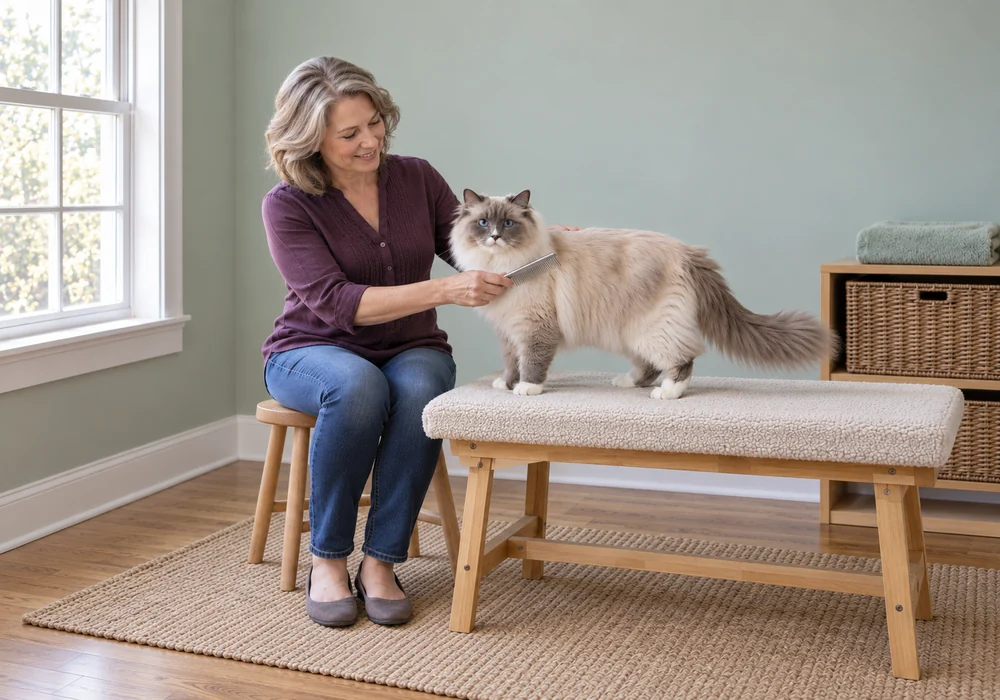
Check the coat briefly each day for loose tangles, soiling, or tenderness. Some breed profiles suggest combing once or twice weekly, while general longhair guidance recommends daily grooming. Use the actual coat to set the frequency: new knots mean the routine needs adjustment.
Start with a short session in a quiet place. Use a suitable comb with smooth teeth, work in small sections, and stop if it catches or pulls the skin. Pay particular attention to friction areas, including behind the ears, under the front legs, and around the hindquarters, while respecting the cat’s handling limits.
Do not cut mats out with scissors. Skin can lie inside tightly tangled fur, and pulling can hurt. Ask a veterinarian or experienced cat groomer for help with tight, extensive, or painful matting. Our guide to grooming cats gently covers tool introductions and combing technique in detail.
Most healthy adult cats with fur do not need routine baths, and a long coat does not automatically require summer shaving. Follow veterinary advice when skin treatment or extensive matting changes the plan. Repeated vomiting or frequent hairballs also deserve assessment rather than an assumption that long hair explains everything.
Ragdoll Cat Characteristics and Health Checks
Appearance and temperament do not establish health. Hypertrophic cardiomyopathy, or HCM, causes abnormal thickening of heart muscle and is an important screening discussion for Ragdolls. The Ragdoll-associated MYBPC3 R820W variant differs from the A31P variant commonly tested in Maine Coons.
- An R820W DNA test identifies that specific inherited variant. Two copies carry particularly high risk; discuss a positive result and its implications with your veterinarian. A negative result does not exclude every cause of HCM.
- An echocardiogram lets a veterinarian assess heart structure and function at the time of the examination. A normal scan cannot guarantee that disease will never develop.
- Clinical history and examination help the veterinarian decide what assessment and follow-up the individual needs. Some cats with heart disease initially show no obvious signs.
Cornell’s cardiomyopathy guidance explains the role of heart ultrasound and clinical assessment. Ask for actual laboratory and cardiac-screening reports with animal identities and dates, rather than accepting “HCM clear” without knowing which check supports the claim.
Seek emergency veterinary care for rapid or labored breathing or sudden painful weakness or paralysis. These signs can indicate serious disease, including cardiac complications. Do not wait for a routine appointment or a genetic result.
Everyday preventive care matters too. A 2025 VetCompass study drew a random sample of 2,025 Ragdolls from the 21,358 of the breed recorded in UK practice data for 2019. It recorded periodontal disease in 8.84% (95% confidence interval 7.60–10.08), diarrhea in 7.11% (5.99–8.23), obesity in 6.91% (5.81–8.02), and overgrown nails in 5.68% (4.67–6.69). These are recorded annual frequencies, not lifetime risks, and the authors did not compare the breed with non-Ragdoll cats in the same dataset, so the figures do not by themselves establish that Ragdolls have higher risk than other cats.
Use those findings to prioritize oral care, body-condition checks, stool observation, and claw inspection. Introduce daily toothbrushing gently with feline products and seek assessment for mouth pain or eating changes. Check claws on a routine so they cannot curl into the pads; our guide to cat nail trimming covers handling and how often to look. Note how often stools are loose rather than waiting months, because when cat diarrhea needs veterinary attention sets out the signs that should not wait. New withdrawal, poor grooming, or reduced movement needs attention; “laid-back” should describe a familiar pattern, not explain a sudden change.
Choosing a Ragdoll With Realistic Expectations
Meet the individual and ask about its usual play, contact preferences, grooming tolerance, and health history. If pedigree matters to you, match the cat to its registration and ancestry records. Ask a breeder about relevant parental tests, cardiac screening, affected relatives, and how the kitten grew up.
A rescue may honestly lack ancestry records while still providing useful observations and current veterinary information. Our questions to ask before buying a cat guide explains how to review the records, support arrangements, and remaining care without relying on an attractive advertisement.
The most useful way to understand Ragdoll cat characteristics is to connect them with care you can sustain: a coat you can maintain comfortably, a home that supports normal feline behavior, and a relationship that respects the cat’s choices.
Common Questions About Ragdolls
Are Ragdolls Hypoallergenic?
No reliable breed-wide guarantee exists. Ragdolls shed, and cat allergens come from sources including saliva and skin. Coat length or softness does not establish allergy safety. Anyone with significant allergy or asthma should discuss the decision with an allergy specialist.
Do Ragdolls Need a Special Breed Diet?
Not as a universal rule. Choose a complete diet appropriate to age and health, measure portions, include treats in the allowance, and review body and muscle condition with your veterinarian. Do not increase food simply to reach a breed-profile weight, and do not impose severe restriction on a growing kitten.
How Long Do Ragdolls Live?
There is no individual deadline. Among 133 deaths in the UK study described above, the median age at death was 12.85 years. That statistic describes the study’s recorded deaths, not a guaranteed lifespan or the remaining years of an adult cat. Plan for ongoing care and reassess needs as your cat ages.
This article draws on what we have learned living with cats of our own as well as on the published sources cited above, and it cannot replace a veterinary examination. Contact a veterinarian promptly for rapid or labored breathing, sudden painful weakness or paralysis, a cat that stops eating, repeated vomiting or frequent hairballs, or a coat that suddenly becomes matted, greasy, or neglected.