
A cat’s tongue is built to catch hair. Most of the hair a cat swallows leaves the body in the stool. A cat swallowing a hairball is the same process one step further along: hair collects in the stomach faster than it can move into the intestine. That sentence explains why the useful fixes are unglamorous. You can influence both sides of it. Less loose fur goes in, the gut moves it along more steadily, and you look at the skin or digestive conditions that quietly push both numbers the wrong way.
The short version
- An occasional hairball in a healthy cat is normal clearance. Grooming and free access to water cover it; you need no product.
- Recurring hairballs call for work on intake and transit. They also call for a look at fleas, itchy skin, overgrooming, or gut disease. A gel hides the symptom without touching any of those.
- Pattern changes need a veterinarian, not a remedy. That covers unproductive retching, weight loss, blood, or a first-ever hairball in an older cat.
What Actually Helps a Cat Swallowing a Hairball, Ranked by Risk
Almost every discussion of a cat swallowing a hairball names the same five approaches. They are not interchangeable, though, and the evidence behind them differs sharply. Plain physiology backs the first. A single two-week trial backs the second. Drug labeling alone backs the third, and that label carries no efficacy data at all. The order below is by risk rather than popularity, because risk is what matters when you decide what to try first.
| Approach | What it does | Best fit | Limits and risks | Evidence |
|---|---|---|---|---|
| Grooming and deshedding | Lifts loose undercoat before it can be swallowed | Every cat; essential with long or dense coats | Only works if it is regular; does nothing for skin or gut disease | Clear rationale, no trials |
| Higher-fiber food or supplement | Insoluble fiber adds bulk and is thought to speed stomach emptying; soluble fiber holds water and firms stool | Cats with repeated episodes | No public efficacy data for commercial hairball diets; some cats refuse the food | One small 14-day study of a psyllium and slippery elm chew |
| Lubricant gel or paste | Petrolatum and mineral oil coat hair strands so they slide on instead of matting | Short courses for an occasional episode | Aspiration risk if syringed; hides the cause; sold as an unapproved animal drug in the US | Label only, no public efficacy data |
| Cat grass | Insoluble fiber, plus a possible behavioral effect on hair evacuation | Enrichment, not treatment | Can trigger vomiting in some cats; response varies widely | One 2025 behavioral study |
| Prokinetic drugs | Improve gastric emptying | Diagnosed motility disorder, under veterinary direction | Prescription only; side effects; cisapride is not licensed for cats | Clinical use in selected cases |
Hairball grooming and deshedding: cutting the intake
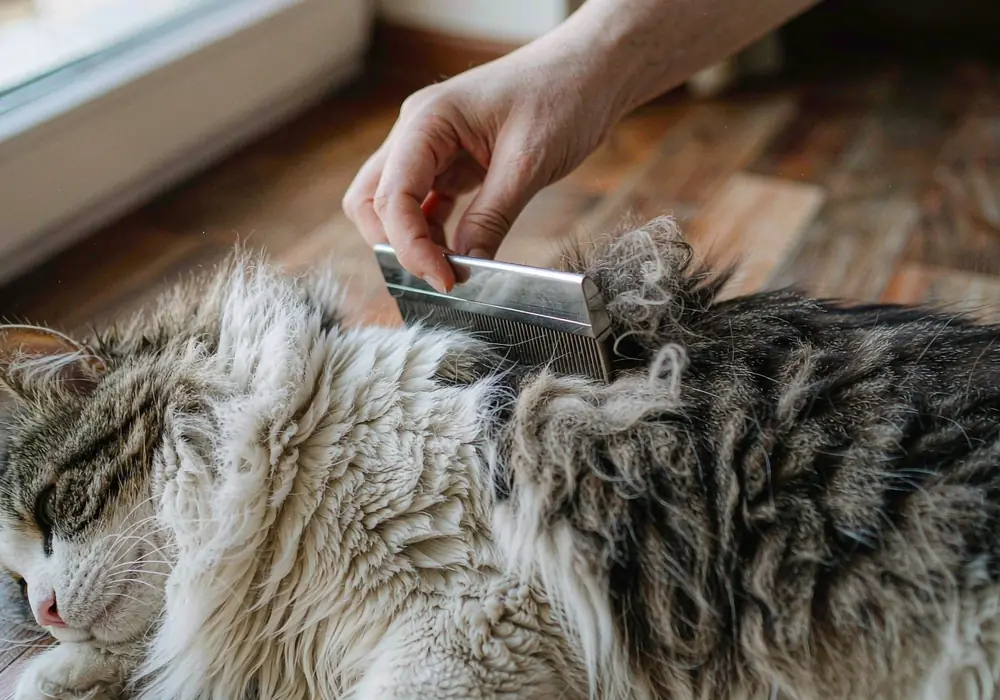
Grooming is the only intervention here with a mechanism you can watch working. Hair that you comb out and throw in the trash cannot mat in a stomach. Removing the loose undercoat is the cleanest way to cut the input side of the problem, and a cat swallows hair every day, so that side keeps refilling. Longhaired cats gain most from this step, because owner surveys put their incidence at roughly twice that of shorthaired cats. Our guide to grooming cats at home covers tool choice and handling in detail. The hairball-specific version is simple: consistency matters more than the tool.
Higher-fiber food and hairball supplements
Fiber has the second-best rationale and the thinnest trial base. Insoluble fiber adds fecal bulk, and researchers think it helps the stomach empty. Soluble fiber such as psyllium holds water and normalizes stool. The most-cited supporting study gave a psyllium and slippery elm chew for two weeks. It reported a 29% drop in combined hairball signs. Vomiting itself did not fall significantly, and that is the outcome most owners actually care about. Commercial hairball-control diets have no published efficacy data. One patent filing names a 1–25% fiber range, but that range describes a protected formulation space rather than a tested dose.
Hairball gels and lubricant pastes
Lubricant gels do something real and mechanical. A cat neither digests nor absorbs petrolatum, so it coats hair and lets the strands slip onward. What is missing is controlled evidence that this changes clinical outcomes. In the United States, sellers generally market these products as unapproved animal drugs. Their safety and effectiveness, says the FDA, remain unestablished. The official label for one widely sold hairball gel states that plainly. That same label also notes no one has proven safe use in pregnant or breeding cats.
The one rule that is not negotiable: never syringe mineral oil or liquid paraffin into a cat’s mouth. Inhaled oil can cause lipid pneumonia. That condition is severe, difficult to treat, and entirely avoidable. Smear a gel on the nose or a paw instead, and let the cat lick it off. No home situation makes the syringe the right delivery method. If a cat will not take a gel, skip it rather than force it.
Grass, hairball treats, and prokinetics
Cat grass and prokinetics sit at opposite ends of the scale. Grass is enrichment that happens to add fiber. A 2025 study lends support to a long-standing idea: plant eating helps cats purge ingested hair. That explains the behavior rather than proving a treatment. Prokinetics are real medication for a diagnosed motility disorder. They have no place in a household hairball routine.
A Hairball Routine That Fits an Ordinary Week
Most plans for a cat swallowing a hairball fail on the third Tuesday, not because they were wrong but because they asked for twenty minutes a day. What follows is deliberately small enough to keep.
A hairball grooming and feeding routine
- Groom to the coat, not to the calendar. Two or three short sessions a week suit most shorthaired cats. Long or dense coats need daily combing, with more during the spring and autumn shed. Use a tool with smooth, rounded metal teeth that reaches the undercoat. Check behind the hind legs and under the belly, where mats start quietly. If your cat has a heavy coat, the profiles in our guide to long haired cat breeds explain which coats need what.
- Split the day’s food into smaller meals. A stomach that faces one large meal empties more slowly, and slow emptying is one of the two conditions that let hair mat. Three or four smaller portions do more for transit than any over-the-counter product. They also cost nothing.
- Keep water where the cat already goes. Hydration supports gut motility. A cat drinks more from a bowl beside a favorite sleeping spot than from one in a laundry room. Wet food counts toward fluid intake.
Hairball fiber, gel, and a written record
- Add fiber only if you can say what you added. Plain canned pumpkin, one teaspoon, or a vet-approved psyllium product is a reasonable start. A “hairball control” kibble is a bigger change with thinner evidence. Transition over a week, and stop if the stool turns loose or the cat refuses the bowl.
- Keep a lubricant gel for occasional use, and read the label. A typical label directs half to one teaspoon for two to three days. It then moves to a quarter to half a teaspoon two or three times a week. The same label lists one teaspoon as 6 g. If you use an oil product daily for months, leave at least one meal a day free of it. Long-term oil use may reduce absorption of fat-soluble vitamins.
- Write the episode down. Record the date, whether hair actually came up, and anything different about the stool. Six weeks of two-line notes will tell a veterinarian more than a memory of “it happens a lot”.
Why Hair Collects in the Stomach at All
Backward-facing barbs cover a cat’s tongue. These filiform papillae catch loose hair and push it toward the throat. Grooming is not a hobby. In one observational study, researchers watched five female cats across 360 hours. Grooming took an average of 3.6 hours a day, close to a quarter of their waking time. So hair swallowing is continuous. Because hair is keratin, a cat cannot digest it. Most of it simply travels the length of the gut and leaves in the stool.
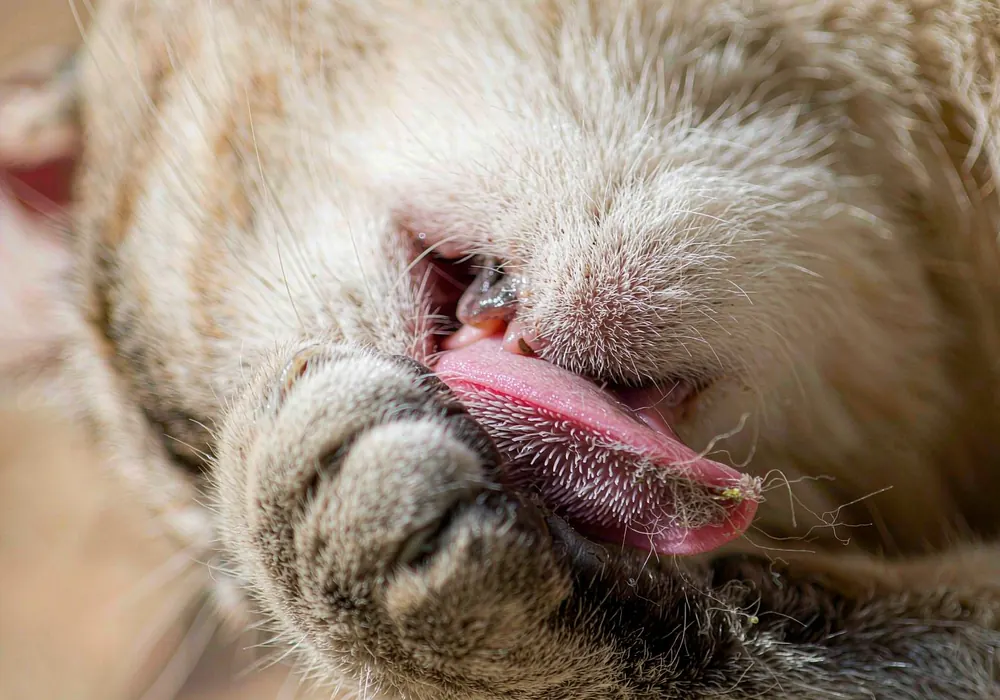
A hairball forms when the arrival rate at the stomach exceeds the departure rate. Cats also appear to have weak interdigestive “housekeeper” contractions. These waves sweep indigestible debris out of the stomach between meals. Because they are weak, cats may clear hair less well than other species do. Once strands mat, the mass is a trichobezoar. Owners recognize the tube shape because a narrow esophagus squeezes it on the way out.
Two consequences follow, and they explain why hairball advice keeps circling the same two levers. Fleas, an itchy skin disease, pain, or anxiety all increase grooming, and more grooming means more intake. On the departure side, chronic dietary intolerance, inflammatory bowel disease, and chronic stress all slow the upper gut; our guide to cat diarrhea and when to worry covers the stool changes that go with them. A retained mass can also mineralize into a tricholith. That is larger, harder, and harder to pass or bring up. This is also why repeated episodes are often a behavioral or dermatological case wearing a digestive costume. A cat that produces hairball after hairball is showing you the messenger, not the disease. Our article on helping a stressed cat covers the overgrooming side. That side is easy to miss, because the visible result is hair on the floor.
How Often Hairballs Appear Before It Is a Problem
No one has validated a number. Any source that hands you one is quoting a convention rather than a threshold. The figure usually cited comes from a review of hairballs in cats, which draws on owner surveys at a cat-only practice. About 10% of otherwise healthy shorthaired cats vomit hairballs regularly. The study defined “regularly” as two or more episodes a year. An accompanying editorial in the same journal cites approximately 10% of healthy cats independently. That strengthens the order of magnitude without turning it into a population estimate.
Practice advice is far looser. A Colorado State University veterinary teaching hospital article describes expecting hairballs once or twice a week before flagging a problem. That threshold is between roughly 25 and 50 times more permissive than the survey definition of “regular”. The gap is not a scandal. It is what happens when a common nuisance has never been studied properly. What it does mean is that the more reliable signal is change from your cat’s own baseline. A cat that has produced one hairball each spring for six years is a different patient from a cat that began producing them weekly in March.
Hairballs in Kittens
Hairballs are rare enough in kittens that you should not write off vomiting in a young cat as one. A kitten’s coat is short, its grooming is still developing, and it spends more time playing than washing. Vomiting in a kitten needs a veterinarian to look for the likelier explanations first. The list includes intestinal parasites, a sudden diet change, an infectious cause, or something swallowed during exploration. Kittens also dehydrate faster than adults because of their size, so a day of vomiting costs them more. Gentle brushing is worth starting early as a handling habit. Whether a kitten should ever take a hairball gel is a question for a veterinarian, not something to work out from a label.
Hairballs in Adult Cats
For a healthy adult between roughly one and eight years old, a seasonal hairball or two is ordinary, and the 10% survey figure describes this group. Watch the pattern tied to coat turnover: more episodes in spring and autumn, fewer in between. A stable seasonal pattern needs grooming and nothing else. If you are still working out what ordinary looks like after the first one, our breakdown of a cat’s first hairball walks through it.
Hairballs in Senior Cats
In cats over about ten, a new or accelerating pattern is a diagnostic clue rather than a coat problem. That includes a cat that now produces hairballs more often than it did last year. Chronic gastrointestinal disease, hyperthyroidism, kidney disease, and dental pain all change either how much a cat grooms or how well its gut moves, and our cat health section groups the conditions that most often sit behind a new pattern. They can push the pattern in either direction. Some older cats overgroom because of pain and swallow more hair. Others groom less and develop mats instead. Weight loss alongside increasing hairballs deserves an examination with bloodwork, not another tube of gel. If the weight is already coming off, our guide to helping a cat gain weight sets out what to raise at that appointment.
Why Dog Hairball Advice Does Not Fit a Cat
Dog guidance does not transfer. Dogs groom themselves, and long-coated dogs can accumulate hair. But the cat-specific pieces here have no canine equivalent. One is a barbed tongue built to rake out undercoat. Another is a species-typical grooming load of several hours a day. Weak housekeeper contractions are a third. A grooming drive and a tongue anatomy that dogs do not share are what push the hair-swallowing behavior higher in cats. Products sold for both species carry separate directions and doses. A fiber plan built for a dog is not a fiber plan for a cat. If a label lists dogs and cats together, read the cat column or ask before you use it.
When a Cat Swallowing a Hairball Means Something Else
Most hairball episodes need nothing but grooming. A minority are the visible edge of something that no product will fix. The distinction usually sits in the pattern rather than in the hairball itself.
Reading the hairball pattern
| What you are seeing | What it usually means | What to do |
|---|---|---|
| A hairball every few weeks in shedding season, cat well | Seasonal coat turnover | Keep grooming; change nothing else |
| Episodes increasing over weeks or months | More hair going in, or slower movement through the stomach | Book an examination; start year-round flea control; bring the log |
| Repeated retching that produces nothing | Possible obstruction in stomach, intestine, or throat, or a respiratory problem | Same-day veterinary assessment; never give a gel to force passage |
| Vomiting without hair, or with blood | Stomach or systemic disease rather than retained hair | Veterinary examination; stop assuming the hairball explanation |
| Visible hair in the stool with fresh blood, cat otherwise well | Hair-related colitis, where a large hair load inflames the colon lining | Mention it at the next visit; review grooming and fiber rather than adding oil |
| First hairball ever in a cat over ten | Often the earliest visible sign of underlying disease | Examination with the history of when it started |
Obstruction is rare, and it is the only reason this article bothers with red flags at all. A 2023 multicenter case series describes 44 cats with surgically managed gastrointestinal trichobezoars, identified among 667 cats operated on for a gastrointestinal foreign body at six specialty practices. That picture shows the severe tail of the distribution rather than what a cat swallowing a hairball usually produces. Because obstruction is rare, it gets missed in both directions. Owners wait too long on a genuine blockage, and cats with asthma get treated for hairballs for months.
Hairball red flags that need a same-day call
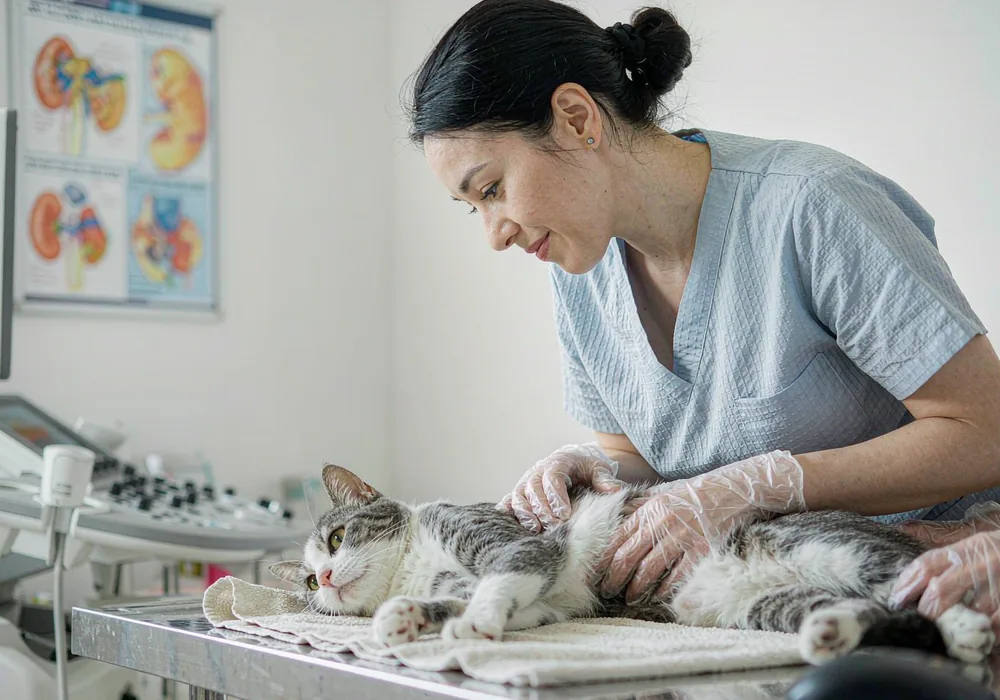
Seek veterinary advice promptly for any of the following:
- Frequent or unproductive retching, especially when no hair comes up
- Vomiting without hair, or vomiting with blood
- Weight loss, appetite change, or unusual tiredness
- Constipation, abdominal pain, or a swollen, tense abdomen
- Fresh blood in the stool, or a sudden change in bowel habit
- Difficulty breathing, coughing, or sneezing with nasal discharge
- Any change in how often the episodes happen
That last item sounds vague, and it is the one most worth acting on. Owners describe vomiting as “coughing up a hairball” so routinely that genuine respiratory disease gets filed under hairballs for months. Watch for wheezing, a stretched-out neck, or effort that comes from the chest rather than the belly. That is not a hairball, and the earlier you sort it out the better.
Disclaimer: this article draws on our own experience living with cats and on published veterinary reviews and product labeling; it is not a diagnosis for your cat. If your cat retches without producing anything, brings up blood, loses weight, breathes with effort, or has a swollen and painful abdomen, contact a veterinarian the same day rather than trying another remedy.