
Playing with kitten toys works best when you move a catchable lure away from your kitten, pause for stalking, and let them grab it. Start with a few minutes on a clear, nonslip floor, keep hands and feet out of the game, and stop when your kitten loses interest or becomes uncomfortable.
A wand, an intact ball, or a sturdy soft toy can turn that simple pattern into several different games. Let your kitten choose whether to join in. You are building a pleasant shared routine, not testing how high they can jump or how long they can keep going.
- Before: check the toy, clear the floor, and leave a retreat available.
- During: invite, pause, and allow catches.
- After: slow down, store interactive toys securely, and allow a quiet break.
Editorial status: Prepared with AI assistance; source information checked October 20, 2026. This article has not received independent veterinary review. It provides general education, not an individual health assessment.
Playing With Kitten Toys: Five Games to Try
Match the game to what your kitten enjoys doing: stalking, batting, carrying, gripping, or searching. Begin with one option rather than scattering every toy around the room. That makes it easier to notice which movement holds their attention; if you are still gathering supplies, our guide to a new kitten kit lists the items worth having before your kitten arrives.
| Game | How to start | What to check |
|---|---|---|
| Wand stalk and pounce | Drag a soft lure away, pause behind a box, then let the kitten catch it. | Supervise closely; put the entire wand and line away afterward. |
| Ball and tunnel | Roll an intact ball a short distance beside an open tunnel. | Choose a ball too large to swallow and a tunnel that cannot trap the kitten. |
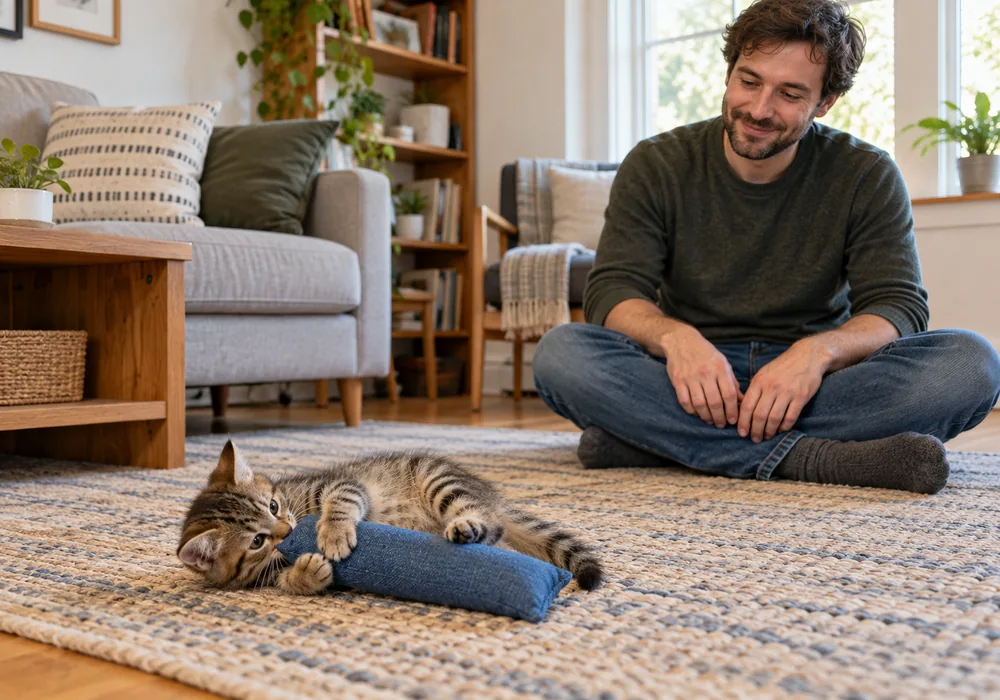
| Soft kicker | Place a sturdy fabric toy within reach for gripping and hind-foot kicking. | Keep fingers away; remove toys with loose threads or exposed filling. |
| Short roll or fetch | Roll a suitable toy across clear floor space. Repeat if the kitten brings it back. | Retrieval is optional. Do not chase the kitten to recover the toy. |
| Easy food search | For a weaned kitten eating independently, offer familiar food in an easy, stable puzzle. | Use part of the normal ration; make food readily accessible. |
These are starting options, not a ranking of safe products. Construction and your kitten’s chewing habits matter. If they tear off pieces or swallow material, remove that item rather than assuming supervision makes it suitable.
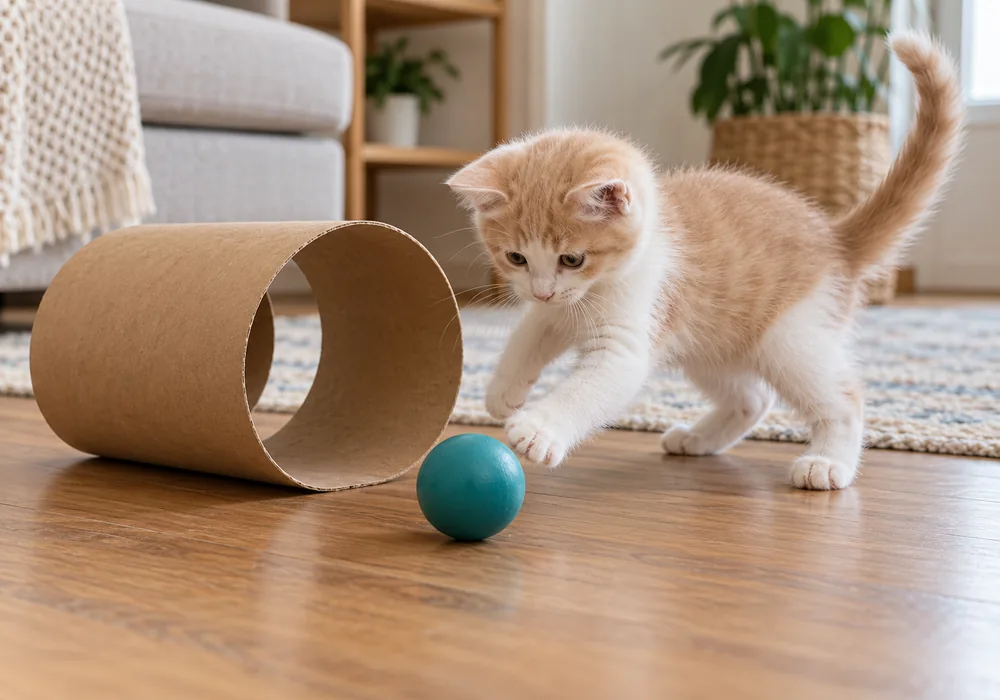
A Step-by-Step Guide to Playing With Kitten Toys
Think of a small hunt: search, stalk, chase, pounce, catch, and handle the toy. These are opportunities, not tasks your kitten must perform in order. Watching quietly can be part of stalking.
1. Set up an invitation
Choose a quiet area with secure footing and room to turn. Clear cords, loose packaging, and objects that could fall. Keep the toy away from hot surfaces, stairs, and open windows. A hiding place should remain accessible.
Sit at a comfortable distance. Move the lure a little way from your kitten, then pause. Let them notice and approach; do not wave it against their face or reach into a hiding place to bring them out.
2. Make the toy escape, then pause
Try a slow drag followed by a short dart behind a box. Leave enough time for the kitten to watch and creep closer. If they seem uncertain, reduce speed and distance before changing toys.
Keep early games mainly near the floor. Repeated high leaps, sharp twists, and slippery landings add difficulty without making the interaction more rewarding. Move the lure around your kitten’s position instead of running it across your lap.
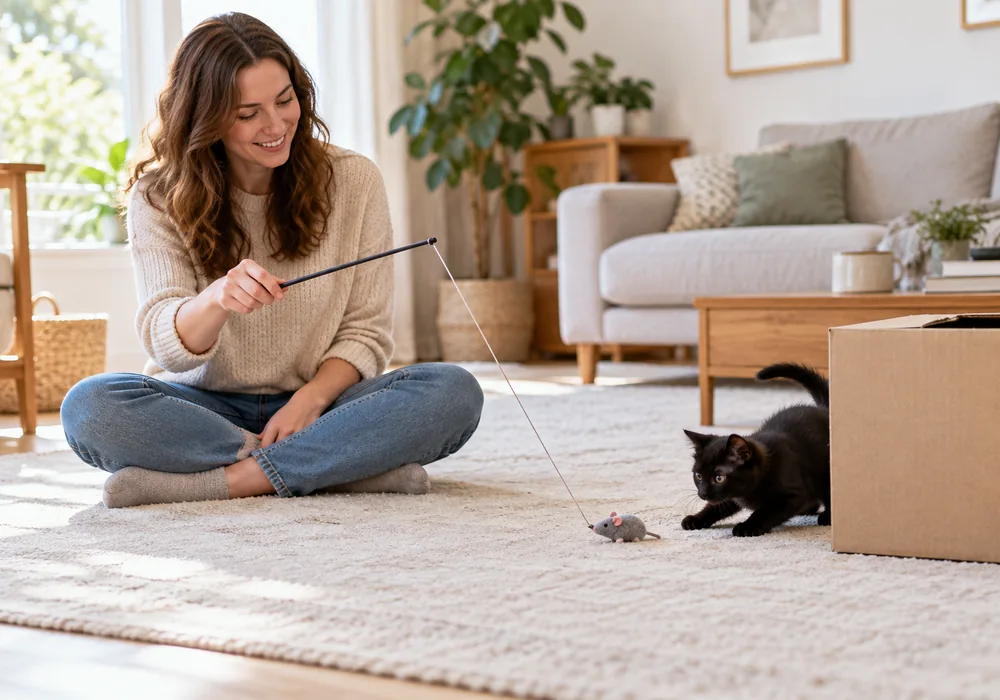
3. Allow catches during the game
Let your kitten grab the lure instead of snatching it away at every attempt. Ease the tension and allow a brief hold. Avoid pulling hard against teeth or claws, and keep the line away from the mouth.
If your kitten wants to wrestle, place a suitable kicker down and move your hand away before they grip it. Playing with a kitten should give those claws an appropriate target, with your fingers outside the action.
4. Finish without a struggle
When your kitten is still comfortable but starting to slow down, reduce the toy’s movement and offer a final easy catch. Let them release it before storing the wand securely. A scheduled meal, a little normal food, or a quiet break can follow.
If the kitten has already walked away, respect that ending; do not pursue them to complete the routine. Likewise, cuddling is optional. Wait until your kitten seeks touch rather than picking them up while they are excited.
A practical example: the box-corner game
After a nap, your kitten watches a fabric lure beside a box. You drag it away, pause, and let it disappear around the corner. The kitten crouches, approaches, and pounces. You allow the catch, wait for release, then repeat only while they remain interested.
After a few brief exchanges, the kitten starts looking elsewhere. You make the last movement slower, allow another catch if they choose, and put the wand away. No leap, command, or compulsory treat is needed.
Playing With Kitten Toys: How Long Is Enough?
Offer several short opportunities across the day while your kitten is awake and interested. An initial two to five minutes is a practical example, not a minimum or a scientifically established dose. Some kittens stop sooner; others want another short bout after a pause.
Morning and evening often provide useful opportunities. You can also plan a game before a normal meal or ahead of a predictable ankle-ambushing period. Do not wake a sleeping kitten, delay necessary food, or keep playing to reach a timer’s target.
A successful session leaves room for normal eating, resting, and exploration. The goal is willing participation, not exhaustion. For a kitten recovering from illness, injury, or surgery, follow the veterinary activity plan instead of a general play schedule.
Food and Rewards When Playing With Kitten Toys
A weaned kitten can explore a simple puzzle with accessible food before trying more difficult versions. Show where the food is, and ensure they still eat enough. Frustrating puzzles should not stand between a growing kitten and needed nutrition.
Where practical, reserve suitable complete kitten food from the measured daily ration. If you add snacks, our guide to how many treats a cat can have explains why calories and nutritional completeness matter. Growing kittens need their own feeding plan; adult calorie examples are not prescriptions for them.
Read Your Kitten Before Increasing the Excitement
Look at the whole interaction: posture, movement, pauses, and whether the kitten chooses to return. Large pupils alone cannot distinguish enjoyment from fear. A crouch may be stalking in one setting and an attempt to avoid contact in another.
- Continue gently: the kitten tracks the toy, moves comfortably, pauses, and returns voluntarily.
- Slow down or stop: the body becomes tense, ears flatten, hard bites repeat, or the kitten growls, hides, or tries to leave.
- Check for a health change: an ordinarily playful kitten suddenly stops joining in, limps, or tires unusually quickly.
When fear seems more likely than playfulness, reduce stimulation and leave space. Our kitten calming guide covers quiet retreats and comfortable contact in more detail. A louder or faster toy is not the answer to a frightened kitten.
What if teeth or claws reach your skin?
Become still rather than jerking your hand or foot away, then disengage when safe. Allow a calm break before another interaction. Avoid immediately producing an exciting game after a bite; instead, plan appropriate play before the usual ambush time.
Keep household rules consistent: hands and feet are never prey, including under blankets. Do not hit, scruff, spray, or pin the kitten down. The ASPCA’s rough-play guidance explains how suitable outlets and calm disengagement can help. Persistent or injurious behavior needs veterinary and qualified behavior support.
For reward timing and everyday habits beyond play, see our guide to training a kitten. Here, the immediate goal is a game both of you can comfortably repeat.
Two kittens and children need room for pauses
With two kittens, watch both participants. Pauses, changes of role, and voluntary returns are useful signs. Repeated pursuit after one tries to escape calls for interruption and separate space. Offer individual games rather than forcing both to compete for one lure.
Children should sit calmly with close adult supervision. An adult can control the wand while the child watches. Keep the lure away from faces and let the kitten approach or leave. Chasing, squeezing, and carrying a struggling kitten are not play.
Playing With Kitten Toys Safely at Home
Before each session, check seams, filling, attachments, cracks, and trailing threads. Choose toys your kitten can handle but cannot swallow. Avoid loose bells, glued-on eyes, ribbon, yarn, hair ties, rubber bands, and loose packaging film.
Cornell’s toy-safety guidance highlights detachable parts and strands as ingestion hazards. A “natural” material or a “self-play” label does not establish safety. Leave an item available for solo play only after observing that the specific kitten cannot dismantle or swallow it.
Clean according to wear and contamination
Follow the toy’s care instructions, rinse washable items thoroughly, and dry them completely. Clean food-contact puzzle surfaces after use. Replace damp or soiled cardboard, and discard toys with accessible filling, sharp cracks, splinters, or frayed strands.
There is no universal cleaning calendar that suits every toy. Check before and after use, and follow veterinary infection-control advice after illness. Store wands and lines in a closed cupboard or container after every game.
Prefer a toy your kitten can actually catch
A laser spot provides pursuit without something physical to grasp. A catchable toy is the simpler default for playing with a kitten. A survey of 618 cat guardians (Kogan and Grigg, Animals) found that more frequent laser play was associated with more owner-reported repetitive behaviors, but it does not prove cause and effect.
If a laser is used, never aim it at eyes or toward hazardous climbing routes, and transition to a physical toy. That transition has not been proved to prevent fixation. Stop light games and seek advice if reflection or shadow chasing begins disrupting normal activity.
When to Stop Playing With Kitten Toys and Get Help
Suspected swallowing: contact a veterinarian promptly if string or a toy part may have been swallowed, even if your kitten looks well. Do not pull visible string from the mouth or anus, induce vomiting, or give oils or laxatives. Keep the remaining toy or a photo for the clinic.
As VCA’s veterinary explanation of linear foreign bodies describes, swallowed string can anchor and damage the intestine. Vomiting, refusal to eat, abdominal pain, lethargy, or unusual hiding increase the urgency.
Breathing difficulty, gasping, or collapse: seek emergency veterinary care. Do not dismiss distressed open-mouth breathing as exercise. Eye injury, limping, or a sudden reduction in normal play also needs prompt assessment.
Make Playing With Your Kitten a Shared Ritual
Notice what your kitten chooses: a slow lure, a brief chase, a soft catch, or company without touching. Keep favorite options and rotate a few alternatives. Price and novelty do not determine whether a game works. For more games and everyday bonding ideas, see our guide to playing with your kitten.
A survey of 1,591 cat guardians in 55 countries (Henning et al., Animal Welfare) found that longer daily play, more different games, and play started by either the cat or the person were each associated with a higher cat-guardian relationship score. These findings do not prove that a set number of minutes causes affection, and they are not kitten-specific treatment results. The practical value is simpler: repeated, responsive play gives you opportunities to learn each other’s preferences.
After a session, note the toy, movement, response, and stopping cue: “Slow lure behind box; two willing approaches; walked away after the catch.” Change one feature next time. When your kitten can approach, enjoy the game, and leave without pursuit, you have a routine worth repeating.
A quick reminder this guide draws on our own time with kittens and on published veterinary and welfare guidance; it is not a hands-on assessment of your cat. If your kitten is vomiting, refusing food, struggling to breathe, or may have swallowed string or a toy part, contact a veterinarian promptly instead of waiting to see whether play returns to normal.