
Choose cat names you enjoy saying, can use consistently, and can tell apart from other names at home. Make a small shortlist, choose the form you will actually call, and help your cat connect that sound with pleasant experiences.
To get started, browse the ideas below. Then use the simple checks to narrow them down. You do not need a scientifically perfect name or a response on the first try.
Popular Cat Names: A Recent List to Start With
Luna, Milo, and Leo are familiar starting points. For example, PetSure’s Top 10 Cat Names of 2025, published in June 2026, lists the following names for cats born in 2025 in its Australian insurance data. The underlying claims data were current as of March 2026.
| Rank | Female cats | Male cats |
|---|---|---|
| 1 | Luna | Milo |
| 2 | Willow | Leo |
| 3 | Coco | Mochi |
| 4 | Nala | Simba |
| 5 | Mochi | Loki |
| 6 | Daisy | Teddy |
| 7 | Bella | Oreo |
| 8 | Lily | George |
| 9 | Cleo | Jasper |
| 10 | Millie | Winston |
However, these rankings describe one insured population, not every cat in Australia or worldwide. The female and male columns reflect the source’s records; you can choose any name for your own cat.
Popular cat names can be useful inspiration, but popularity does not show which name a cat will learn fastest. A common name is fine if you like it. Likewise, a less common one is fine too.
More Cat Names by Style
First, choose a category that feels right. Then write down a few favorites. These are suggestions rather than rankings, and names can fit more than one style.
Classic human names
Alice, Arthur, Edith, Felix, Fred, Mabel, Nellie, Oscar.
Try these if you enjoy a familiar first name that works just as well for an adult cat as a kitten.
Nature-inspired names
Fern, Ivy, Maple, Poppy, River, Sage, Sunny, Winter.
A favorite season, tree, or place can provide a name with a personal connection.
Food-inspired names
Biscuit, Chai, Dumpling, Noodle, Olive, Peaches, Pepper, Waffles.
Say each name in an ordinary voice. After that, consider which one you would enjoy using every day.
Names inspired by the coat
Ash, Cloud, Ginger, Inky, Midnight, Patch, Smokey, Socks.
A patch of white fur, a dark coat, or a warm orange color can give you an immediate starting point.
Playful names
Bean, Bounce, Bubbles, Dash, Nibbles, Pip, Scout, Ziggy.
Let your cat settle in before judging its personality, because a quiet first afternoon may simply mean a new home takes time to explore.
Stories, games, and wordplay
Binx, Kiki, Meowzart, Merlin, Nyx, Pixel, Purrlock, Zelda.
Alternatively, borrow from something you love, and decide whether you want a shorter everyday version. If you are drawn to a name tied to a breed, our guide to cat breed name origins shows where those words came from.
If you choose a name from another language, check its meaning and pronunciation with a reliable dictionary or a fluent speaker. A pleasing sound is a good starting point; an unverified translation is not a meaning to rely on.
How to Choose Cat Names That Work in Your Home
The best cat names for your household are names people can remember and use comfortably. Once you have a few favorites, work through these checks before ordering a tag or changing records.
- Make a short list. First, pick a few names you like, using your cat’s appearance, familiar interests, or a favorite style as inspiration. You can take time to decide while a new cat settles in; our guide to the first days with a new kitten covers that settling-in period.
- Say the daily version aloud. Next, try it at a normal speaking volume and as you would say it to a vet receptionist. One or two syllables can be convenient, but a longer name is not automatically a poor choice. For example, decide whether Professor Pippin will usually be called Pip.
- Compare it with household names. If you already call another cat Molly, try saying Millie and Molly in turn. If people keep mixing them up, a more different choice, such as Fern, may be easier to use consistently.
- Agree on the pronunciation. Also, ask everyone who will care for the cat to use the same everyday form at first. A formal name on the paperwork and a calling name can coexist, provided caregivers know both.
- Choose for long-term use. Finally, check that you are comfortable saying the name in public and sharing it with a clinic or sitter. Pick a word you will still enjoy using when the kitten is grown.
Example shortlist: You like Mabel, Noodle, and Pip. Say each aloud, ask household members to try it, and compare it with names already used at home. Choose the one everyone can use naturally. However, a first ear twitch or glance is not a reliable test of which new name your cat prefers.

Do Cats Recognize Their Names?
Some do, and a response can be subtle. A 2019 study of name recognition (Saito et al., Scientific Reports) ran four experiments with 78 cats in total, and some cats took part in more than one. After responses to repeated words faded, some cats reacted again to their own names. For instance, responses often involved ear or head movements. In addition, some household cats showed this response when unfamiliar people spoke the words.
The comparison words had the same length and accent patterns as the cats’ names. The results show that cats could respond to differences between spoken words under the test conditions. However, they do not establish whether cats understand a name as a personal label.
The study did not rank names by consonant, vowel ending, or syllable count. Short names can be handy for people. Still, there is no proven rule that a name ending in a particular sound will be best for every cat. Recognizing a name also does not guarantee that a cat will come when called.
Help Your Cat Learn the Chosen Name
Practice when your cat is awake, relaxed, and free to leave. Begin in a quiet room.
- Prepare a reward. Before you start, choose something your cat enjoys. Keep food at your side rather than under the cat’s nose.
- Say the name once. Then use the everyday form in your usual calm voice.
- Reward a look toward you. As soon as your cat looks toward you, give the reward. A small head turn is a useful starting point.
- Pause and keep it easy. Finish while your cat is comfortable. Take a break if either of you becomes frustrated.
- Add a little variety. Once it is easy, try slightly more distance or a new quiet spot. Change one thing at a time.
If nothing happens, reduce distraction or try a different reward instead of repeating the name louder. For more detail, Cats Protection’s name-training guide explains this approach.
For example, say Pip, wait for a look, and offer a small piece from the measured meal. Our guide to training a kitten explains reward timing for other everyday skills.
Also, count food rewards within daily feeding, using food suited to your cat’s age and health. Our guide to how many treats a cat can have helps with portions.

Cat Names for a Two-Cat Home
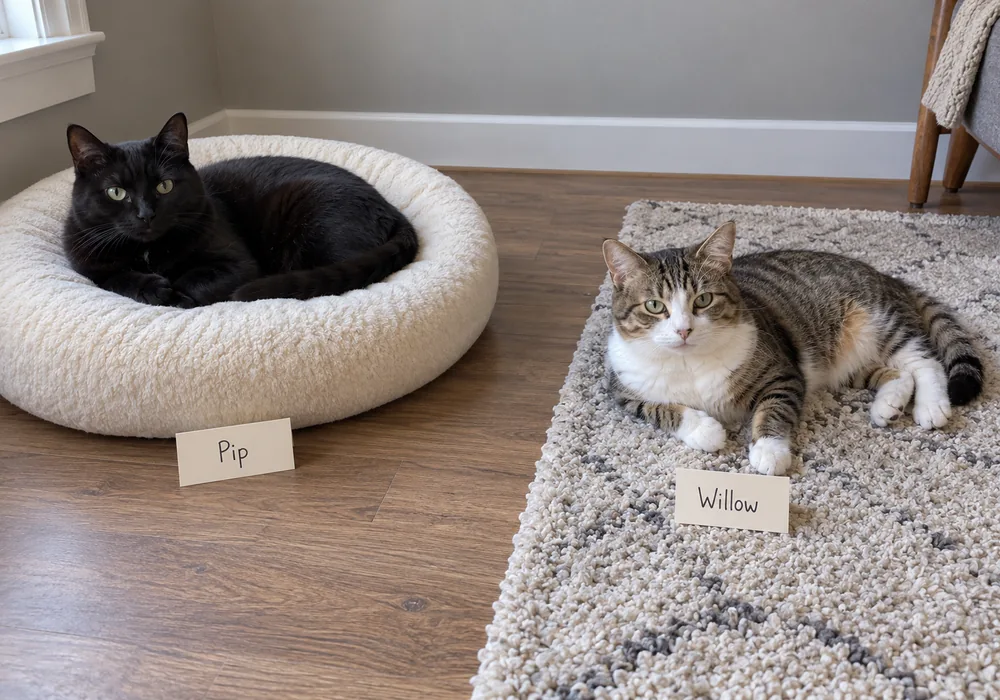
Matching names can be fun, but each cat still needs a clear everyday name. Pip and Willow, for example, give people two quite different words to say. Millie and Molly may take more care to keep straight.
At first, try short individual practice while the other cat rests somewhere comfortable. Reward the cat you addressed for responding, rather than calling several names and rewarding whoever arrives first. However, do not force separation if it upsets either cat.
This is a practical way to keep household cues clear. Still, research has not established a guaranteed sound formula for naming cats that live together.
Can You Rename an Adult or Rescue Cat?
Yes. You can introduce a new name through the same calm, rewarding practice. However, if your cat already has a familiar name you like, keeping it is also a reasonable choice.
First, choose the new everyday form and use it consistently. Give a newly adopted cat time to eat, rest, and explore before expecting a training response. Keep practice comfortable, and avoid using the name mainly to interrupt or scold.
Even so, there is no fixed learning deadline, and you should not assume every adult cat will take longer than every kitten. Look for small, repeatable responses rather than testing from farther away each day.
Finally, tell your vet and other caregivers about the new name, and ask the microchip registry to update the pet’s record. Check your contact details at the same time. Our guide to cat microchipping and registration explains why the registry record matters.