
Choosing a house cat is about more than a favorite look. A Maine Coon needs equipment that fits its large frame; a Persian needs daily coat care; an Abyssinian needs plenty of opportunities to climb and play. Comparing those everyday needs helps you find a cat whose care fits your home and routine.
This guide compares ten familiar breeds through coat care, activity, handling, and health considerations. Breed descriptions can help you decide what to ask a caregiver, but the individual cat’s habits and history matter more than a label.
What Is a House Cat?
A house cat is a domestic cat kept as a companion, often primarily indoors. The term includes pedigree breeds and cats with no established breed ancestry. A domestic shorthair or domestic longhair can be just as affectionate, playful, or comfortable at home as a pedigreed cat.
Those two domestic labels describe coat length, not a standardized breed or personality. Similarly, tabby is a coat pattern. If you are trying to work out your own cat’s background, our guide to identifying your cat’s breed explains how appearance and ancestry records differ.
Why these ten breeds? They appear in the Cat Fanciers’ Association’s 2026 popularity list, published April 22, 2026, using the previous year’s data. This is a selection based on one registry, not a worldwide census of pet cats. The profiles below are grouped by practical care questions rather than ranked from best to worst.
Ten House Cat Breeds at a Glance
For a house cat, coat type and body size help you plan grooming and equipment. Temperament descriptions are less certain: age, health, early experiences, and the home environment all influence behavior.
| Breed | Distinctive features | Main care consideration |
|---|---|---|
| Maine Coon Cat | Large, rectangular body; shaggy coat; square muzzle | Roomy equipment and regular combing |
| Ragdoll Cat | Large body; blue eyes; silky, pointed coat | Coat checks and supported lifting |
| Persian Cat | Long, dense fur; compact body; shortened face | Daily combing and attention to facial health |
| Exotic Shorthair Cat | Persian-like build; dense, plush short coat | Eye and breathing comfort despite shorter fur |
| Devon Rex Cat | Fine, wavy coat; large ears; prominent cheekbones | Gentle grooming and regular interaction |
| Abyssinian Cat | Lean, muscular body; short, ticked coat | Active play and secure climbing routes |
| British Shorthair Cat | Rounded head; substantial build; dense short coat | Grooming, play, and body-condition checks |
| Siberian Cat | Powerful body; full, multilayered coat | Extra coat care during seasonal shedding |
| American Shorthair Cat | Muscular build; dense, firm-textured short fur | Interactive play and routine grooming |
| Russian Blue Cat | Silvery blue coat; green adult eyes | Patient introductions and quiet retreats |
Common breed descriptions offer a starting point. Ask the current caregiver what the particular cat does during play, grooming, visits from strangers, and time alone.
Size and handling
What a Large House Cat Needs
Maine Coon Cat
The Maine Coon has a long, rectangular body, substantial paws, a square muzzle, and a shaggy coat with uneven hair length. Many are sociable and playful, showing an interest in household activities and interactive games.
Its size makes equipment measurements especially useful. Can the adult cat turn comfortably in the carrier and litter box? Does a resting platform support its whole body? Check furniture anchoring and load instructions, since jumping places different demands on a perch than lying still.
Allow time for regular combing and check underneath the body for tangles. A large frame also does not justify unlimited food: the aim is a healthy body condition, not the highest weight associated with the breed. Our guide to large cat breeds compares adult sizes and the equipment they need.
Ragdoll Cat
Ragdolls have substantial bodies, blue eyes, and silky, medium-long coats. Their colorpoint pattern places darker coloring on the face, ears, legs, and tail; some patterns also include white. They are commonly described as affectionate cats that enjoy staying close to familiar people.
Ask how this particular cat prefers to spend time with people. Does it enjoy being held, follow people between rooms, or prefer resting nearby? If lifting is welcome, support the chest and hindquarters. The breed name does not mean the cat should go limp or accept rough handling.
The coat generally has less undercoat—the shorter insulating layer of fur—than a Persian’s, but it can still develop knots. Check where the legs meet the body and increase combing when shedding makes tangles more likely.
Before choosing either breed: ask about heart screening and family history, as well as grooming and handling. The health-record section below explains what screening results can tell you.
Coat length and facial structure
Persian and Exotic Shorthair: Coat and Facial Care
Persian Cat
A Persian combines a compact, sturdy body with a long, dense coat and a shortened face. Many enjoy gentle attention and quieter play. That relaxed reputation can obscure a considerable daily care commitment.
Plan for daily coat checks and combing that reaches through the fur without pulling. Include the underside, where knots may be hidden. Never cut tight mats with scissors: skin can be caught inside the knot. Seek professional help for painful or extensive matting. Our step-by-step cat grooming guide covers gentle techniques and when to seek help.
Ask about eye discharge, breathing, dental care, and screening for inherited kidney disease. Coats and daily care needs vary widely among long-haired cat breeds. Persistent symptoms need veterinary assessment, even if a previous caregiver calls them typical for the breed.
Exotic Shorthair Cat
The Exotic Shorthair has a rounded head, compact body, and Persian-like facial features, paired with a dense, plush short coat. CFA registers the breed as Exotic; this profile describes the shorthaired form. Breed descriptions commonly emphasize quiet, affectionate companionship.
Shorter fur usually reduces the work of managing hair length compared with a Persian, but the coat still needs grooming. More importantly, it does not change the shortened facial structure.
Brachycephalic means short-headed. When assessing a cat with this anatomy, ask whether it breathes comfortably at rest, eats without difficulty, and has comfortable eyes. Recurring noisy breathing or eye irritation should be examined. When choosing a cat, prioritize comfortable breathing, eating, and eye health.
Activity and interaction
Play and Exploration for an Active House Cat
Devon Rex Cat
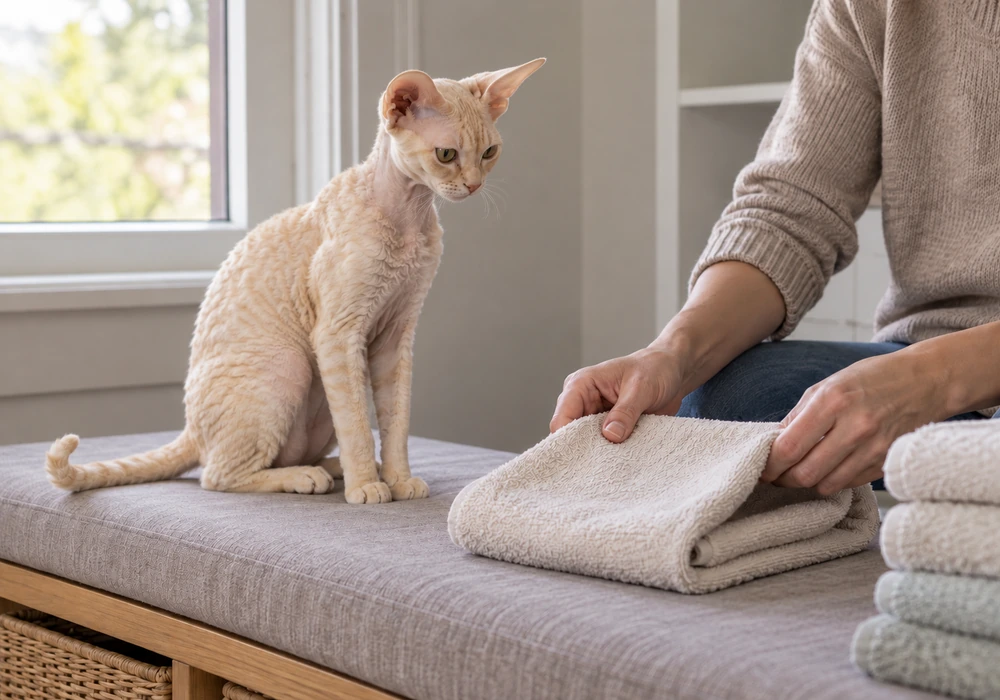
Large ears, prominent cheekbones, and a fine, wavy coat give the Devon Rex a distinctive appearance. Coat density varies, and the hairs and whiskers can be fragile. These cats are often described as curious, playful, and keen to join their people’s activities.
For someone who enjoys regular interaction, that interest can make play and short reward-based training sessions enjoyable. Ask how the individual cat behaves when its caregiver is busy or away, rather than assuming that a small cat needs little attention.
Use a light touch during grooming; vigorous brushing can damage fine hair. Provide a comfortable resting place away from drafts and direct heat sources. New bald patches, redness, or greasy skin should not be dismissed as ordinary features of the coat.
Abyssinian Cat
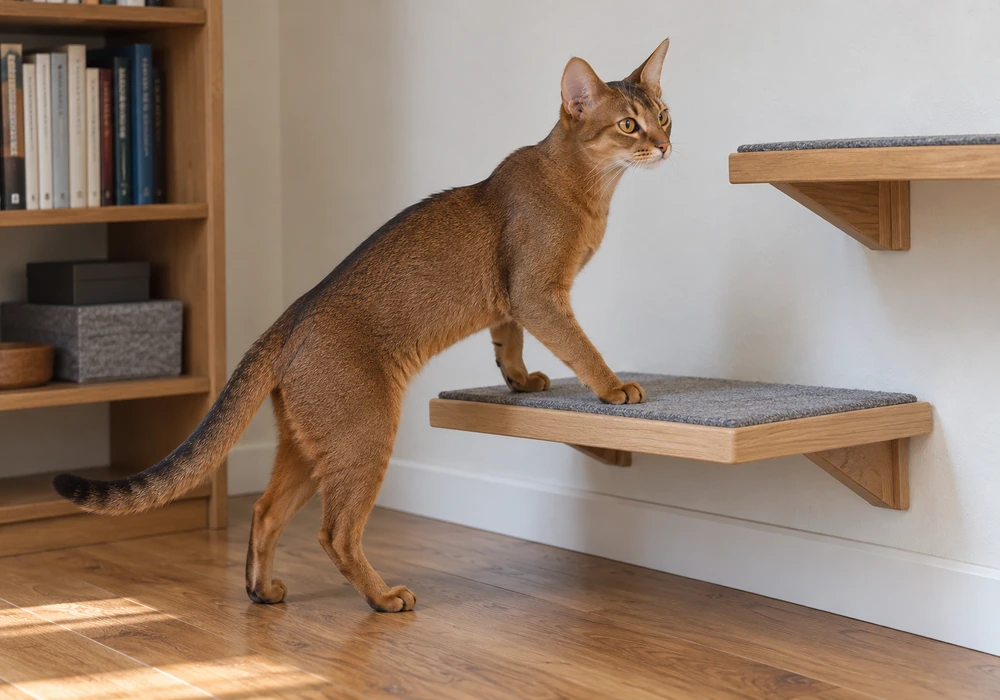
The Abyssinian has a lean, muscular body and a short, ticked coat, meaning that individual hairs have alternating bands of color. Breed descriptions commonly emphasize an interest in exploring, climbing, and active play.
Think about an ordinary workday before choosing an energetic cat. Can you provide interactive games, a manageable food puzzle, and safe places to climb? Secure shelves and perches, and keep cleaning products, small swallowable objects, and accessible food out of reach.
The short coat generally needs less detangling than a dense long coat, but that saving does not remove the need for interaction. An Abyssinian may seek affection through play and nearby activity rather than long periods on a lap. Meet the cat and ask how it settles between games.
For both breeds: a second cat is not an automatic solution to boredom. Consider the cats’ social histories and whether they already have a comfortable relationship.
Coat density and body condition
Coat Care and Body Condition for Your House Cat
British Shorthair Cat
The British Shorthair has a rounded head, a substantial build, and a very dense short coat. Blue-gray is familiar, but the breed comes in other colors and patterns. Many enjoy watching household activities and spending time near familiar people.
Companionship does not necessarily mean being carried. Ask about handling preferences and let the cat choose whether to sit beside you or move closer. A calm adult may still enjoy lively games, so make daily play part of the routine.
The broad outline and plush fur can make weight changes hard to judge by sight. Ask your veterinarian to demonstrate body-condition assessment: evaluating fat coverage by feeling the body as well as looking at it. Keep track of weight and portion sizes, and discuss relevant heart history.
Siberian Cat
Siberians have powerful bodies and full, multilayered coats. The coat is often called a triple coat because it includes longer outer hairs, intermediate hairs, and a soft undercoat. Fullness changes with the season and the individual.
Many Siberians combine an interest in company with bursts of energetic play. Plan for both: secure climbing furniture with adequately sized platforms, interactive games, and undisturbed resting places.
Watch for loose undercoat collecting on the belly and around the hind legs, especially during shedding. Groom often enough to prevent it from forming mats. A thick coat does not establish a healthy weight, and an adaptation to cold weather does not mean the cat needs to roam outdoors.
What about allergies? Siberian, Devon Rex, and Russian Blue cats are sometimes promoted as hypoallergenic. No breed guarantees freedom from allergy symptoms. The American College of Allergy, Asthma & Immunology explains that all cats produce allergens, including proteins in saliva and on skin and fur. Low shedding or short hair is not a reliable way to predict personal tolerance. Discuss significant cat allergies or asthma with an allergist before adopting.
Short coats and social preferences
Shorthaired House Cat Breeds and Social Preferences
American Shorthair Cat
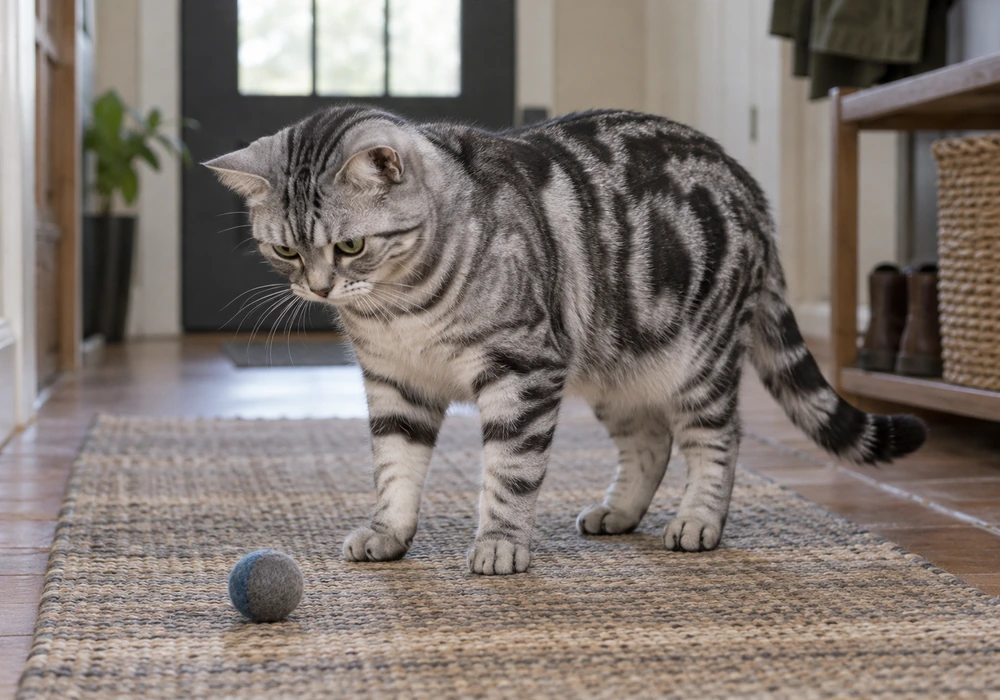
The American Shorthair is a recognized breed with a muscular build and a dense, relatively firm-textured coat. Silver tabby is a familiar pattern, but there are many others. The breed name is distinct from the general description “domestic shorthair.”
Breed profiles often describe an easygoing companion with an interest in interactive hunting-style games. Give that interest an indoor outlet through supervised chasing and catching toys. Put wand toys and loose strings away afterward.
Ask what “easygoing” means for this particular cat. Does it recover comfortably after visitors leave? Accept a short grooming session? Have experience with children of similar ages to yours? Those details are more useful than a broad promise of adaptability. Expect shedding and routine coat care despite the short hair.
Russian Blue Cat
A Russian Blue has a short, dense blue coat with silvery tips and green eyes in adulthood. Many are described as affectionate with familiar people but more cautious around strangers. A gray coat alone, however, cannot confirm Russian Blue ancestry.
If you enjoy a relationship that develops gradually, ask how the cat behaves once it knows someone. An unfamiliar meeting room or a busy visit may not show its usual sociability. Offer a retreat and allow introductions at the cat’s pace.
Continue regular play and occasional grooming to remove loose hair. Reserved behavior is not a reason to overlook a sudden change: new hiding, reduced appetite, or reluctance to move warrants a health and environment review.
Which House Cat Fits Your Home?
Once a few breeds interest you, turn the comparison into questions a caregiver can answer. An adult cat with a detailed foster or home history may offer clearer information about daily habits than a kitten’s predicted temperament.
If You Live in an Apartment
Measure usable space rather than judging by the cat’s size alone. Where can it turn in a litter box, stretch out, climb safely, and retreat from visitors? A large cat can potentially live comfortably in an apartment; a smaller, highly active cat may need more planned activity than you expect.
If You Have Children or Other Cats
Ask about relevant experience and supervise voluntary contact. Teach children to invite interaction and let the cat leave. For another cat, arrange gradual introductions and separated resources. Staring, blocked routes, and avoidance can signal tension even without fighting. Our guide to reducing stress at home explains useful changes to hiding places, resource placement, and play.
If Your Schedule Is Busy
Include grooming, feeding, litter cleaning, play, and veterinary visits in your plan. Ask to see an ordinary grooming session, and arrange backup care for absences. A quiet temperament or short coat does not make a cat comfortable with every routine.
House Cat Health: What Screening Records Tell You
Request veterinary history, vaccination and parasite-control records, current diet, medications, and any written screening results. For a kitten from a breeder, ask about relevant parental results too. Confirm the cat’s identity, the test name, and the date. Incomplete background in a rescue cat means uncertainty to discuss with a veterinarian, not proof of poor health.
Hypertrophic cardiomyopathy (HCM) is a disease in which the heart muscle thickens. It can affect pedigree and nonpedigree cats. Cornell’s Feline Health Center explains that cardiac ultrasound, called echocardiography, is used to diagnose it. DNA testing checks particular genetic variants and answers a different question.
- Maine Coon cats: the MYBPC3 A31P test checks one HCM-associated variant.
- Ragdoll cats: the MYBPC3 R820W test checks a different HCM-associated variant. The two breed-specific tests are not interchangeable.
- Persian cats and cats with Persian ancestry: ask about PKD1 testing for an inherited form of polycystic kidney disease, which causes kidney cysts.
A negative result does not rule out every cause of heart or kidney disease. Your veterinarian can interpret the records and advise whether imaging or follow-up is appropriate. Comfortable breathing, movement, eating, and grooming matter alongside test reports; our overview of cat health explains how to read what you are given.
Do not explain sudden illness as a breed trait. Seek emergency veterinary care for labored or open-mouth breathing, collapse, or sudden painful weakness or paralysis of the hind legs.
Meet the Cat Before You Decide
Breed information can help you anticipate a dense coat, a large frame, or an interest in climbing. A caregiver’s observations and the cat’s own behavior tell you more about the relationship you may share. Meet the cat, ask about the less convenient parts of its care, and choose needs you can meet consistently.
Every house cat needs a complete and balanced diet appropriate to its life stage, clean feeding and litter areas, scratching surfaces, and daily opportunities to play. Choose washable bedding and inspect furniture for loose fixings or exposed fasteners. Keep up with preventive veterinary care and adjust the routine as the cat ages. Our guide to basic cat care covers the everyday essentials.
This guide draws on published breed information, registry descriptions, and years of living with cats; it is general information, not a diagnosis and not a guarantee about any individual cat. A breed label cannot confirm health or temperament. If a cat has labored or open-mouth breathing, stops eating, or suddenly cannot use its hind legs, contact a veterinarian without delay.