
If you’re wondering how to get a cat to use a scratching post while your sofa keeps collecting claw marks, start beside the sofa. Offer a steady scratcher that matches the surface and posture your cat already chooses, then reward voluntary scratching immediately.
A post in an unused room may lose out to a sofa arm that offers a firm grip in a familiar place. The aim is to make the acceptable surface convenient and satisfying enough to use again.
Your first move: Put a stable upright post beside a scratched sofa arm, or a secured flat scratcher beside a targeted rug. Keep a small reward ready and notice the first voluntary scratch. Let your cat investigate without moving its paws for it.
Why the Sofa Wins Over an Unused Post
Scratching helps cats shed outer claw sheaths, stretch, and leave visual marks and scent signals. A repeatedly scratched corner can therefore remain appealing. Your cat needs an acceptable place to express this normal behavior.
Before buying another post, watch where the claws go. Does your cat reach up and pull downward, rake a flat surface, or choose an incline? Notice the texture, the location, and whether scratching follows a nap. These observations give scratching-post training a useful starting point, and our guide to understanding cat behavior explains why normal behaviors need an outlet rather than a deterrent.
Scratching furniture differs from scratching itchy skin. Excessive licking, hair loss, redness, or sores need a veterinary assessment rather than a different post.
Choose a Scratcher That Fits Your Cat
Working out how to get a cat to use a scratching post starts with matching its preferred posture and the resistance under its claws. An upright post should allow a comfortable full stretch without a shelf or cap interrupting the scratching area. Check the usable surface, not just the advertised total height.
Cats Protection’s scratching guidance suggests a heavy, stable base so the post does not wobble or topple, a post tall enough for a full stretch, and a vertical weave that lets claws run downward. Any base that swivels, slides, or tilts when pulled is not yet a usable post.
- Sisal rope or woven sisal: Useful coarse surfaces for posts and panels. Check for loose wrapping, lifting edges, and long unraveling fibers.
- Corrugated cardboard: A useful option for floor pads, ramps, and replaceable inserts. Secure lightweight pads against sliding and replace damp or weakened cardboard.
- Carpet or textile: May suit a cat that already seeks fabric. Avoid snagging loops and loose threads; construction and attachment matter.
- Suitable unfinished wood: Can suit a wood-scratching cat, provided its treatment history is known and it has no splinters or sharp edges. Very smooth wood may offer little grip.
The Feline Veterinary Medical Association’s behavior guidance notes that most cats prefer vertical surfaces and others prefer horizontal ones, and that a cat’s preference can shift with age, with a senior cat more likely to move from vertical to horizontal. Sisal is a reasonable starting option, but it is not a universal winner. If preference is unclear, compare a stable upright option with a secured horizontal one rather than buying several at once.
Put the Post Where Scratching Already Happens
Placement is central to how to get a cat to use a scratching post. Set the alternative immediately beside the current target, with room to approach, stretch, and walk away. A nearby resting place can also work well because cats often scratch after waking.
The same Cats Protection guidance describes this as a starting position rather than a permanent one: once your cat uses the post reliably, the post can be moved gradually toward a better location and any furniture protection removed. Keep a successful setup in place while the habit develops, and do not relocate it while use is still inconsistent.
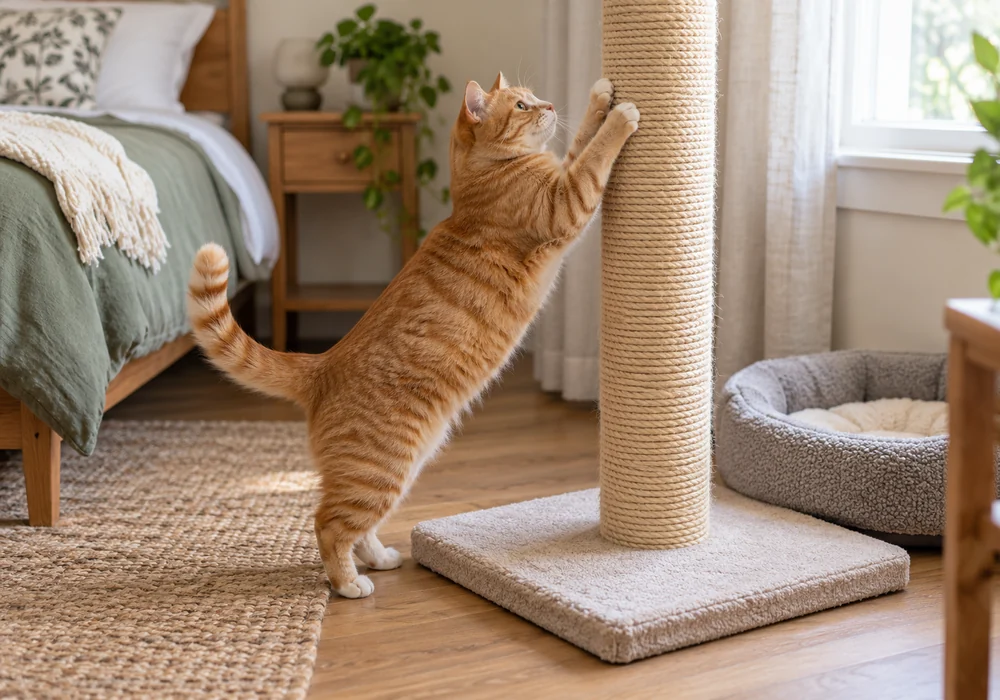
If the post eventually needs to move, shift it gradually and watch whether use continues. Return to the previous position if use declines. There is no proven relocation distance or timetable for every household, and hiding it away can make it irrelevant again.
How to Get a Cat to Use a Scratching Post With Rewards
Prepare the setup first, then make the learning sequence clear. The Feline Veterinary Medical Association’s positive reinforcement guidance recommends rewarding appropriate scratching immediately with something the individual cat values, and puts the useful window at about three seconds.
- Have the reward ready. Use a tiny suitable food portion, a favorite game, or attention your cat welcomes. Count food rewards in the daily feeding plan; keep regular meals available.
- Invite investigation. Let your cat approach and sniff. If it enjoys play, move a supervised wand toy near the scratching surface to encourage comfortable engagement. Keep your hands out of the claw path.
- Reward the scratch. As soon as your cat scratches the chosen surface, offer the reward. A familiar, quiet marker word can identify the moment, followed promptly by the reward. Sniffing alone is not the final behavior you want to reinforce.
- Pause while it is still easy. A minute or two may be plenty if your cat stays interested; it is a practical example, not a required session length. Let it leave without following or repeatedly putting it back.
- Notice independent use. Reward spontaneous scratching too. Gradually rely less on toys or invitations while keeping the successful surface available.
Do not drag your cat’s paws down the post. That does not teach willing use and can make the object unpleasant. If scratching never starts, revisit texture, orientation, stability, and location before adding more repetitions.
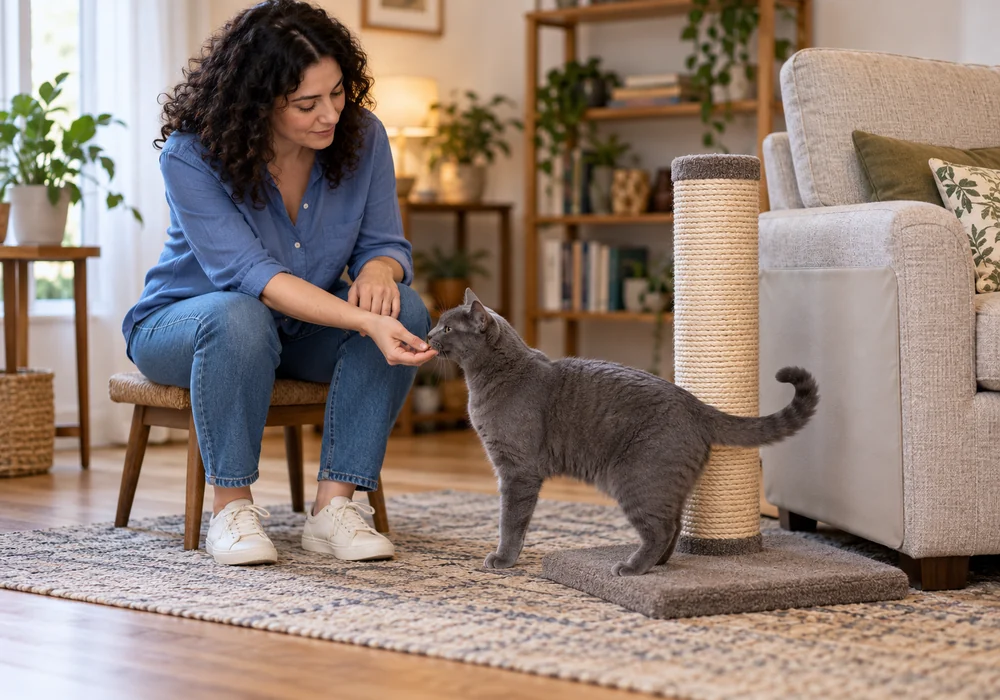
For kittens, introduce scratching alongside other useful routines without turning each encounter into a long lesson. Our guide to training a kitten covers those broader everyday habits.
Protect Furniture While the New Habit Develops
Scratching-post training works better when the sofa is harder to damage at the same time. Fit a secure cover or suitable smooth protector over the targeted area and keep the alternative beside it. Avoid loose coverings that could entangle your cat, and check whether an exposed edge becomes the next target.
Double-sided sticky tape is a common suggestion that the FelineVMA advises against, because an aversive surface is still a form of punishment. A physical cover tends to be the more useful approach: it protects the fabric without adding a negative experience.
Do not make sofa scratching the reliable way to start a treat delivery or exciting chase. Instead, arrange opportunities at the post before predictable scratching periods and reward actual use there. If your cat scratches furniture, stay calm, manage access safely, and reassess why that spot still wins.
Yelling, spraying water, and startling can create fear without teaching a better surface choice. FelineVMA’s behavior-training guidance pairs furniture protection with an appropriate nearby outlet and rewards, and states plainly that punishment increases undesirable scratching.
When Your Cat Still Ignores the Scratcher
If you’re still working out how to get a cat to use a scratching post, change one manageable feature at a time so you can see what helps. The following checks guide an adjustment; they do not diagnose a behavior or medical problem.
| What you notice | What to try next |
|---|---|
| Sniffs the post, then walks away | Match the texture and angle of the surface your cat actually scratches. Check that there is enough usable length. |
| Starts scratching, then abruptly stops | Inspect for movement, loose covering, and claw snags. Persistent hesitation or signs of discomfort need veterinary attention. |
| Uses the post and still scratches the sofa | Keep the post beside the target, improve furniture protection, and reward voluntary post use. Check for fresh damage separately. |
| Chooses rugs instead of an upright post | Offer a secured horizontal pad nearby. A comfortable flat surface may meet this cat’s preference better. |
| Another cat uses the post, but this one avoids it | Provide another option in a separately accessible area. Watch for staring, blocked routes, or waiting for the other cat to leave. |
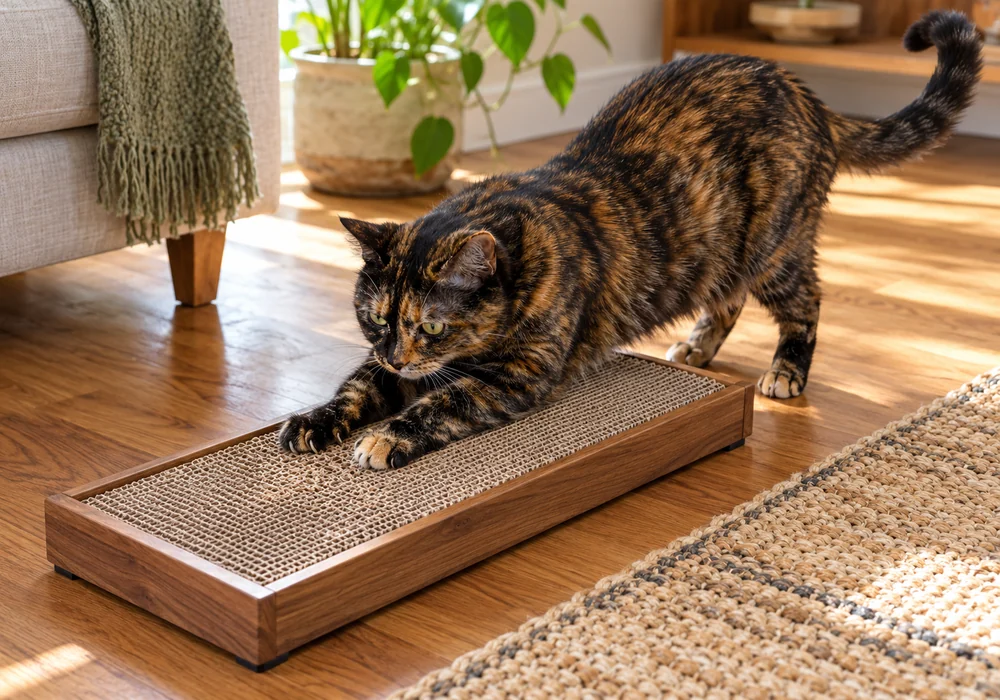
For a simple preference check, offer two safe alternatives with similarly convenient access. If one location always wins, exchanging their positions briefly may help distinguish a location preference from a surface preference. This is an informal home comparison, not a clinical test. Once something works, stop rearranging it unnecessarily.
Adjust Scratching-Post Training to Your Household
For a growing kitten, reassess the scratcher’s fit as body length changes. For an older or less mobile cat, offer a secure floor pad or gentle incline instead of insisting on an upright stretch. A new reluctance to stretch, jump, or accept paw handling warrants a veterinary check.
In a multi-cat home, distribute scratching options rather than clustering them at one doorway. A separate post per cat in different locations is a useful starting point, but actual access matters more than the count. Our cat stress relief guide explains how blocked routes and competing resources can affect ordinary activities.
Do Catnip or Pheromones Help?
Attractants are optional when you’re deciding how to get a cat to use a scratching post. Some cats investigate catnip or silver vine; others show little interest. Rolling, rubbing, or sniffing shows a response to the plant, not proof that the cat has learned where to scratch. If your cat responds strongly to catnip, our guide to things cats love covers other low-effort favorites.
Cats Protection notes that rubbing quality catnip on the post, or placing a few pieces of cat food on it, can entice some cats to approach. Either way, follow the product’s directions, supervise initially, and stop if your cat avoids it or becomes overly excited. Do not use concentrated essential oils as homemade attractants or deterrents.
Pheromone evidence depends on the specific formulation and outcome studied. The FelineVMA mentions synthetic feline pheromones as something that may help a cat with underlying distress, which is a different claim from teaching a scratching location. Research on a room diffuser does not prove that spraying any scent on a post teaches scratching. Fix an unstable, inconvenient, or uncomfortable setup first; ask your veterinarian about persistent distress.
Keep the Favorite Scratcher Safe and Useful
A worn surface can still be useful. Remove loose debris, follow construction-specific cleaning instructions, and inspect the base, joints, covering, and fixings regularly. Repair or replace long loose strands, detached loops, exposed hardware, recurring claw snags, or instability.
Do not soak cardboard or assume fabric glued to a wooden core is machine-washable. Replace porous parts that remain damp, moldy, or inadequately cleaned after contamination. If an old post is still safe, place its replacement alongside it; remove unsafe equipment immediately.
For a homemade post, use known suitable materials, secure joints and covering, and keep fasteners out of the claw path. Follow adhesive curing instructions. A quick pull test can reveal obvious defects, but it does not certify structural safety.
Questions About Scratching-Post Training
Will Nail Trimming Replace Scratching?
No. Trimming sharp tips may reduce damage, but cats still need to stretch, maintain their claws, and communicate. Our cat nail trimming guide explains safe tip care. Declawing removes the end bone of affected toes; the procedure carries a risk of lasting pain and later behavior changes, and the FelineVMA opposes it as a routine solution.
How Long Should It Take?
There is no dependable deadline for every cat. When deciding how to get a cat to use a scratching post, track two outcomes: comfortable voluntary scratching on acceptable surfaces and less new furniture damage. A quick photo of the same furniture area can help distinguish old marks from fresh ones.
If progress stalls, review one change at a time rather than repeating the same unsuccessful invitation. Seek veterinary advice for sudden behavior changes, pain, or persistent problems. Suspected swallowed string or rope needs prompt veterinary attention; do not pull visible string from the mouth or anus.
Disclaimer: this article draws on our own experience living with cats and on published veterinary and behavior guidance; it does not assess your individual cat. If your cat suddenly scratches far more than usual, cries while scratching, has red or broken skin, is lame, or stops eating, contact a veterinarian rather than trying another post.