
Introducing your kitten to the outside world begins with a secure place to explore and a plan for getting back indoors. Check its vaccinations and parasite protection with your veterinarian, then prepare a fully enclosed catio or practice with a well-fitted harness before the first outing.
New smells, surfaces, and sounds give your kitten plenty to investigate. Let it choose whether to step out, explore, or return indoors. This guide explains when to start, how to prepare the space and equipment, and what to do if your kitten hesitates or becomes frightened.
Before Introducing Your Kitten to the Outside World
There is no single safe starting age for every kitten. At eight or twelve weeks, a kitten may still be completing its vaccinations, settling into a new home, or growing into suitable equipment. Tell your veterinarian where you plan to take it, how you will prevent escape, and whether other animals can reach the area.
One vaccine injection does not complete a kitten’s vaccination course. Maternal antibodies—protection passed from the mother—can interfere with an early vaccine response. As a US example, the 2020 AAHA/AAFP core vaccine table recommends injectable combination vaccines every three to four weeks through 16–20 weeks of age for kittens starting before 16 weeks. This schedule does not, by itself, tell you when outdoor access is appropriate.
Ask your veterinarian which vaccines your kitten needs and how long to wait before the outing you have planned. Discuss rabies protection according to local requirements, along with feline leukemia virus, or FeLV, testing and vaccination. These US guidelines recommend FeLV vaccination for kittens and young cats under one year, with testing before vaccination.
Before the first outing, check these four essentials:
- Identification: Arrange microchipping, confirm that the registration has your current contact details, and keep a recent photograph and chip number handy. A microchip identifies a cat when scanned; it does not track its location. Getting your cat microchipped walks through registration, cost, and what to expect.
- Spaying or neutering: Discuss timing and recovery with your veterinarian. Cats Protection’s UK guidance recommends neutering around four months and waiting until kittens are settled, vaccinated, neutered, and microchipped before outdoor access. Your veterinarian can account for your kitten’s health and the setting you have planned.
- Parasite prevention: Follow the current veterinary plan, using products labeled for cats of your kitten’s age and weight. A screened enclosure does not necessarily keep out fleas, mosquitoes, ticks, or contaminated material.
- Comfort at home: Your kitten should be eating normally, using the litter box, resting comfortably, and exploring familiar rooms. If it has only just arrived, bringing new kittens home sets out what to establish first.
Postpone the outing if your kitten is unwell, recovering from surgery, still unsettled, or uncomfortable in its equipment. An opening your kitten could escape through, or another unresolved hazard, is also a reason to wait. Continue gentle indoor preparation until the problem is addressed.
Safe Settings: A Catio, a Harness, or Indoors
A kitten can squeeze through a gap or climb a fence before you can reach it. Staying nearby helps you respond, but it does not prevent an escape. Start with a fully enclosed space, or a quiet private area where you can use a harness your kitten already wears comfortably.
The 2024 feline indoor/outdoor lifestyle statement recommends controlled outdoor access while meeting cats’ needs for exploration, play, and other normal activities. For a first outing, choose somewhere close to home, away from traffic, busy entrances, public parks, and shared areas where unfamiliar animals gather.
| Option | What to consider |
|---|---|
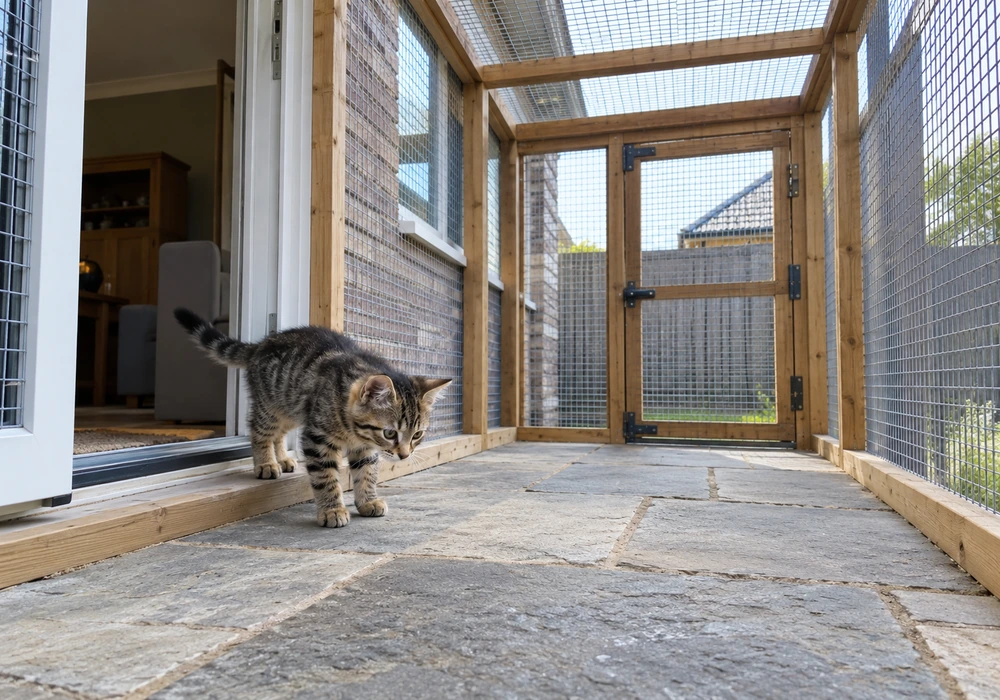
| Fully enclosed catio or porch | A catio is an enclosed outdoor space for cats. It lets your kitten investigate outdoor sights and smells within a physical boundary. Check the roof, floor-level gaps, doors, mesh, and connection to the house. Keep a sheltered retreat available. |
| Cat harness and handheld leash | Suitable only after comfortable indoor practice. Check the fit and attachment, keep the leash in your hand, and watch for attempts to back out or signs of distress. |
| Indoor exploration and play | A practical choice if outdoor access is unsuitable or your kitten dislikes it. Offer places to climb, scratch, hide, rest, and play. |
An ordinary yard fence is not reliable kitten containment. Plants, furniture, climbable surfaces, and small gaps can provide escape routes. Balcony railings are also insufficient; a balcony needs a structurally secure, fully enclosed setup designed for the kitten’s size.
Letting a kitten roam freely exposes it to traffic, loss, fights, hunting, toxins, and infection. Enjoying time in a catio or on a leash does not mean it should later be allowed to roam.
Leash walking is optional. Some cats find restraint or unfamiliar surroundings stressful, and welfare guidance varies in its recommendations about walks. If your kitten repeatedly struggles or freezes in the harness, reassess the fit and training. A secure enclosure or indoor activities may suit it better.
Practice Indoors Before Heading Outside
Help Your Kitten Feel Comfortable in the Carrier
Choose a sturdy, ventilated carrier with room for your kitten to stand, turn, and lie down comfortably. Check the door, clips, seams, and connections between the top and base. Support the carrier from underneath when carrying it. If you are still assembling the basics, essential items for a new kitten kit covers the rest of the list.
Leave the carrier accessible indoors with familiar bedding. Reward voluntary entry, then practice brief door closure and gentle lifting once your kitten is comfortable. Give it time to get used to these steps before using the carrier for an outing.
Check the Harness Fit While Your Kitten Moves
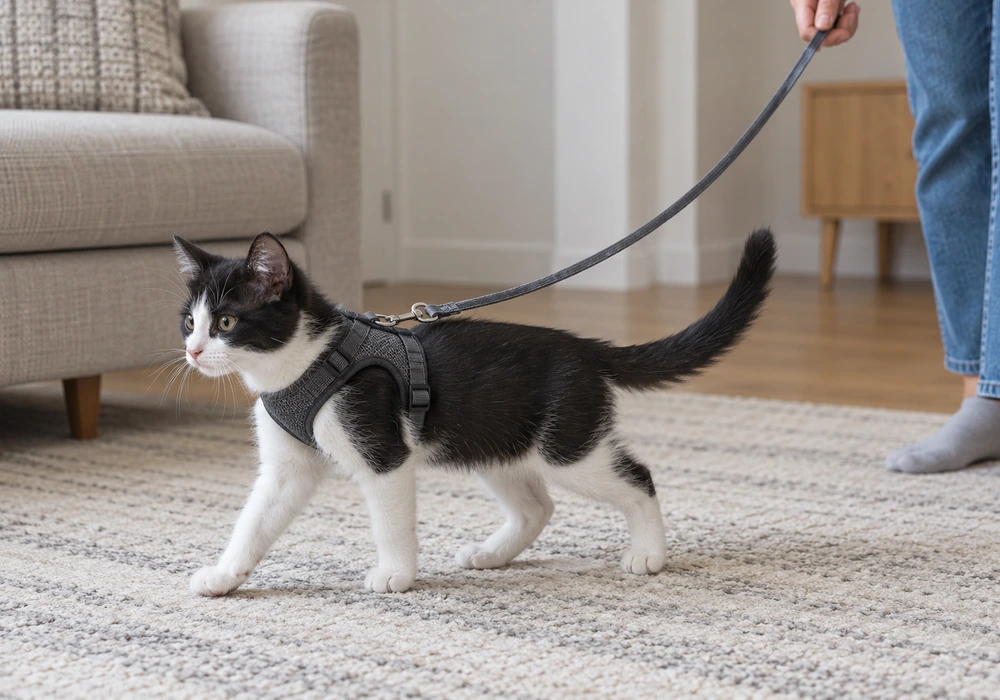
Follow the manufacturer’s fitting instructions, then watch your kitten stand and walk indoors. It should be able to breathe and move normally. Look for rubbing near the front legs, shifting straps, slipping adjusters, or an opening that could slide over the head or shoulders. A finger-gap check alone cannot tell you whether the fit is secure. Recheck before every session as your kitten grows.
Lightweight nylon or polyester straps can be easy to adjust, but narrow edges may rub. A fabric or mesh vest covers more of the body; that coverage can retain heat, and mesh can snag or tear. Check the stitching, buckles, and other closures as well as the fabric. Even a well-fitted harness may allow a kitten to back out. If no suitable size fits, choose another method or wait.
Once your kitten moves comfortably in the harness, introduce a lightweight leash under direct indoor supervision. Clip it to the harness’s intended attachment point, never to a neck collar. Hold the leash rather than tying it to something, and remove the equipment after practice. An unattended leash can catch on objects and trap the kitten.
Practice Coming When Called
Choose a consistent signal, such as your kitten’s name followed by “come.” In a quiet room, reward it for looking toward you or approaching. Gradually practice from different positions, keeping sessions short and rewards within its normal food allowance. Training a kitten breaks down the same approach for other habits, from carrier practice to gentle handling. This response can help during an outing, but a frightened or distracted kitten may not come when called.
Check for Escape Routes and Outdoor Hazards
Inspect the whole area before the first visit. For a catio, check the whole structure: frame, roof, base, doors, and connections to the house. One strong mesh panel cannot make up for a loose latch or an opening underneath it.
- Gaps and openings: Look at corners, hinges, drains, roof edges, and floor-level connections. Openings suitable for an adult cat may be unsafe for a smaller kitten.
- Frame and attachments: Check anchors, screws or other fasteners, latches, and panels for looseness, damage, or corrosion. Get qualified installation advice for wind exposure, roof loads, and connections to the building. Check building requirements and lease restrictions before attaching a structure.
- Surfaces and edges: Cover sharp wire ends and exposed fasteners, remove splinters, and check for door pinch points. Provide a comfortable solid resting surface rather than requiring the kitten to stand on wire.
- Shade and shelter: Check how shade changes as the sun moves. Provide ventilation, a dry resting place, and a route indoors. Attach weather covers securely without turning the enclosure into a hot, poorly ventilated box.
- Entry and access: Plan how to enter, clean, and retrieve the kitten without leaving an escape route open. A double-door entrance lets one door remain closed while the other opens, helping reduce door-dashing.
Soft mesh playpens and carriers should not be assumed to provide secure unattended housing or protection from other animals. Check their zippers, seams, and mesh. For containment netting, check the guidance for kitten use; some systems should not be used until kittens are close to adult size.
Keep your kitten away during construction, painting, and curing—the time a finish or sealant needs to harden as directed. Follow the product’s permitted uses and curing instructions, and remove accessible residues and loose cords before the kitten enters.
Check what is inside the enclosure, too. Remove accessible tools, garden chemicals, and debris. Identify plants by species. The FDA’s lily guidance explains that true lilies and daylilies can cause severe kidney injury in cats. Plant material, pollen, and contaminated water are all concerns. If exposure is suspected, contact a veterinarian or animal poison-control service immediately, even if the kitten seems well.
Prevent hunting, scavenging, and contact with sick or dead birds. Cats are susceptible to H5N1 avian influenza, a bird-flu virus; follow relevant local veterinary or animal-health alerts. An enclosure can still be exposed to small animals or contaminated droppings.
Choose a mild day with shade available throughout the outing. Skip the outing in extreme heat, cold, storms, or other unsuitable conditions. Water and shade do not make an overheating carrier or enclosure safe. Panting, drooling, weakness, or collapse in hot conditions may indicate heatstroke; move the kitten out of the heat and seek urgent veterinary care.

The First Outing, Step by Step
Have one responsible adult handle the kitten and equipment. Keep visitors from crowding around, and assess each kitten individually if you have siblings. A confident kitten can be ready for something its sibling still finds frightening.
1. Get Everything Ready Indoors
Check your kitten’s health, the weather, shade, nearby animals, latches, and route back inside. Have the familiar carrier available for transfers or a retreat where needed. If using a harness, fit it and attach the leash before opening the door.
2. Let Your Kitten Take the First Step
In a connected enclosure: Close and secure the outer doors before opening access from the house. Let your kitten approach, sniff, and step out on its own. Keep the indoor doorway accessible so it can retreat.
With a harness and leash: Use a closed, secured carrier when crossing open or unfamiliar areas. At the chosen quiet location, hold the leash before opening the carrier. Let your kitten come out voluntarily; do not tip it out. Follow its movements with slack in the leash while keeping it away from hazards.
3. Keep the Outing Short and Unhurried
Your kitten may investigate a few smells, take a few steps, or simply watch from the entrance to the catio. You do not need to aim for a particular distance or duration. Watch its response, and help it return indoors if it hesitates or appears tense.
Keep the introduction supervised and in daylight, with a planned return indoors. A first outing should not become an overnight stay. You can time it before a normal meal to encourage a return, but do not fast your kitten. Food and a familiar call cannot reliably prevent escape, so keep the enclosure secured or the leash under control.
4. Head Inside Before Your Kitten Becomes Overwhelmed
Finish the session if your kitten repeatedly tries to escape, stays crouched or frozen without relaxing, or cannot look away from something frightening. Help it return calmly to its familiar indoor space, reward the return, and remove restraint equipment indoors.
Note what it explored, what startled it, and how it behaved afterward, along with the weather and equipment used. Repeat an outing your kitten handled comfortably before expanding the area or staying out longer. Change one thing at a time, such as the explored area or duration.
What If Your Kitten Freezes or Tries to Escape?
Watch for freezing as well as attempts to escape. A kitten that stays still may be frightened rather than relaxed. Look at its posture, ears, tail, movement, and response to its surroundings together. The finer signals, including ear set, tail position, and pupil shape, are described in signs of fear in cats. If your kitten looks tense or overwhelmed, make the situation easier or head indoors.
| What you notice | How to respond |
|---|---|
| Freezes or crouches only when wearing the harness | End the attempt. Check fit, rubbing, weight, and whether indoor practice moved too quickly. Return to easier practice or choose another method if distress continues. |
| Moves normally indoors but freezes at the doorway | Let it return indoors. Reconsider unfamiliar sounds, surfaces, smells, and the route back. Do not pull it across the threshold. |
| An unfamiliar animal approaches or stares through the mesh | Move to the planned retreat. Adjust the location or add a secure visual screen that preserves ventilation and creates no new climbing route. |
| Repeatedly bolts or tries to back out of the harness | Stop the outing and use the carrier or indoor retreat. Check the trigger and fit before trying again. Do not drag a panicking kitten forward. |
Keep unfamiliar cats at a distance, avoid passing the leash between people, and give a hesitant kitten room to retreat. If the same equipment or setting repeatedly causes distress, choose a different activity. Settling work done at home, before any outing, achieves more than coaxing outdoors; how to calm a kitten collects the techniques that work in a familiar room.
What to Check When You Get Back Indoors
Look over your kitten’s coat, paws, and skin for irritation, injury, or parasites. Notice whether it moves, eats, breathes, and behaves normally. Contact your veterinarian promptly about a bite wound, persistent limp, poor appetite, vomiting, or another unusual change. Pause further outings until the cause is assessed.
Open-mouth or labored breathing, collapse, suspected poisoning, or a significant injury needs immediate veterinary care. Breathing difficulty should not be dismissed as excitement or fear. Do not give human painkillers or use unprescribed sedatives for another outing.
Remove waste and debris, refresh drinking water, and clean bowls and washable surfaces as directed. Follow cleaner labels for dilution, rinsing, and drying. Keep your kitten away from wet cleaning products and stored concentrates.
Recheck the enclosure after storms, repairs, relocation, or changes to nearby plants and furniture. Look for new gaps, loose panels, corrosion, or damaged covers, and repair problems before use. Recheck harness fit regularly. Keep your kitten’s weight current in its veterinary record, and ask whether its prescribed parasite product or dose needs to change as it grows.
What If Your Kitten Prefers Staying Inside?
You can skip outdoor outings if they consistently upset your kitten. An indoor home can offer plenty to investigate: resting places, hiding spots, scratching surfaces, play, and opportunities to climb. Simple home changes for cat stress relief shows how to make those activities comfortable and accessible.
Whatever you set up, keep a clear route back indoors and let your kitten choose when to return. If your kitten explores briefly and returns comfortably, finish there. You can repeat the same setup another day before adding anything new.
Disclaimer: this article draws on our own experience of raising kittens and on published veterinary and shelter guidance; it is not a substitute for advice about your own kitten. If it goes off its food, breathes with effort, collapses, is bitten or stung, or you suspect poisoning or heatstroke, contact a veterinarian immediately rather than waiting to see how it settles.