
Cat diarrhea after eating can make the most recent meal look like the cause. However, a meal may trigger a bowel movement without causing the loose stool. A food change or adverse food reaction may be involved; parasites, infection, or an ongoing disease can produce the same pattern. Start by separating what triggered the bowel movement from what made the stool loose.
Medical information and limits of home care. This article is for general education, not a diagnosis or a substitute for veterinary care. The steps below are only for a previously healthy adult cat with mild, newly started diarrhea that is still alert, eating, drinking voluntarily, keeping water down, and passing urine normally. Early onset does not guarantee a mild problem. Kittens, senior cats, cats with existing conditions, and any cat with warning signs need veterinary advice rather than a home-treatment trial.
Check the cat before investigating the food. Seek emergency help for collapse, marked weakness, severe pain, repeated vomiting with inability to keep water down, substantial bleeding, or black, sticky, tar-like stool. Suspected poisoning, a swallowed object, or repeated straining with little or no urine also needs immediate veterinary advice.
Call promptly for diarrhea in a kitten, an elderly or medically vulnerable cat, or a cat with reduced appetite, dehydration concerns, fresh blood, frequent watery stools, or worsening signs. Brief observation fits only a well adult with mild, recent symptoms and no warning signs. Contact the clinic if the diarrhea is not improving within 24 hours of onset, and sooner if anything changes. Our guide to when to worry about cat diarrhea explains the care priorities in more detail.
What to Do First for Mild Cat Diarrhea After Eating
After checking the warning signs above, use these steps only for a well adult cat during a brief observation period. They support feeding, comfort, and monitoring; they do not identify or treat every possible cause.
1. Simplify the menu. Pause newly introduced treats and toppers, and leave out table scraps and milk. Keep one familiar, tolerated complete cat food available rather than testing several recipes. If the problem began during a food change, ask the clinic whether returning to the previous safe diet is appropriate. Do not change a prescribed diet or essential medication without advice.
2. Offer small, frequent meals instead of fasting. Measure the usual appropriate daily food allowance and divide it into smaller servings rather than one large meal. Do not deliberately cut the total intake to rest the gut. Plain chicken or rice is not complete nutrition, so keep it to a short period agreed with the clinic rather than using it as a diet. Cats Protection’s digestive-care guidance describes smaller, more frequent servings of the usual food when a cat is otherwise well, and offers a brief bland alternative such as plain boiled chicken. Call if your cat refuses food.
3. Make drinking easy. Keep clean, fresh water in easy-to-reach bowls, with an extra bowl near the resting area if helpful. Continue familiar wet food if it is already tolerated and fits the feeding plan. Do not force water with a syringe; International Cat Care’s drinking guidance explains the risk of distress and fluid entering the lungs. Contact the clinic if dehydration is suspected.
4. Keep the routine calm and observable. Provide a quiet resting place and an easily accessible litter tray. Feed separately in a multi-cat home so you can measure intake. Scoop promptly, wash hands after litter cleaning, and clean bowls after use. Record each loose stool, any vomiting, and changes in appetite or energy.
5. Set a clear review point. Contact the clinic if stools are not improving within 24 hours of the first episode. Seek help sooner for worsening signs, reduced eating, blood, frequent or profuse watery diarrhea, pain, or vomiting. Do not wait for the 24-hour mark if a warning sign appears. This brief observation limit follows PDSA’s diarrhea guidance.
Why Cat Diarrhea After Eating Can Be Misleading
Eating can stimulate movement in the colon, a response known as the gastrocolic reflex. The Merck Veterinary Manual, in its chapter on large-intestine disease, describes these propulsive movements as common after meals. They can move feces that were already in the large intestine; they do not show that the meal just eaten has traveled through the entire digestive tract.
This explains the timing of defecation, not the diarrhea itself. A formed stool after breakfast is different from repeated watery stools. Record episodes between meals and overnight as well. The following five categories organize possible causes; they are not a ranking from most to least likely, and more than one can apply.
1. Cat Diarrhea After Eating a New Food
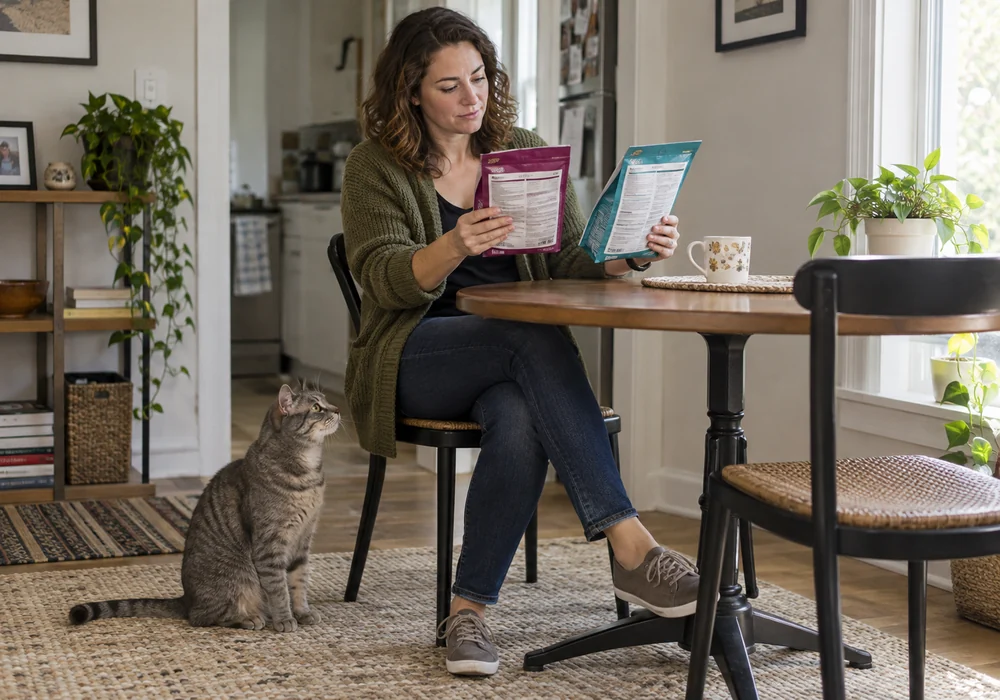
If cat diarrhea after eating began with a new food, compare the whole feeding routine. A different recipe changes more than its main protein: fat, fiber, calorie density, digestibility, and moisture may all change together. The relevant exposure could also be a new topper, milk, table scraps, a supplement, larger portions, or access to another cat’s bowl.
Ask everyone in the household what they have offered. Note the exact recipe, dates, and amounts rather than simply “one bowl.” Two foods can provide different calories in the same volume, and several small treats can add up. A stressful change in routine may coincide with the new food and complicate the picture; our article on helping a stressed cat covers the signs that a recent upheaval is still affecting a cat.
For a stable adult without warning signs, pause new nonessential extras and discuss a consistent feeding plan with the veterinarian. Make future planned transitions gradually at a pace suited to the cat and the clinical reason for the change. Repeatedly alternating brands after each loose stool makes the response harder to interpret. For more on planning a food change, see our guide to changing cat food safely.
The exception is a reasonably suspected unsafe food: stop offering it and arrange a suitable replacement rather than continuing it just to avoid an abrupt change. Also, eating quickly is not a sufficient explanation for persistent diarrhea, even when the cat does both.
2. Food Reactions and Cat Diarrhea After Eating
Recurring cat diarrhea after eating may lead the veterinarian to consider an adverse food reaction. Intolerance is a nonimmune response; poor lactose digestion is one example. Food allergy involves an immune reaction to dietary components. Loose stool alone cannot distinguish them.
Persistent itching or skin problems alongside digestive signs can make a food reaction more suspicious, but their absence does not exclude it. A cat can also react to a food it has eaten before. “Premium,” “natural,” and “grain-free” labels do not establish tolerance or identify an allergy.
How a Controlled Diet Trial Answers the Question
The veterinarian may choose a complete, life-stage-appropriate novel-protein diet, using a protein new to this particular cat, or a hydrolyzed-protein diet, in which proteins are broken into smaller fragments to reduce immune recognition. Neither approach guarantees success. The CAVN/VCA guide to feline elimination–challenge trials explains the process.
A useful trial controls treats, toppers, supplements, food used for pills, flavored medicines, and access to other food. Review essential medication with the clinic rather than stopping it. Manufacturing controls that limit unintended protein exposure also matter; a similar ingredient list is not enough to make two diets interchangeable.
Follow the agreed duration and reassessment plan. If the cat improves, a veterinarian-directed challenge with the previous diet or selected ingredients may help confirm the relationship. Do not challenge with food suspected of contamination, and contact the clinic if the trial food is refused. Blood, hair, or saliva allergy panels are not reliable substitutes.
A 2001 elimination–challenge study by Guilford and colleagues in the Journal of Veterinary Internal Medicine shows why improvement needs interpretation: among 55 selected cats with chronic unexplained gastrointestinal problems, 16 were classified as food-sensitive. Another 11 improved on the elimination diet without relapsing when their previous food returned. These were selected clinical cases, not a population-wide allergy estimate, and food sensitivity does not automatically establish an immune mechanism.
3. Contaminated Food or an Infection
When investigating cat diarrhea after eating, review food storage as well as ingredients. Spoiled food, damaged packaging, raw products, and contaminated bowls are relevant exposures. However, an intestinal infection can also come from the environment; noticing diarrhea after a meal does not establish where or when the infection began.
Several animals becoming ill after sharing a product raises concern, although they may share other exposures too. Stop a reasonably suspected unsafe product, retain its packaging and lot details, and call the veterinarian. Ask whether remaining food should be kept for investigation and how to handle it. Do not feed it again to test your suspicion.
Freezing, freeze-drying, or dehydrating raw animal ingredients does not reliably eliminate all pathogens. A dry-looking treat is not necessarily cooked. Raw food is therefore not an appropriate experiment for an unexplained “sensitive stomach.” An infectious possibility also does not automatically justify antibiotics.
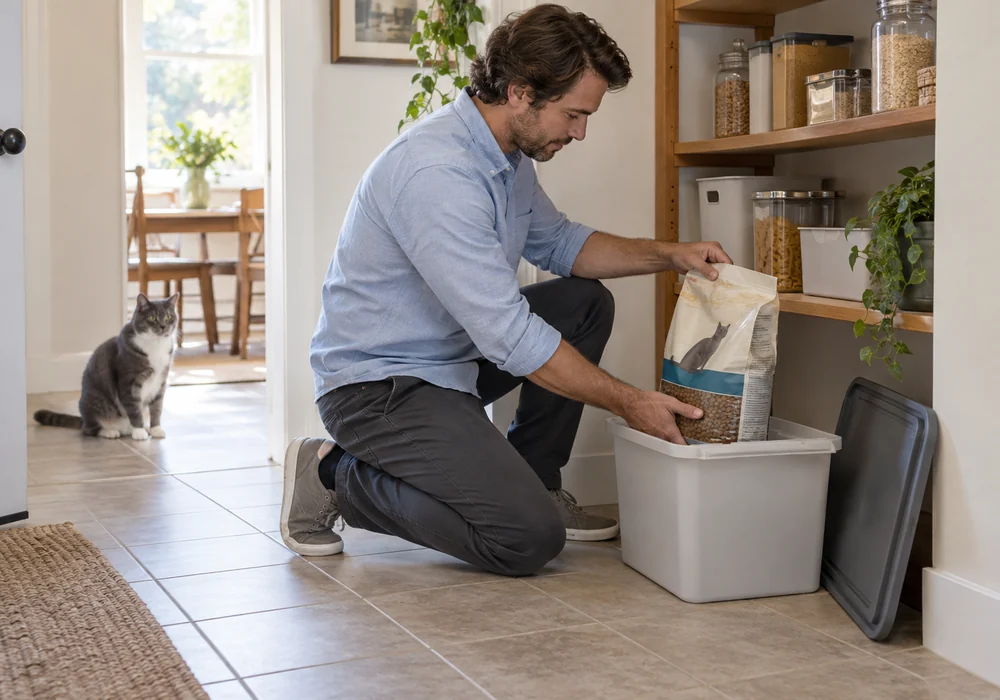
The FDA’s food-handling guidance recommends keeping dry food in its original bag at below 80°F, about 27°C, and promptly covering and refrigerating unused wet food at 40°F, about 4°C, or below. Follow the product’s storage limits, wash bowls and utensils after use, and keep the feeding bowl separate from the scoop. Contaminated food and feces can expose people as well as cats.
4. Intestinal Parasites
Parasites can disrupt intestinal function between meals; eating may simply prompt the cat to pass the abnormal stool. Recent adoption, group housing, and exposure to infected feces are useful clues. Indoor living and a previous deworming dose do not exclude every parasite or prevent every later exposure.
Giardia can occur with diarrhea or without obvious illness. Tritrichomonas is particularly relevant to persistent large-intestinal diarrhea in young cats from group housing, and affected cats may remain active and playful. Roundworms and coccidia are additional considerations, especially in kittens. Mucus, frequent small stools, or odor cannot identify the organism.
The veterinarian may combine fecal examination with targeted antigen or PCR tests, or request additional samples. Different tests require different handling, so ask about collection and storage instead of automatically freezing a sample. A negative routine test does not exclude all parasites, while a positive result still needs to fit the symptoms and history. Treatment and household cleaning should match the organism.
5. An Underlying Digestive or Systemic Disease
Cat diarrhea after eating with weight loss, vomiting, or a changing appetite deserves assessment even if the cat still looks eager for meals. Intestinal inflammation, food-responsive disease, and intestinal lymphoma can overlap in outward signs. Ultrasound can help investigate them, but it cannot reliably distinguish every inflammatory condition from lymphoma on its own.
Problems with digestion or nutrient absorption are another possibility. In exocrine pancreatic insufficiency (EPI), the pancreas supplies too few digestive enzymes. A feline trypsin-like immunoreactivity (fTLI) blood test helps investigate EPI, and a result at or below 8.0 mcg/L is diagnostic. Cobalamin, or vitamin B12, testing belongs alongside it, because almost all cats with EPI are cobalamin deficient and enzyme replacement alone may not settle the signs. Confirmed EPI needs prescribed enzyme replacement and nutritional monitoring, rather than an arbitrary “digestive enzyme” supplement.
Hyperthyroidism can cause weight loss despite increased eating, sometimes with diarrhea, vomiting, or increased thirst, particularly in older cats. Our article on increased appetite in cats explains how those changes fit together. Meal timing alone does not identify thyroid disease or justify a particular test. If weight has already come off, our guide to helping a cat gain weight sets out what to track before that appointment.
Bring the full medicine and supplement list to the appointment. Depending on examination findings, the workup may include fecal tests, blood and urine tests, targeted pancreatic or thyroid testing, imaging, or tissue sampling. Persistent or recurring signs need a defined investigation, not an endless sequence of new foods.
Build a Useful Record of Cat Diarrhea After Eating
A short timeline helps separate a feeding association from an all-day problem. Record what actually happened without assuming the interval between a meal and a stool measures the transit time of that food.
Record any hairball episodes separately from loose stools. For related context, see our guide to cat hairballs and diarrhea.
| Record | Useful details | Why they help |
|---|---|---|
| Meals and extras | Time, exact recipe and lot, amount offered and eaten, treats, supplements, and other food access | Identifies changes and actual intake. |
| Every stool | Time, consistency, frequency, approximate amount, mucus, blood, and straining | Shows whether episodes also occur away from meals. |
| The whole cat | Appetite, activity, vomiting, drinking, observed urine, and weight trend when safely measurable | Helps identify illness that a food-focused history could miss. |
| Previous changes | Diet trials, parasite treatments, medicines, prior results, and illness in other household animals | Makes improvement, recurrence, and test results easier to interpret. |
In a shared household, establish which cat passed the stool. Photographs of the stool and food label can help; collect a physical sample only as the clinic directs. Do not delay urgent care to finish a record or obtain a sample.
Choose Food for a Defined Purpose
A highly digestible gastrointestinal diet aims to support digestion. An elimination diet controls dietary exposure to investigate an adverse reaction. Those goals overlap in some patients, but the diets are not automatically interchangeable.
Neither wet nor dry food is a diagnosis or a universal treatment. Tolerated wet food can contribute water, but it cannot replace treatment for significant dehydration. Fat and fiber choices depend on the whole formulation and the clinical problem; different fibers behave differently, and more is not always better. Moisture also changes label percentages, so compare nutrient values on a consistent basis.
A 2011 randomized diet comparison by Laflamme and colleagues in the Journal of Veterinary Internal Medicine enrolled 60 cats with chronic diarrhea; 55 completed six weeks. Across two highly digestible diets with different fat contents, 78.2% met the study’s improvement criterion: a rise of at least 25 points or a final score of at least 66 on its 0–100 fecal scale. Clinical responses did not differ significantly between diets. With no untreated control and manufacturer-affiliated authors, this supports a role for dietary management in selected cats, not a universal low-fat cure or equivalence of all foods.
Keep the chosen diet nutritionally complete for the appropriate life stage. Our guide to prepared food for kittens explains growth labels and nutrient comparisons; it is not a treatment plan for a sick kitten. Plain meat, rice, milk, or broth should not replace complete nutrition.
What About Probiotics or Anti-Diarrhea Products?
A veterinarian may recommend a cat-specific probiotic, a suitable gastrointestinal diet, or treatment for an identified cause. Ask which product, feeding amount, and review point apply to your cat. Do not give human anti-diarrhea medicines, leftover antibiotics, or an unselected dewormer. VCA’s diarrhea guidance explains why medications and supplements should be selected with veterinary advice.
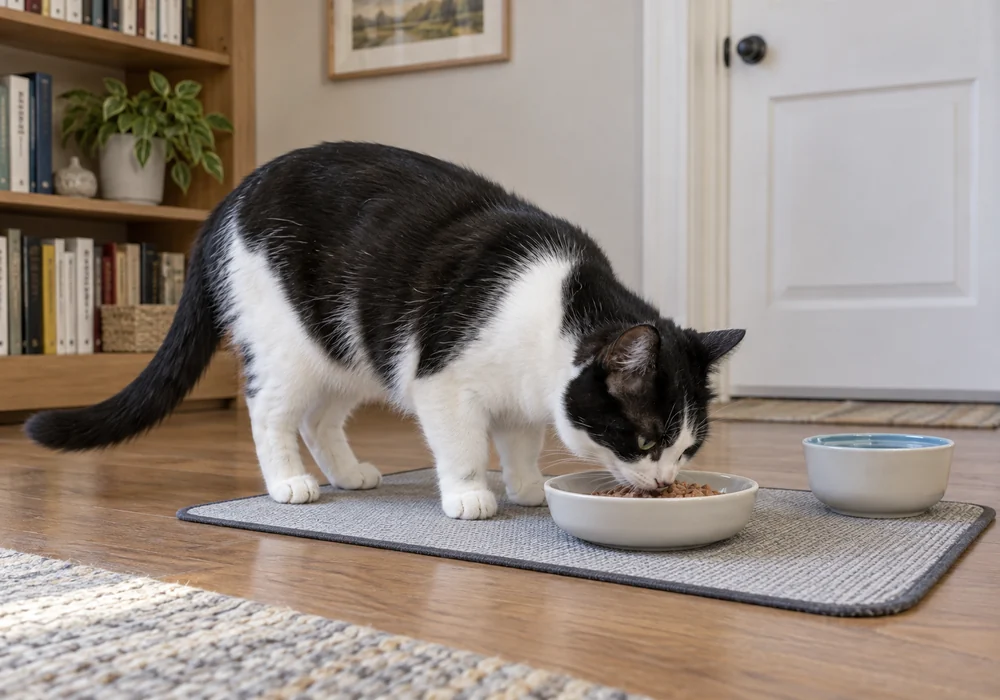
For a stable adult that wants to eat and has no warning signs, small, frequent portions of a suitable tolerated food and ready access to water may fit a brief observation plan. Do not routinely fast the cat, force food or water, give human antidiarrheals, or stack several new supplements. Reduced eating, deterioration, or recurrence calls for veterinary reassessment.
The useful question with cat diarrhea after eating is not simply “Which food should I buy next?” It is “What changed, what else is happening, and what evidence will help identify the cause?” A consistent feeding history and a plan matched to the cat provide a better answer than the timing alone.
Disclaimer: this article draws on our own experience living with cats and on published veterinary and welfare guidance; it is not a diagnosis for your cat. If the diarrhea lasts beyond 24 hours, or comes with repeated vomiting, blood in the stool, a swollen or painful abdomen, marked tiredness, or refusal to eat or drink, contact a veterinarian rather than trying another food.