
FIP diarrhea can occur when feline infectious peritonitis affects the intestines, but loose stools alone do not mean a cat has FIP. Diarrhea has many possible causes, and even a positive fecal coronavirus test cannot establish this diagnosis. A cat with suspected or confirmed FIP needs the cause of its digestive signs assessed while its food intake and hydration are protected.
FIP is treatable with modern veterinary care. Food can support an ill cat, but no diet or supplement has been shown in the reviewed research to cure FIP. The useful next steps are to recognize when help is urgent, understand what testing can show, and agree on a feeding plan your cat can actually tolerate.
When Diarrhea Needs Prompt Veterinary Care
Seek emergency care for difficulty breathing, collapse, seizures, severe weakness, substantial bleeding, or repeated vomiting that prevents your cat from keeping water down. Call the clinic and arrange transport; a food change should not delay assessment.
If FIP is suspected or has already been diagnosed, contact the treating veterinarian promptly when diarrhea worsens or appears with reduced eating, vomiting, or lethargy. Kittens and already debilitated cats need especially early attention.
Do not give an over-the-counter anti-diarrhea medicine without veterinary advice; some products can be harmful to cats.
A bright cat that is eating normally after one loose stool may need a different response from a cat that is declining. Record what happened and ask the clinic for a plan. Persistent or recurrent diarrhea still warrants investigation, and Cornell’s guidance on feline diarrhea is direct about the threshold: diarrhea lasting longer than a day or two and accompanied by poor appetite, lethargy, or vomiting should be seen as soon as possible.
For a general overview of warning signs, see our guide to when to worry about cat diarrhea.
How FIP and Diarrhea Are Connected
Feline coronavirus, usually shortened to FCoV, commonly infects the intestinal tract. Many infected cats remain well, while some develop digestive signs. In a minority of infected cats, changes in the virus and the cat’s response to infection contribute to FIP, a disease that causes inflammation beyond the gut.
When FIP involves the intestinal wall or nearby tissues, it can interfere with normal digestion and cause vomiting or diarrhea. However, a cat with FIP can also have an unrelated or concurrent problem, such as parasites, a food change, or another intestinal disease. Loose stools are not automatically “early FIP,” and every new episode in a treated cat does not necessarily have the same cause.
“Wet” and “dry” FIP describe fluid accumulation, not stool consistency. Wet, or effusive, FIP involves fluid in a body cavity, commonly the abdomen or chest. Non-effusive presentations lack obvious fluid accumulation, although presentations can overlap or change. Neither term tells you what the stool should look like.
There is no distinctive color, smell, or appearance that identifies FIP diarrhea. A photograph can document a change, but it cannot distinguish FIP from other causes. Persistent fever, appetite loss, weight loss, abdominal swelling, or changes involving the eyes or nervous system may increase concern; they still need veterinary interpretation.
What Testing Can—and Cannot—Tell You
A veterinarian evaluates the whole illness: its history, examination findings, blood results, and sometimes imaging. If fluid or abnormal tissue is present, testing an appropriate sample can provide much stronger evidence than checking stool alone.
- Positive fecal FCoV PCR: coronavirus genetic material was detected in that stool sample. Many cats without FIP shed FCoV, so the result does not diagnose FIP or prove that coronavirus caused the diarrhea.
- Negative fecal FCoV PCR: viral shedding was not detected in that sample. This does not rule out FIP.
- Coronavirus antibodies: these indicate an immune response to exposure, not a stand-alone diagnosis of FIP.
- Fluid or affected-tissue investigations: examining cells or tissue and testing for FCoV can help establish how likely FIP is. The sample, method, and other findings determine what a result means.
The ABCD FIP guideline emphasizes this distinction between detecting coronavirus and diagnosing FIP, and notes that a diagnosis built on a single positive antibody or PCR result is not reliable. A useful question for the clinic is: “Which findings support FIP, and which investigation would help distinguish it from the alternatives?”
Diarrhea also needs its own investigation. Depending on the history, the veterinarian may check for Giardia or other parasites, food-responsive disease, chronic intestinal inflammation, or pancreatic problems. Persistent signs sometimes require investigation for intestinal lymphoma, a type of cancer. No single negative stool test excludes every parasite, and food alone will not reliably treat a parasitic infection.
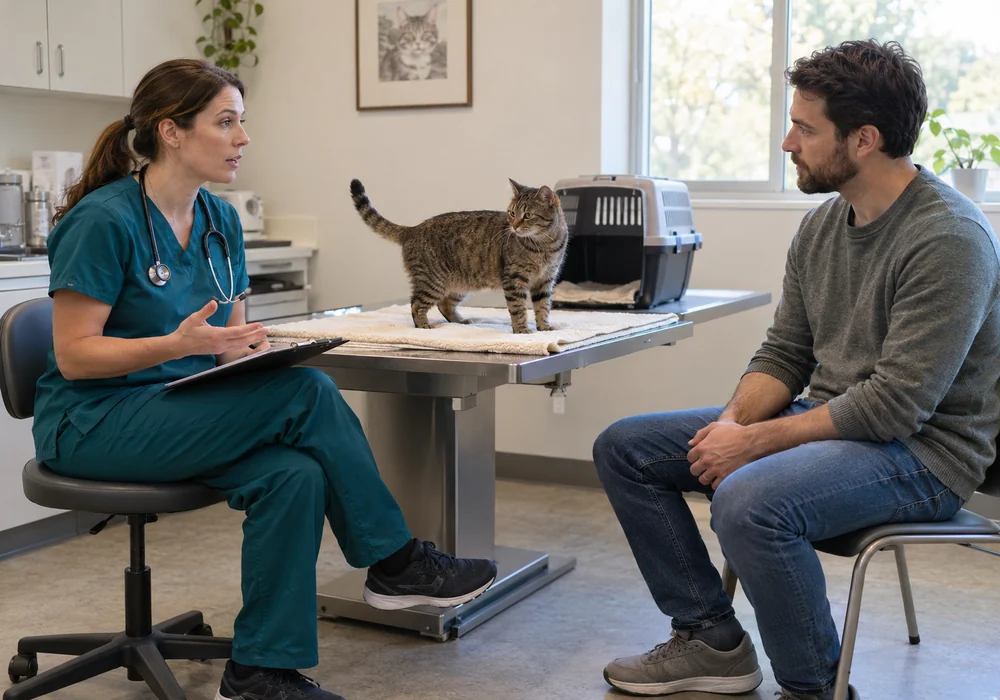
Choosing Food for FIP Diarrhea Care
There is no single best food for FIP diarrhea. The right choice depends on the cause of the intestinal signs, the cat’s life stage, other illnesses, and how much it will eat. Before buying another “sensitive stomach” recipe, ask what the food change is intended to achieve and when the result will be reviewed.
For the main diet, check nutritional adequacy rather than relying on the front label. A complete feline food supplies required nutrients; a topper or a bowl of plain chicken does not necessarily do so. Growing kittens need growth-appropriate nutrition unless the veterinarian selects a different therapeutic plan. Our guide to choosing prepared food for kittens explains the label distinctions in more detail.
| Food option | When to discuss it with your veterinarian |
|---|---|
| Familiar complete food | May preserve voluntary eating while a stable cat is assessed. Confirm that it is tolerated, suitable for the cat’s life stage, and eaten in sufficient amounts. |
| Veterinary gastrointestinal diet | May help manage selected digestive problems. The clinic chooses digestibility, calorie density, and fiber characteristics for the individual case. |
| Hydrolyzed or novel-protein diet | May be used for a controlled trial when food-responsive disease is suspected. Hydrolyzed proteins are broken into smaller fragments; a novel protein is one the cat has not eaten before. Other foods and treats can interfere with interpreting the trial. |
| Recovery formula or assisted nutrition | May be needed when ordinary eating cannot meet the clinical plan. The formula, feeding route, and amount require veterinary selection. |
Wet Food, Dry Food, and Fat Content
Wet food contributes water and may offer an accepted texture. Dry food often provides more calories per gram. Neither format is automatically better: an uneaten wet meal supplies little nutrition, while a concentrated food is useful only if the cat accepts and tolerates it.
Low fat is not a universal rule either. In a randomized, double-blinded six-week trial of chronic diarrhea in cats, 60 cats were enrolled and 55 completed the study. Fecal scores improved significantly, with 78.2% of cats improving by at least 25 points on a 100-point scale or reaching a final score of at least 66, and more than one third developing normal stools. The researchers did not detect a difference between the two fat levels, and improvement was usually visible within the first week. This was not an FIP study, so it does not establish an ideal diet for every cat with FIP, and the authors worked for the company whose diets were tested.
Agree on any transition with the clinic. A gradual switch may suit a stable cat, but a sick cat needs an individualized plan. Do not withhold food to make your cat accept a replacement, and avoid changing the main diet, treats, and several supplements at the same time. For more on stool changes around meals or a diet switch, see our guide to cat diarrhea after eating.
Protect Food Intake and Hydration
Diarrhea can increase water and electrolyte losses while illness reduces eating. That combination makes actual intake important. Set a daily calorie goal with the veterinarian rather than assuming that the amount on a package is the right recovery allowance.
Measure What Your Cat Eats
Zero the scale with the empty dish on it, weigh the food offered, and weigh leftovers before discarding them. Account for spills and include any other permitted foods. Use the calorie information for the exact recipe.
Illustrative calculation—not a feeding prescription
60 g offered − 15 g left = 45 g eaten.
If that food supplies 1 kcal per gram, the portion eaten supplied approximately 45 kcal. This example does not set your cat’s daily target. Water added to food increases its volume, but adds no calories.
Calorie tracking is useful during FIP diarrhea care because a few licks or an apparently full bowl can hide inadequate eating. Our guide to measuring food for a cat that needs to regain weight covers portion calculations; the treating veterinarian should set this patient’s target.
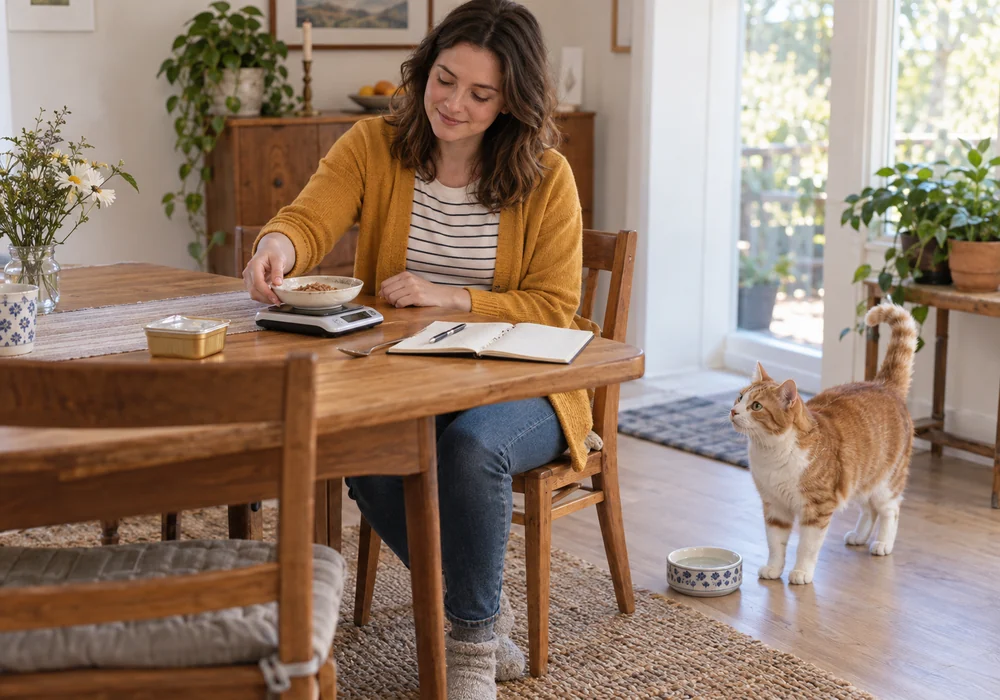
Make Eating Easier Without Forcing It
Offer small, fresh portions in a quiet, accessible place. Use a familiar texture if it fits the plan, and ask whether gentle warming or a different presentation might help. In a multi-cat home, supervise separate meals so you know which cat ate the food.
If your cat stops eating or eats substantially less, contact the clinic promptly rather than waiting for hunger to win. Nausea, pain, dehydration, or the underlying illness may need treatment. If voluntary eating remains insufficient, the team may recommend a feeding tube and a supervised nutrition plan.
Do not push food or water into a resisting cat’s mouth. Syringe feeding can cause distress, food aversion, and aspiration, meaning material enters the airway. A veterinary feeding tube is a different, carefully assessed intervention. Severely depleted cats also need controlled refeeding and electrolyte monitoring rather than large catch-up meals.
Water in Food Does Not Replace Fluid Assessment
Keep fresh water easy to reach. Accepted wet food can contribute moisture, but it may not correct dehydration or electrolyte losses. FIP can cause fluid to collect in the abdomen or chest while other fluid-balance problems coexist. A swollen abdomen does not remove the need for a fluid assessment, and fluids should not be improvised at home.
What About Probiotics, Pumpkin, and Homemade Meals?
In FIP diarrhea care, an added product should have a specific purpose and a review point. A 2025 systematic review and meta-analysis of probiotics, prebiotics, synbiotics, and postbiotics in cats included 20 reports. Five of the seven probiotic trials showed a beneficial direction of effect on fecal consistency, but the authors concluded that the evidence did not permit a high-confidence judgment of overall effectiveness, and they called for research in sick cats before wider supplementation is advocated. It did not establish biotics as essential FIP treatment or as a cure.
If a probiotic is suggested, ask which strain and preparation the veterinarian recommends, what improvement to look for, how to store it, and when to reassess. Evidence for one preparation does not automatically apply to every product labeled “probiotic.”
Fiber may help selected intestinal problems, but more is not always better, and pumpkin has no established FIP-specific dose or antiviral effect in the reviewed research. Persistent intestinal disease may also justify checking cobalamin, or vitamin B12, and replacing it when indicated.
Plain chicken, tuna, and similar additions should not displace a complete diet. Milk can worsen digestive upset in susceptible cats, while raw food adds avoidable infection risks. A long-term homemade diet needs expert formulation. Discuss additions before altering a therapeutic feeding plan.
Diarrhea During FIP Treatment: What to Report
Antiviral treatment, including veterinarian-directed use of GS-441524, remdesivir, or molnupiravir, has changed the outlook for FIP. The 2026 ABCD treatment update describes FIP as now treatable and frequently curable, and also emphasizes supportive care and monitoring. The preparation, treatment duration, and prescribing options depend on the individual cat and the region.
Diarrhea has been reported during antiviral treatment. However, its onset after a medicine is started does not, by itself, prove that medicine caused it. Intestinal disease, another infection, diet changes, or treatment-associated effects may contribute.
Tell the prescriber when the diarrhea began, how often it occurs, what changed in the diet, and whether there have been other new medicines, vomiting, or missed doses. Do not independently stop, repeat, or change a dose because of a stool change. Ask about the exact preparation before crushing medicine or mixing it into food; a partly eaten medicated meal can leave the delivered dose uncertain.
If appetite increases during treatment, our guide to increased appetite in cats offers general background to discuss with the treating veterinarian.
How to Monitor FIP Diarrhea at Home
Keep a short daily record that can be compared with the clinic’s goals. Note stool frequency and consistency, blood or mucus, vomiting, exact food intake, and prescribed medicines given. Add changes in energy, drinking, urination, or breathing. In a multi-cat household, identify whose stool you are recording.
If you are also noting hairball episodes, see our guide to cat swallowing hairball.
Agree on a weighing schedule and use the same scale under similar conditions. Weight needs context in FIP: losing accumulated fluid can lower the reading while the cat improves, and gaining fluid can hide muscle loss. Send the trend with appetite and other observations; dose adjustments belong to the prescriber.
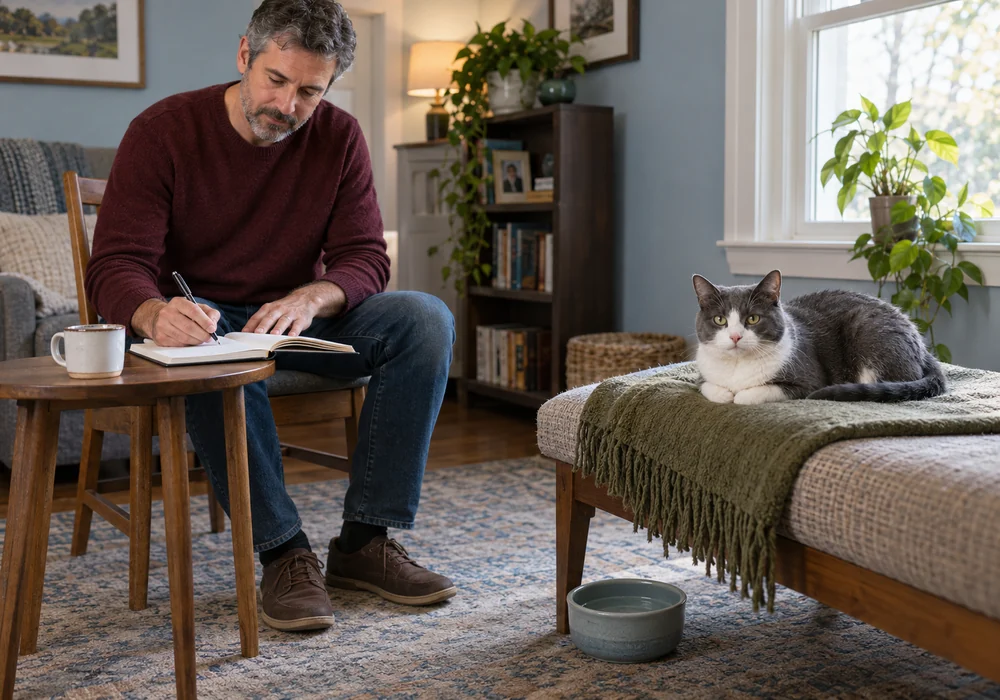
Keep food preparation separate from litter cleaning, remove feces promptly, wash hands, and clean bowls and utensils after use. FCoV commonly spreads through fecal contamination, so ask the clinic about household hygiene if several cats are affected. Refrigerate or discard unused wet food promptly and follow its storage instructions.
Improvement in FIP diarrhea is encouraging, but firmer stools do not confirm remission or prove that nutrition is adequate. Report reduced eating, worsening condition, or continuing symptoms rather than endlessly rotating foods. Disease-directed treatment, suitable nutrition, and follow-up need to work together.
This guide combines published veterinary guidance with years of living with cats; it is general information, not a diagnosis or treatment plan for your cat. FIP still needs a veterinarian. Contact the clinic the same day if your cat stops eating, becomes withdrawn or weak, breathes with effort, vomits repeatedly, passes blood, or has diarrhea lasting more than a day or two.