
Kitten care · A practical selection guide
The best calming kitten treats are suitable for your kitten’s exact age and current weight, disclose their active ingredients and amounts, and come in a form your kitten willingly eats. Before buying, ask your veterinarian whether a supplement fits the problem. A kitten that needs more play, relief from pain, or a safer place to rest needs that help first.
Choose for the individual kitten rather than the strongest formula or the longest ingredient list. Research in cats offers some encouraging findings, but it does not establish one best product, dose, or minimum age for every kitten. Successful support should leave your kitten comfortable, alert, and able to behave normally.
Fits this kitten
The product’s feline directions cover your kitten’s age and current weight. If either is unclear, resolve that before feeding it.
Makes the serving clear
You can identify the active ingredients, their amounts per serving, and how much your kitten would actually eat.
Comes with a workable plan
You know when to give it, how to store it, what improvement to watch for, and when to contact your veterinarian.
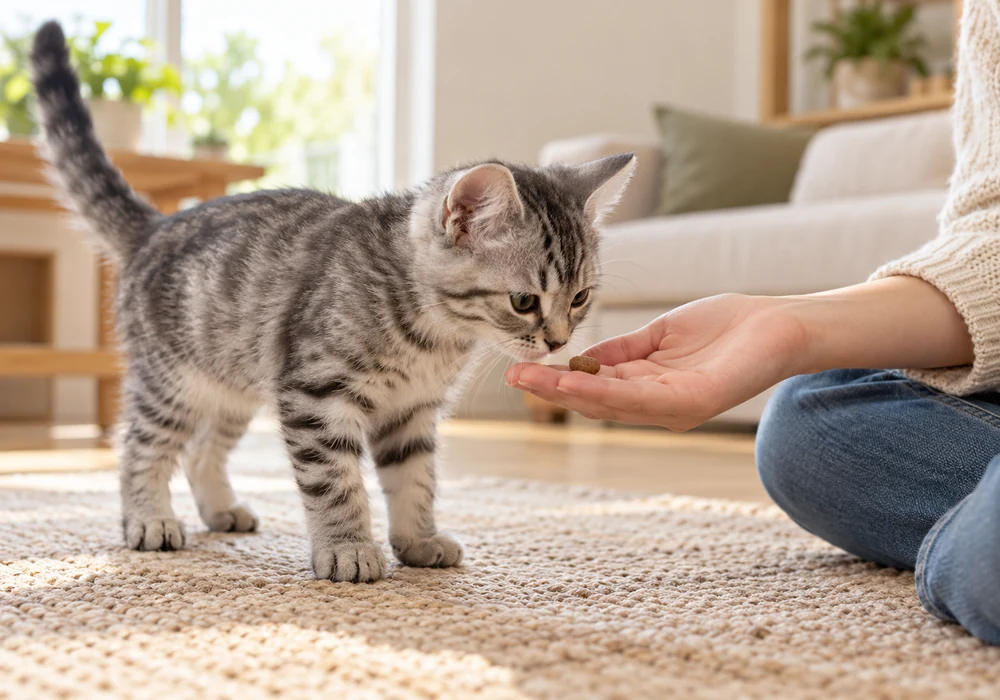
Start with the situation
Decide Whether a Calming Supplement Fits the Problem
Start with a specific observation: your kitten hides whenever visitors arrive, backs away from the carrier, or becomes tense during gentle handling. Note what happens beforehand and whether eating, activity, and litter-box habits have changed. These details help your veterinarian distinguish fear from normal play, discomfort, or illness.
Running, pouncing, and short bursts of evening activity do not, by themselves, justify a calming supplement. A newly adopted kitten may need time and predictable care. Keep a quiet retreat available and let your kitten control contact. These gentle ways to help a kitten settle remain part of the plan even if a supplement is recommended.
Also distinguish a formulated supplement from a food reward. A supplement contains ingredients intended to support a behavioral effect; an ordinary treat can reward a voluntary action without having an anti-anxiety effect, and the everyday kitten treat options show how that distinction works in practice. The basics of reward-based kitten training explain how suitable food rewards support learning.
Calming kitten treats should not be used to make a frightened kitten tolerate handling it is trying to escape. Severe fear, persistent withdrawal, or behavior that interferes with normal daily life calls for veterinary assessment and a broader plan. A wider approach to cat stress explains what that plan usually includes.
Read before buying
Read the Calming Kitten Treats Label Before Buying
Use the exact package you intend to buy. Formulas, serving sizes, and directions can differ between products from the same brand and between countries.
- Confirm the species. The directions must include cats. Do not adapt a dog-only chew by cutting it into a smaller piece.
- Check minimum age and weight. Both matter. A kitten can meet an age requirement while remaining below the product’s weight range.
- Find the active amount per serving. Check whether a serving means one chew, two chews, a whole tube, or a measured quantity of powder.
- Read the full ingredient list and cautions. Include flavorings, other active ingredients, and warnings about medications or health conditions.
- Check traceability. Look for a manufacturer contact, lot number, expiration date, and clear storage instructions.
Is 12 Weeks a Universal Starting Age?
No. If a particular product says it is for kittens 12 weeks and older, follow that restriction. It does not establish that every calming product becomes suitable at 12 weeks, or that all products share the same restriction. If kitten use is unclear, ask the manufacturer and your veterinarian before feeding it.
Kittens are growing, and studies in older cats may not answer questions about their safety or dosing. Adult cats still need a product matched to their health, weight, and medications. Senior cats require their own assessment: a new behavior change can accompany pain or disease, and an adult-cat serving should not be copied automatically. Neither group provides a shortcut for choosing a kitten’s supplement.
Compare Milligrams on the Same Basis
Do not give extra chews to match a dose found in a study. Doing so also increases every other ingredient and the calories. A larger number is not automatically more effective or more suitable. A blend that lists only a combined weight also makes individual ingredient amounts harder to assess.
Ask What the Quality Claims Mean
The NASC Quality Seal requirements include an independent quality audit, labeling standards, adverse-event reporting, and random independent product testing. Those are useful manufacturing and monitoring safeguards. The seal does not mean FDA approval or prove that a formula treats anxiety in kittens.
Ask how the manufacturer verifies ingredient identity, finished-product amounts, contamination control, and stability through expiration. For probiotics, ask whether the stated organism count applies through the end of shelf life. Terms such as “natural,” “grain-free,” and “cold-extruded” do not establish clinical effectiveness.
Understand the evidence
Compare Ingredients With the Research in Cats
When comparing calming kitten treats, separate three questions: has the ingredient been studied in cats, was the tested formulation comparable, and were the cats similar in age to your kitten? A dog study or a laboratory mechanism cannot answer all three.
2018 · Open-label study
L-Theanine: Promising Findings With Important Limits
L-theanine is an amino acid found in tea leaves. A 2018 study of L-theanine in 33 cats reported improvements in stress-related signs during 30 days of treatment. The cats ranged from about five months to 16 years old.
The study was open-label and had no placebo group, so the owners and investigators knew treatment was being given. Its results cannot establish how much improvement came from the supplement itself or predict an individual kitten’s response. It studied a particular tablet and schedule, not every chew containing L-theanine. Do not turn its results into a guaranteed kitten success rate or a home dosing instruction.
2007 · Placebo-controlled study
Alpha-Casozepine: Milk-Derived Does Not Mean Ordinary Milk
Alpha-casozepine is associated with a hydrolysate of bovine casein, a milk protein broken into smaller peptides. A 2007 placebo-controlled study of alpha-casozepine enrolled 34 cats and ran for 56 days. It reported benefits for anxiety-related behavior, but the youngest enrolled cat was nine months old.
That is useful feline evidence with a clear age limitation. It does not establish a dose or safety profile for a very young kitten. A measured casein hydrolysate is also different from giving milk, and the weight of a hydrolysate is not interchangeable with the weight of a purified peptide. Ask about suitability if your kitten has a suspected milk-protein reaction or follows a prescribed diet.
Other Blends and Probiotics Need Their Own Evidence
Some formulas combine L-theanine with colostrum-derived ingredients, L-tryptophan, thiamine, or herbs. Evidence for one ingredient does not prove that every combination works. Colostrum complexes and alpha-casozepine are different preparations; their milligram amounts cannot be compared as equivalents. Thiamine is vitamin B1, but its presence alone does not demonstrate a calming benefit.
Some veterinary products use the probiotic strain Bifidobacterium longum BL999. Feline research is preliminary and strain-specific. A product labeled simply “probiotic” cannot borrow that evidence, and it should not be expected to provide immediate relief during a frightening event.
Herbal ingredients also deserve individual review. “Herbal” is not a kitten safety category, and making a cat less active is not sufficient evidence of reduced fear. Show your veterinarian the whole formula, including any supplements or medicines already being given, before combining products.
Screen Out Unsuitable Substitutes
Do not substitute human sleep gummies, dog-only calming products, or an unidentified hemp preparation. Propylene glycol is not permitted as an added ingredient in U.S. cat food, so a product containing it is not an appropriate cat-food choice.
CBD is not an established home calming treatment for kittens. The FDA’s animal-use guidance on cannabis and CBD states that it has not approved cannabis for any use in animals and cannot assure these products’ safety or effectiveness. Do not infer a calming benefit from hemp imagery or the word “natural.”
Make eating comfortable
Choose a Format Your Kitten Will Actually Eat
Calming treats for kittens come in several forms. The practical choice depends on comfortable eating, reliable consumption, and the product’s directions. Softness, moisture, or an attractive flavor cannot compensate for an unsuitable formula.
| Format | Practical advantage | What to check |
|---|---|---|
| Soft chew | Convenient when the directed portion is willingly eaten. | Piece size, actual softness, and whether splitting is allowed. |
| Lickable puree | Requires little chewing. | Amount per tube, portion directions, and after-opening storage. |
| Powder or capsule contents | Can suit a kitten that accepts it mixed into food. | Whether mixing or opening is allowed and the whole portion is eaten. |
| Tablet or measured liquid | May provide another accurately measured option. | Feline directions, measuring equipment, and a low-stress administration method. |
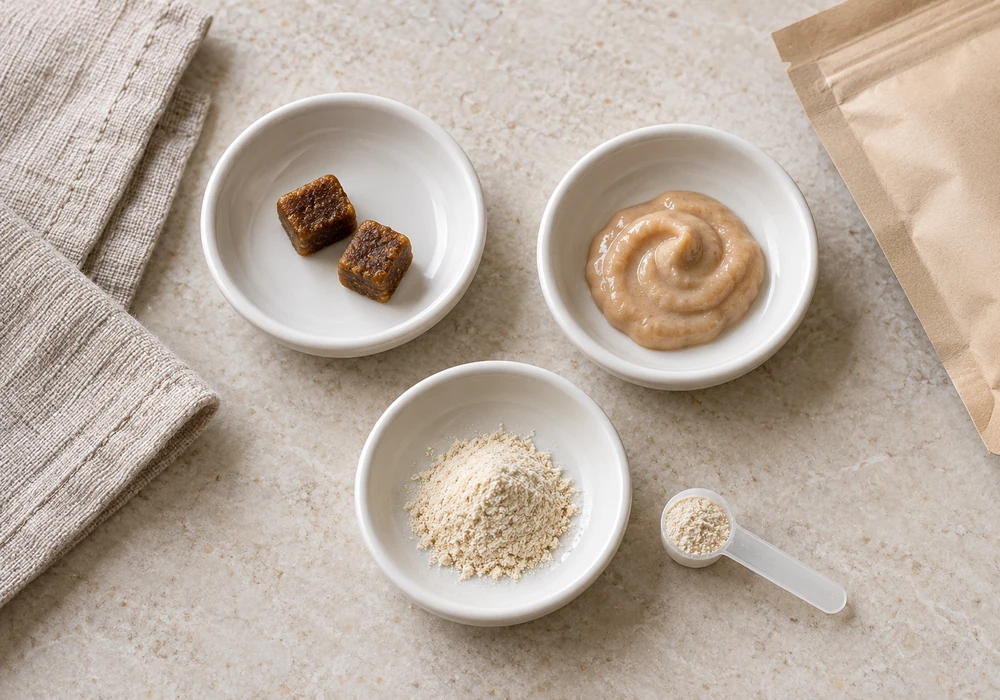
A kitten with sore gums may manage a suitable puree more comfortably than a firm chew. Persistent pain, dropping food, or difficulty swallowing needs an examination rather than repeated texture changes. Do not force a chew or syringe liquid into a struggling kitten.
If food mixing is permitted, use a small portion of familiar food that your kitten reliably finishes before serving the rest of the meal. Mixing into a full bowl can leave the consumed amount uncertain. If some remains, do not automatically repeat the dose; ask how to handle incomplete servings.
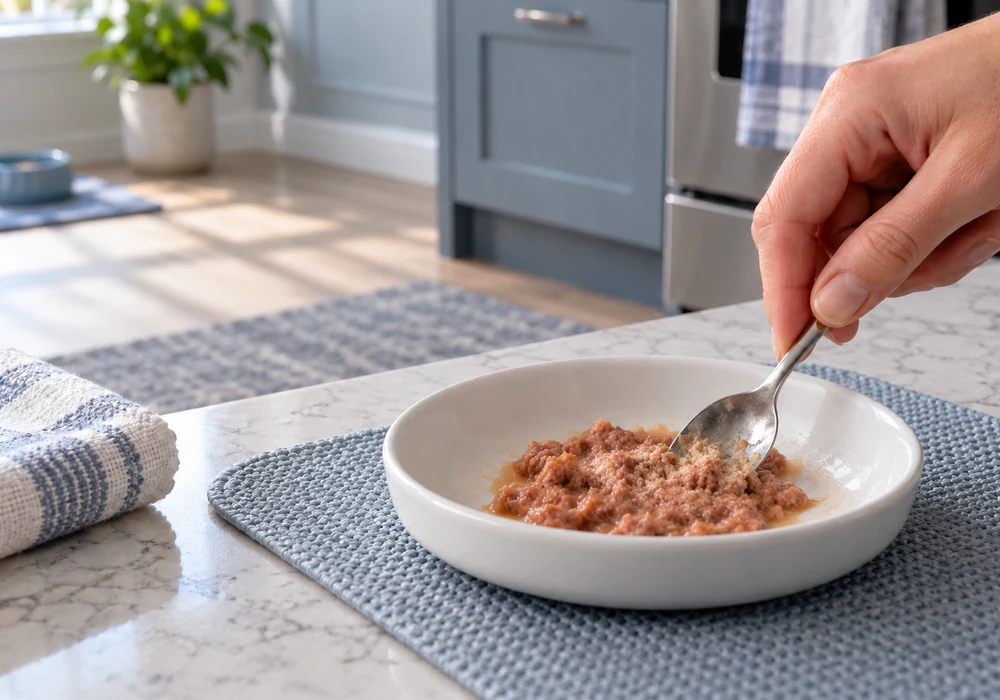
Keep the original packaging and follow its storage directions. Discard spoiled product or damaged packaging. A chew that has become too hard or a puree stored incorrectly is not made suitable by an unexpired date.
Observe the individual
Plan a Safe Trial and Watch the Response
Protect Meals and Keep Supplement Doses Separate From Calories
A supplement does not replace complete nutrition for growth. Count its calories with other nutritionally incomplete extras. General treat guidance keeps those extras below 10% of appropriate daily calories; an individual feeding or medical plan may be stricter.
That ceiling does not authorize more supplement servings. Follow the agreed product-specific amount, even when there is room in the calorie budget. The guide to calculating a cat’s treat allowance explains the food arithmetic. Use ordinary suitable rewards for repeated training moments instead of offering an active calming chew each time.
Agree on Timing and Observable Goals
Ask your veterinarian when to start, how long to assess the chosen product, and what would count as a useful response. Calming kitten treats do not share one proven onset time. The 30-day and 56-day studies above do not support expecting every product to work within minutes.
Try the agreed plan during an ordinary, manageable situation before relying on it for travel. For example, an appropriate goal might be a kitten approaching an open carrier voluntarily while remaining free to leave. Do not provoke fear to test the supplement or postpone necessary veterinary care while waiting for a trial to work.
Keep brief notes on the product, amount actually eaten, timing, situation, and response. Track voluntary approach, exploration, comfortable resting, and recovery after a disturbance, alongside appetite and litter-box habits. Short videos of naturally occurring behavior can help your veterinarian assess changes. Where practical, introduce one optional product at a time so the response is easier to interpret.
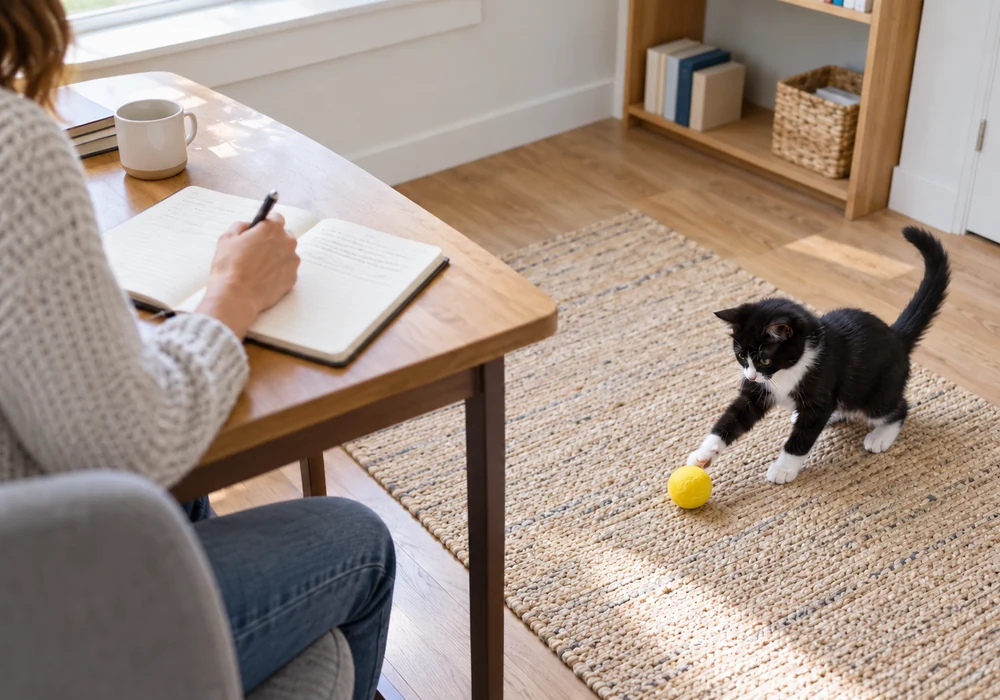
If a trial of calming kitten treats produces no useful improvement, bring the label, intake notes, and observations to the follow-up visit. Your veterinarian can reassess the cause, change the support plan, or recommend behavior treatment or medication appropriate for that kitten.
This guide draws on everyday experience caring for cats and does not replace veterinary advice about a particular kitten. A kitten that stops eating, becomes weak, struggles to breathe, collapses, or cannot pass urine needs a veterinarian promptly, and any new supplement should be stopped and reported if it causes drowsiness, wobbliness, vomiting, or diarrhea.