
Cat breed name origins usually fall into four groups: places, physical traits, comparisons, and wordplay. Siamese keeps an old name for Thailand, while Balinese refers to dancers in Bali rather than a breed from the island. These 13 examples explain what each name means and which parts of the history are certain.
A breed’s naming story does not prove an individual cat’s ancestry. For practical guidance on traits and records, see how to identify your cat’s breed.
Cat Breed Name Origins: A Quick Comparison
A place in a breed name can be a real clue or a borrowed image. Start with these examples before looking at the individual stories.
| Name clue | Examples | What it means |
|---|---|---|
| An old place name | Siamese, Turkish Angora | Siam refers to Thailand; Angora is an older name for Ankara. |
| A borrowed image | Balinese, Bombay | Dancers and black leopards inspired the names, rather than a birthplace. |
| A visible trait | Scottish Fold, Cornish Rex | Folded ears or a curly coat helped shape the name. |
| Words joined together | Burmilla | Burmese and chinchilla supplied parts of one new name. |
Cat Breed Name Origins: Places Used as Inspiration
For these breeds, a place or cultural image helped breeders describe the cat they had in mind. The naming story and the place where the breed developed are separate facts.
Balinese: Named for Bali’s Dancers
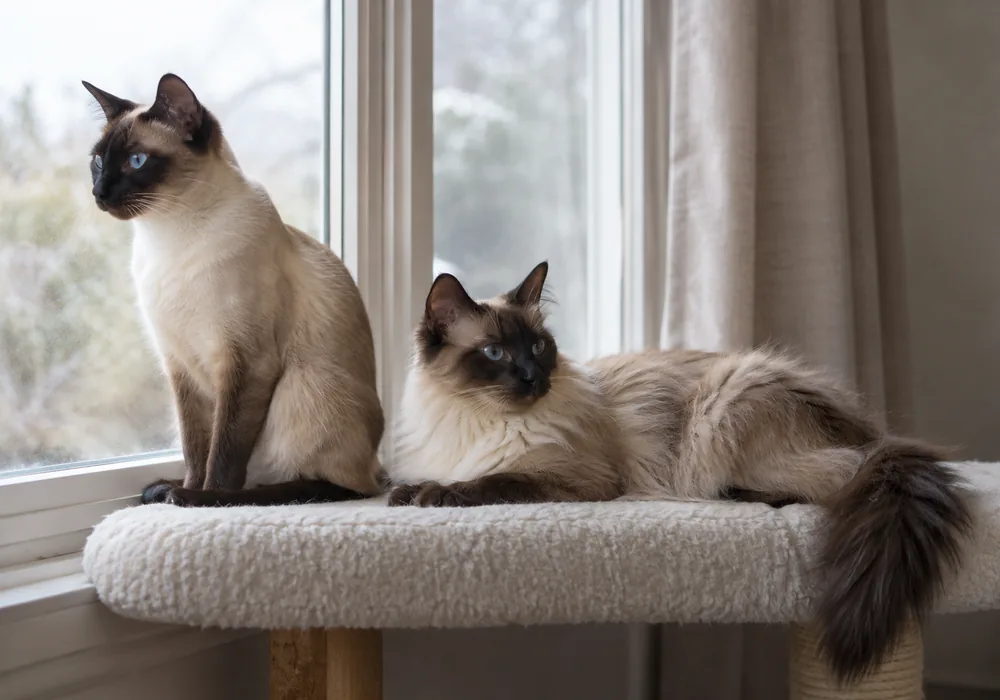
The Balinese developed from longhaired Siamese lines. Breeders chose the name because the cats’ graceful movement brought Balinese dancers to mind. The Cat Fanciers’ Association’s breed history records that connection. CFA accepted the Balinese for championship competition in 1970; longhaired kittens had appeared in Siamese litters much earlier.
Bombay: An Indian Name, an American Breed
Bombay, now Mumbai, supplied the name, and India’s black leopards supplied the image. Breeder Nikki Horner developed the American Bombay in Kentucky using American Shorthair and Burmese cats. She wanted a domestic cat with a sleek black coat and a leopard-like look. The comparison describes appearance; it does not mean the cats have leopard ancestry.
Himalayan: Named for Dark Points
The Himalayan name refers to its pointed color pattern. In cats, colorpoint means darker coloring on the face, ears, legs, and tail against a lighter body. Work combining Persian features with Siamese coloring included experiments by Virginia Cobb and Clyde Keeler beginning in 1931. The name describes the pattern rather than an origin in the Himalayan mountains.
Why do breed lists differ? The International Cat Association (TICA) includes the Himalayan in its Persian Breed Group. CFA treats it as the Himalayan Division of the Persian breed. Check which organization’s list you are reading.
Sphynx: An Ancient Image, a Modern Cat
The name brings to mind the Egyptian sphinx, but the modern breed’s history centers on North America. A hairless kitten born in Ontario in 1966 was part of its early history, and other hairless cats later helped establish the breed. That first kitten should not be treated as the only starting point. Many Sphynx cats have a fine layer of fuzz rather than completely bare skin.
Cat Breed Name Origins: Real Places and Local Stories
Siamese: The Old Name for Thailand
Siam is the historical country name associated with present-day Thailand. The Siamese name therefore preserves a real regional link. Pointed cats appear in historical Thai accounts, and Siamese cats later became established in British and American breeding programs. The name’s age does not mean that every feature favored in today’s show cats has stayed the same.
Turkish Angora: A Name From Ankara
Angora is an older name for Ankara, Turkey’s capital. The Turkish Angora name preserves that link and the region’s history of silky, longhaired cats. Here, Angora is part of a specific breed name, not simply another word for fluffy fur.
Coat length alone does not identify a breed. Coats and care needs differ among long-haired cat breeds.
Maine Coon: Maine Roots and Tail Stories
Maine points to the breed’s New England roots. Coon is commonly explained as a comparison with raccoons, especially the bushy, ringed tails of some early cats. That familiar account is not a complete record of who first chose the name.
Stories about Viking ships, Marie Antoinette’s cats, and a sea captain named Coon add interest, but do not prove ancestry. Size, coat, and daily care are other aspects of Maine Coon cats to consider.
The raccoon story is a comparison: domestic cats and raccoons cannot produce a hybrid. A similar-looking tail does not make them related.
Abyssinian: A Name That Leaves Questions Open
Abyssinia is a historical name associated with Ethiopia. The naming story is tied to nineteenth-century accounts of cats brought to Britain from that region. The breed’s deeper ancestry is a different question: CFA discusses genetic links to Indian Ocean coastal areas and Southeast Asia. The name alone cannot settle that history, and a resemblance to cats in ancient Egyptian art is not proof either.
Coats and Traits Behind Cat Breed Name Origins
Cornish Rex: Cornwall and a Curly Coat
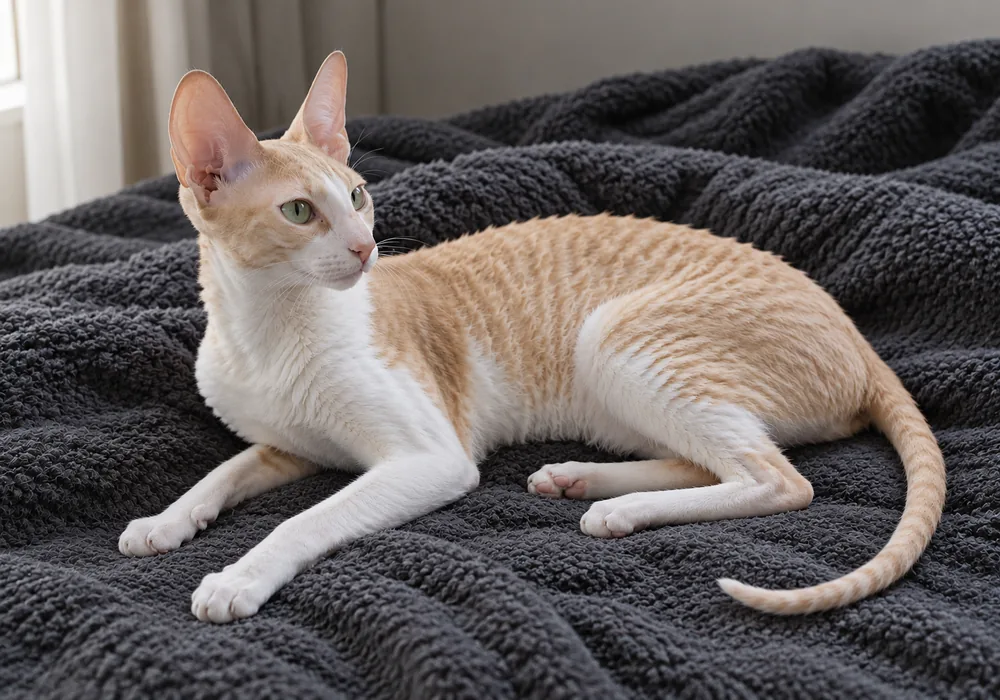
Cornish refers to Cornwall, England, where a curly-coated kitten named Kallibunker was born in 1950. Breeder Nina Ennismore had experience with Rex rabbits and reused Rex for the cat’s unusual coat. The CFA’s Cornish Rex history records this link. A shared Rex name does not mean every curly-coated cat breed has the same genetic cause for its curls.
Ragdoll: A Name Inspired by Relaxed Handling
Ann Baker developed the Ragdoll in Riverside, California, during the 1960s. The name came from the impression of a cat relaxing when held, like a soft rag doll. It is not a promise that every Ragdoll wants to be picked up or will go limp. The breed’s build, coat, and personality are all part of Ragdoll cat characteristics.
Scottish Fold: Scotland and Folded Ears
The name joins a place and a visible feature. The breed’s founding history centers on Susie, a farm cat with folded ears noticed in Scotland in 1961.
The inherited change behind the ears also affects cartilage, the flexible tissue found in ears and joints. Research on the folded-ear gene links a change in TRPV4 to the ear trait and abnormal cartilage and bone development. Severity varies, so the ear shape alone does not tell you how much an individual cat is affected.
Wordplay Behind Cat Breed Name Origins
Nebelung: Mist, Silver Fur, and a Literary Link
The German word Nebel means fog or mist, which suits the Nebelung’s blue-gray coat with silvery tips. The name also draws on the Nibelungenlied, a medieval Germanic poem. Cora Cobb developed the modern breed in the United States. Its first registered foundation cats, Siegfried and Brunhilde, were born in 1984 and 1985 and share that literary connection. TICA championship recognition followed in 1997.
Burmilla: Burmese Plus Chinchilla Persian
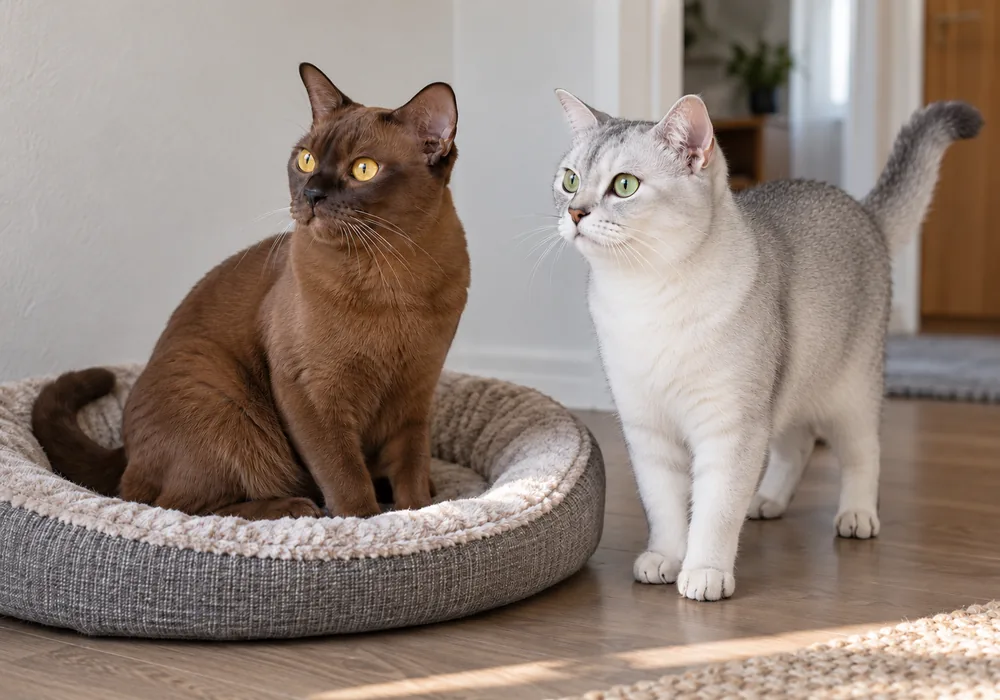
Burmilla blends parts of Burmese and chinchilla. The breed began in Britain in 1981 after a pairing between a European Burmese and a Chinchilla Silver Persian. Here, chinchilla refers to a Persian coat variety with a pale base and colored hair tips. The name records the two cat varieties in that founding pairing.
How to Check Cat Breed Name Origins
When a breed story sounds surprising, use these three checks:
- Separate the word from the birthplace. Bombay refers to an Indian city, while the American breed developed in Kentucky.
- Check what a date describes. Kallibunker’s birth in 1950 is a founding event; the Balinese’s CFA championship acceptance in 1970 is a recognition date.
- Look for records behind a legend. Breed histories and recorded family lines carry more weight than a similar-looking tail or an often-repeated story.
If you are researching your own cat, a name or appearance is only a clue. A glossy black coat does not confirm Bombay ancestry, and a long coat does not establish Turkish Angora ancestry. When identifying your cat’s breed, consider visible traits alongside pedigree records—a recorded family history.
More Cat Breed Questions, Answered
Breed names can raise practical questions about the cat living in your home. Here are a few more answers to help you interpret labels and plan everyday care.
Is a Domestic Shorthair the Same as an American Shorthair?
In everyday adoption descriptions, domestic shorthair generally describes a shorthaired cat without an established pedigree. American Shorthair is a recognized breed with a breed standard and recorded ancestry. The labels are not interchangeable: a short coat or familiar tabby pattern does not establish American Shorthair ancestry.
Are Tabby, Calico, and Tuxedo Cat Breeds?
No. These terms describe coat patterns or color arrangements. Tabby includes several patterns, such as stripes and spots; calico combines dark and red or cream areas with substantial white; tuxedo is an informal name for a black-and-white arrangement. These descriptions can apply to pedigreed cats and cats without a known pedigree.
Can a DNA Test Tell Me My Cat’s Exact Breed?
Do not treat a breed-similarity report as a recorded family tree. Results depend on the test and the reference populations used, and a resemblance to a breed’s genetic profile does not document specific ancestors. Read what the test actually measures. If you need to confirm a claimed pedigree, check registration records and documented parentage with the relevant registry.
Does a Breed Name Predict My Cat’s Personality?
A breed profile can suggest tendencies, but it cannot promise that an individual cat will be cuddly, independent, playful, or comfortable being held. Age, health, early experiences, and the current environment also matter. Watch the cat’s behavior and ask its caregiver about daily habits instead of choosing by a breed’s reputation alone.
Will a Quiet Cat Breed Never Meow?
No. A reputation for being quiet does not mean a cat will never vocalize, and quiet cats still need attention and play. Comparing cat breeds that meow less means allowing for individual differences in vocal tendencies. A new change in your cat’s usual voice or behavior deserves attention rather than a breed-based explanation.
Will a Large-Breed Kitten Definitely Become a Very Large Cat?
No. Adult size varies within a breed, so a breed’s largest reported weight is not a feeding target. Feed for healthy growth and ask your veterinarian to assess body condition. When choosing a carrier, litter box, or climbing furniture, consider your cat’s actual size and room to move. See our guide to large cat breeds for their size and practical care needs.
Does Every Longhaired Cat Need the Same Grooming Routine?
No. Coat density, texture, shedding, and the cat’s ability to groom itself all affect the routine. Check regularly for tangles and use gentle tools suited to the coat. Comfortable sessions are an important part of grooming cats. If a mat is tight against the skin or handling hurts, ask a veterinarian or experienced cat groomer for help. Dental care is a separate topic; our guide to cat teeth trimming covers the risks of home clipping and the role of veterinary assessment.
Are Hairless or Shorthaired Breeds Safe for People With Cat Allergies?
No breed is guaranteed to be allergy-free. Cat allergens include proteins from saliva and skin, so having little or no visible fur does not remove the risk. The Asthma and Allergy Foundation of America’s pet allergy guide explains why coat type is not a reliable safeguard. If someone in the household has cat allergies, discuss adoption with an allergist before committing.
Which Cat Breeds Are Best for Indoor Life?
Start with the individual cat’s activity level, social needs, and the environment you can provide. Indoor cats need opportunities to play, scratch, climb, hide, and rest undisturbed. The everyday needs of house cat breeds vary. A small body or quiet voice does not automatically make a cat a good match for every apartment.
Should My Cat’s Everyday Name Match Its Breed or Origin?
No. A breed name describes a recognized group; your cat’s everyday name is a personal choice. You can choose a name for its sound, meaning, or connection to your cat without matching a country or breed history. Narrow your list of cat names to the options that suit your preferences.
Explore more breed histories, comparisons, and care considerations in Cat Breeds.
These histories come from published breed accounts and our own years of living with cats. They are background reading, not a breed identification, a pedigree record, or a view endorsed by any registry, and where accounts disagree we say so rather than settle it. A name cannot predict how a cat will look or behave. If a cat has labored breathing, joint pain, or a sudden loss of appetite, ask a veterinarian rather than a naming story.